

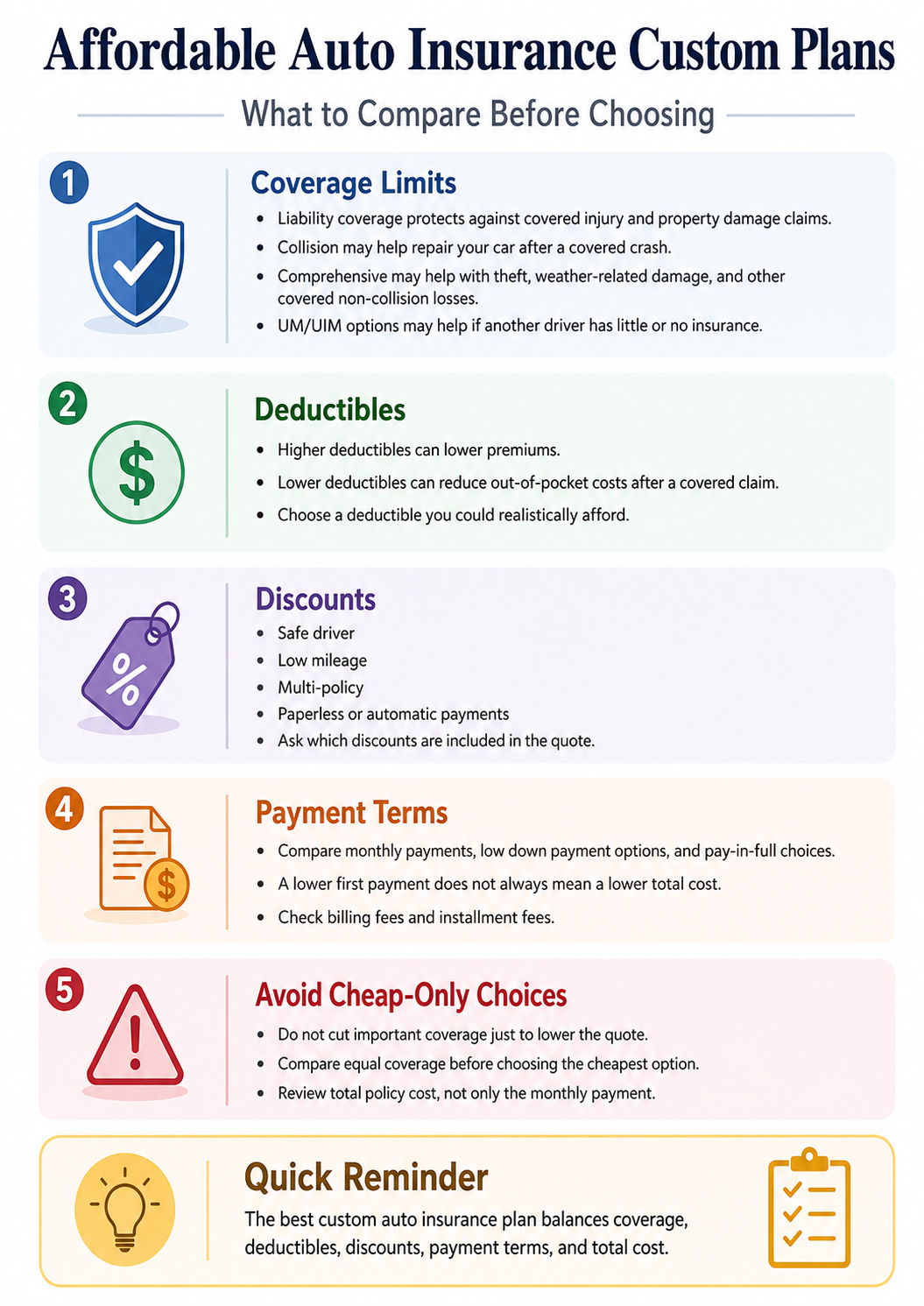
An affordable auto insurance plan should do more than lower your monthly bill. The best custom plan balances price, liability limits, deductibles, optional coverages, payment terms, discounts, and your real driving situation.
Customizing a policy does not mean removing every coverage until the quote looks cheap. It means choosing the protections you need, avoiding unnecessary extras, understanding what your lender may require, and comparing equal coverage before you buy.
What Makes an Auto Insurance Plan Affordable and Custom?
A custom auto insurance plan is built around your vehicle, driving habits, household, budget, and risk tolerance. It may include state-required liability coverage, optional physical damage coverage, uninsured or underinsured motorist options where available, medical-related coverages where offered, and practical add-ons such as rental reimbursement or roadside assistance.
The affordable part comes from choosing the right mix. A policy with lower limits or higher deductibles may cost less, but it can also leave you with more financial responsibility after an accident. NAIC explains that collision pays for damage to the insured vehicle after hitting another car or object, while comprehensive coverage applies to certain non-collision events such as fire, theft, or weather-related events. NAIC also notes that collision and comprehensive are not usually required by state law, but lenders may require them for financed or leased vehicles.[1]
Important coverage note
Affordable does not always mean minimal. If a quote is cheaper because it removes important coverage, lowers liability limits too far, or sets a deductible you cannot afford, the plan may not be the best fit.
Affordable vs. Cheap Auto Insurance
Cheap auto insurance usually focuses on the lowest visible price. Affordable auto insurance focuses on value: what you pay compared with what the policy actually protects. The difference matters because a very low quote can come from lower limits, fewer coverages, higher deductibles, or stricter payment terms.
| Policy approach | What it focuses on | Main risk | Better question to ask |
|---|---|---|---|
| Cheapest quote | Lowest monthly or upfront payment | May reduce protection too much | What coverage am I giving up to get this price? |
| Affordable custom plan | Balanced cost, coverage, deductibles, and payment terms | Requires more comparison work | Does this policy fit my vehicle, budget, and risk? |
| High-coverage plan | Stronger protection and lower out-of-pocket risk | Higher premium | Do the extra coverages justify the added cost? |
If you are comparing several quotes, use a same-coverage approach. This same-day car insurance comparison guide can help you review policy details without focusing only on the lowest payment.
Core Coverages to Customize
Most custom auto insurance plans start with the main coverage categories. Availability, limits, and rules vary by state and insurer, but these are the areas drivers usually compare first.
| Coverage | What it generally helps with | Customization question |
|---|---|---|
| Liability coverage | Helps pay others for covered injury or property damage if you cause an accident. | Are state minimums enough for my financial situation? |
| Collision coverage | May help repair or replace your vehicle after a covered collision. | Is the vehicle financed, leased, or valuable enough to protect? |
| Comprehensive coverage | May help with covered non-collision losses such as theft, vandalism, fire, or weather. | What deductible can I realistically afford? |
| Uninsured or underinsured motorist options | May help if another driver has no insurance or not enough insurance, depending on state rules and policy terms. | Is this available and appropriate in my state? |
| Medical-related coverages | May help with certain medical costs, depending on the state and policy. | How does this interact with my state rules and other coverage? |
| Optional add-ons | May include rental reimbursement, roadside assistance, or other extras. | Would I actually use this benefit, or can I skip it? |
Quick custom-plan rule
Start with the coverages you need, then adjust deductibles, discounts, payment method, and optional add-ons. Do not start by cutting coverage before you understand the risk.
How Deductibles Affect an Affordable Plan
A deductible is the amount you pay before insurance pays on a covered claim. Higher deductibles can lower premiums, but they also increase your out-of-pocket cost after a covered loss. Insurance Information Institute recommends considering higher deductibles as one way to lower costs, while also making sure you can afford the deductible if a claim happens.[2]
That makes the deductible one of the most important customization choices. A $1,000 deductible may reduce the premium compared with a $500 deductible, but it only works if you could pay that amount after an accident. For more detail, review this guide on the impact of deductibles on insurance costs.
Discounts That Can Make a Custom Plan More Affordable
Discounts can help reduce the cost of a customized plan without cutting important coverage. Texas Department of Insurance recommends asking about discounts and notes that drivers may qualify for savings related to driving fewer miles, maintaining a good driving record, automatic payments, paperless billing, driving monitoring programs, certain occupations, or group memberships.[3]
Discounts vary by insurer, state, and eligibility. The best approach is to ask which discounts are already included in the quote and which require extra proof or enrollment. For a deeper savings angle, review low-mileage car insurance discounts and ask whether mileage-based savings apply to your situation.
| Discount category | Who it may help | Question to ask |
|---|---|---|
| Safe driver | Drivers with a clean record or fewer recent violations | How many years of driving history are reviewed? |
| Low mileage | Drivers who use their car less often | Do I need to verify annual mileage? |
| Multi-policy | Drivers who combine eligible policies | Is bundling actually cheaper than separate policies? |
| Automatic payment or paperless billing | Drivers who prefer digital billing and reliable payments | Are there billing fees or payment-method requirements? |
| Driver training or monitoring | Drivers who qualify for approved programs | What data is collected, and how can it affect renewal pricing? |
Payment Options: Monthly, Low Down Payment, or Pay in Full?
Payment structure is part of affordability. A monthly plan can make budgeting easier, while paying in full may reduce fees or qualify for a discount with some insurers. A low down payment option can reduce the amount due today, but it may increase later installments or total cost.
If you are mainly trying to reduce the first payment, compare this article with affordable auto insurance without deposit. Just remember that “no deposit” wording can be misleading because many policies still require at least an initial payment before coverage is active.
Payment terms matter
A custom plan should include a payment schedule you can maintain. A missed or declined payment can put coverage at risk, depending on the policy terms, state rules, and insurer procedures.
How to Build a Custom Auto Insurance Plan Step by Step
Building a custom plan works best when you start with your real needs instead of the lowest advertised price. Use your current declarations page, vehicle details, driver information, and budget to compare options clearly.
- List your legal requirements. Know your state’s required coverages and minimum limits.
- Review your vehicle situation. Financed or leased vehicles may require collision and comprehensive coverage.
- Choose liability limits carefully. Minimum limits may be legal, but they may not be enough for every driver.
- Set deductibles you can afford. Do not raise deductibles only to lower the premium if you could not pay them after a claim.
- Add optional coverages only when they make sense. Roadside assistance, rental reimbursement, and similar extras can be useful, but not every driver needs them.
- Ask about discounts. Confirm which discounts are included and which require proof.
- Compare payment terms. Look at total policy cost, not just monthly payment.
- Review cancellation and renewal rules. Understand what happens if a payment is missed or the policy changes at renewal.
For a broader policy menu, review auto policy options before choosing a plan. That can help you separate required coverage from optional protection.
Custom Plan Examples by Driver Situation
The right plan can vary widely by driver. The examples below are not quotes or recommendations. They are planning scenarios to show how different drivers might think about coverage choices.
| Driver situation | Coverage focus | Cost-control strategy | What to avoid |
|---|---|---|---|
| Driver with an older paid-off vehicle | Liability limits, uninsured motorist options, and whether physical damage coverage is still worth it | Compare the vehicle’s value against comprehensive/collision cost and deductible | Dropping coverage without considering replacement cost |
| Driver with a financed vehicle | Liability plus lender-required comprehensive and collision | Compare deductibles and discounts without violating lender requirements | Removing required coverage to lower the payment |
| Low-mileage driver | Appropriate liability and physical damage coverage based on vehicle use | Ask about mileage-based or low-mileage discounts | Assuming low mileage automatically means the cheapest quote |
| Young or first-time driver | Strong liability planning, realistic deductibles, and available discounts | Compare good student, driver training, and safe-driving options where available | Choosing limits that are too low just to reduce price |
| Driver comparing after a renewal increase | Same coverage comparison across multiple quote paths | Match limits, deductibles, vehicles, drivers, and dates | Comparing a weaker quote against stronger current coverage |
If you are shopping in Texas, you may also want to review whether full coverage is worth it in Texas for state-specific coverage, liability-limit, lender-rule, and deductible context.
Claims Support and Service Should Be Part of the Plan
Price matters, but claims support also matters. A lower premium is less attractive if the policy is hard to understand, documents are difficult to access, or claims steps are unclear. A custom plan should give you a practical path for billing, proof of insurance, policy changes, and claims questions.
Before buying, ask how to report a claim, how to upload documents, how to reach support, and how quickly proof of insurance becomes available. You can also review this auto claims process guide to understand the steps drivers may need after an accident.
Service checklist
- Can I access proof of insurance immediately after purchase?
- How do I make policy changes?
- How are claims reported?
- What documents should I keep after buying?
- Who do I contact if billing or payment issues happen?
Common Mistakes When Customizing Auto Insurance
Customizing coverage can help reduce costs, but the wrong changes can create expensive gaps. The goal is to remove waste, not protection you may need.
Avoid these mistakes
- Choosing state minimums without considering your assets, vehicle use, or accident risk.
- Raising deductibles higher than you could afford after a claim.
- Dropping comprehensive and collision on a financed or leased vehicle.
- Comparing quotes with different limits and assuming the cheapest one is better.
- Ignoring installment fees, policy fees, or missed-payment consequences.
- Forgetting to ask about discounts before buying.
- Assuming optional add-ons are always unnecessary or always worth it.
Compare Custom Auto Insurance Options by ZIP Code
Auto insurance pricing and availability can vary by ZIP code, vehicle, driver history, coverage selection, deductibles, payment method, and insurer. Use the form below to begin reviewing available quote paths, then compare the full policy details before choosing.
Review Auto Insurance Quote Paths and Custom Plan Options
Enter your ZIP code to start comparing available auto insurance quote paths. Review coverage limits, deductibles, payment terms, and discounts before choosing a plan.
FAQ
What is a custom auto insurance plan?
A custom auto insurance plan is a policy structure adjusted around your vehicle, drivers, coverage needs, deductibles, optional protections, payment preferences, and budget. It should still meet legal and lender requirements.
Is the cheapest auto insurance plan the best?
Not always. The cheapest plan may have lower limits, fewer coverages, higher deductibles, or stricter payment terms. A better plan balances affordability with the protection you actually need.
How can I make auto insurance more affordable?
Compare quotes, review deductibles, ask about discounts, avoid unnecessary add-ons, choose a payment plan you can maintain, and make sure you are comparing equal coverage.
Should I raise my deductible to lower my premium?
Only if you could realistically pay the higher deductible after a covered claim. A higher deductible can reduce the premium, but it increases your out-of-pocket risk.
Can I remove collision and comprehensive coverage?
It depends on your vehicle, risk tolerance, and whether the car is financed or leased. Lenders may require collision and comprehensive coverage for financed or leased vehicles.
Do discounts apply automatically?
Not always. Some discounts may require proof, enrollment, a clean driving record, mileage verification, paperless billing, or automatic payments. Ask which discounts are included in your quote.
What should I compare before choosing a custom plan?
Compare liability limits, deductibles, optional coverages, total premium, first payment, installment fees, discounts, cancellation rules, and proof-of-insurance timing.
Conclusion
An affordable custom auto insurance plan should fit your budget without leaving important risks uncovered. The best plan is not simply the cheapest quote. It is the policy that balances coverage limits, deductibles, discounts, optional protections, payment terms, and your real driving situation.
Before choosing a plan, compare equal coverage, ask about discounts, review deductible choices, check payment terms, and confirm what your lender or lease may require. A thoughtful custom plan can help you control costs while keeping the protection you need.