
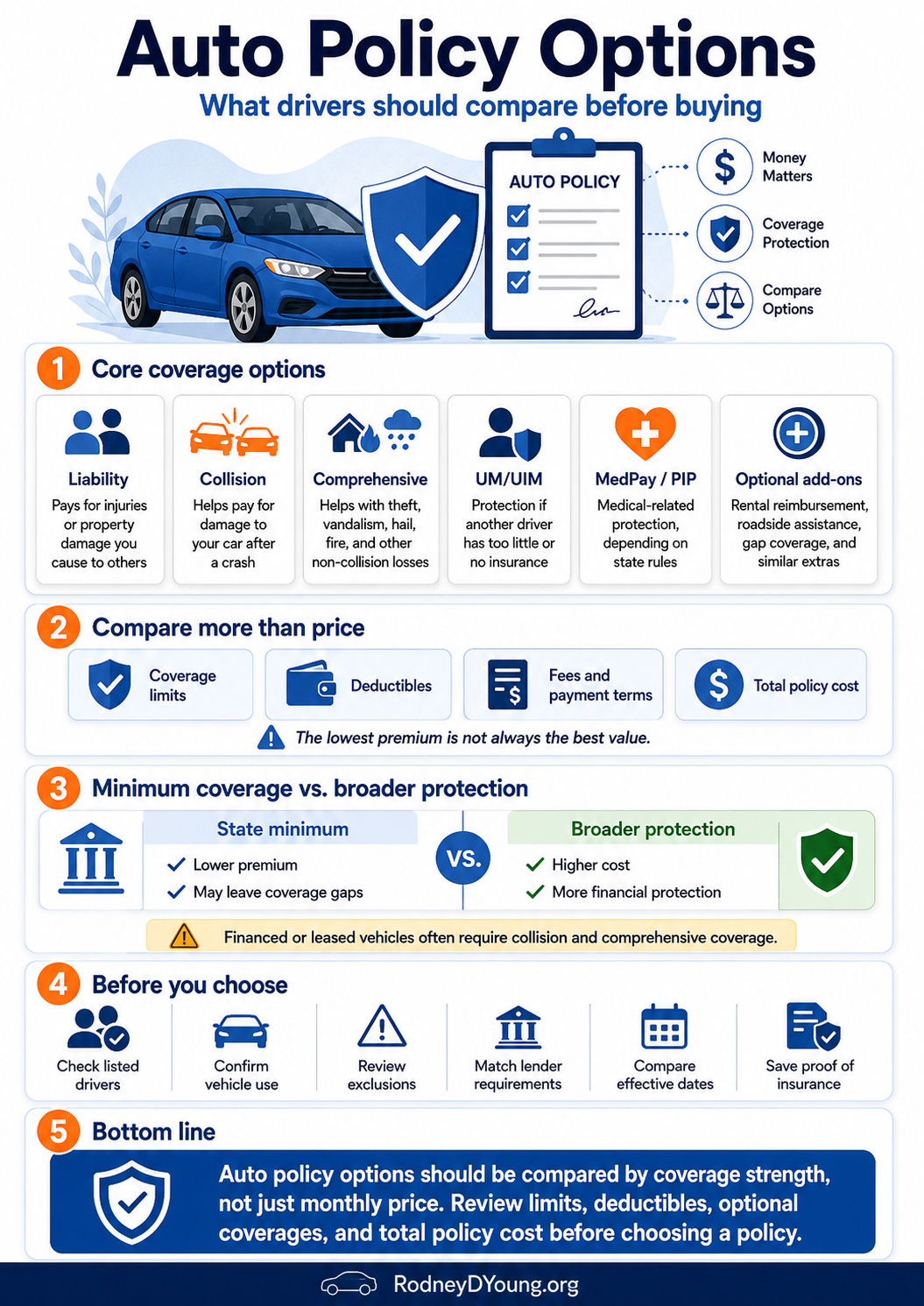
Auto policy options can look similar at first, but the details matter. Before choosing a policy, drivers should compare liability limits, deductibles, optional coverages, exclusions, payment terms, effective dates, and total policy cost. The lowest premium is not always the best value if it leaves major gaps in protection or does not meet state, lender, or household needs.[1]
Auto policy options should be compared carefully because each coverage choice can affect your premium, deductible, claim protection, and total out-of-pocket risk.
Choosing an auto policy is not only about finding a cheap monthly payment. A good policy should fit your vehicle, driving habits, state requirements, financial risk, and ability to pay after a claim. Drivers comparing Rodney D. Young auto insurance information or other quote paths should review the same core details before submitting payment or switching providers.
This guide explains the main auto policy options drivers usually compare, including liability, collision, comprehensive, uninsured/underinsured motorist coverage, medical-related coverages, deductibles, optional add-ons, and payment considerations. It also shows how to compare policies without relying only on the lowest advertised price.
What Auto Policy Options Usually Include
Auto insurance can generally be divided into liability protection and protection for damage to your own vehicle, although the exact coverages and requirements vary by state. Most states require drivers to carry auto insurance or meet another form of financial responsibility before legally operating a vehicle.[2]
Required protection
Liability coverage is commonly required by state law and helps pay for injuries or property damage you cause to others, up to your policy limits.
Vehicle protection
Collision and comprehensive coverage may help pay for damage to your own vehicle, subject to deductibles and policy terms.
Optional add-ons
Rental reimbursement, roadside assistance, gap coverage, and other add-ons may be available, depending on the insurer and state.
The best policy for one driver may not be the best policy for another. A paid-off older vehicle, a new financed vehicle, a teen driver, and a commuter with long daily mileage can all require different coverage decisions.
Coverage Types Drivers Should Compare
When comparing auto policy options, review each coverage type separately instead of assuming every quote includes the same protection. The Insurance Information Institute explains that a basic auto insurance policy may include liability, medical payments or personal injury protection, uninsured/underinsured motorist coverage, collision, and comprehensive coverage, depending on the policy and state.[3]
| Coverage option | What it generally does | When it matters | What to check |
|---|---|---|---|
| Liability coverage | Helps pay for injuries or property damage you cause to others, up to your policy limits. | Usually required by state law and important after at-fault accidents. | Check bodily injury limits, property damage limits, and whether higher limits fit your risk. |
| Collision coverage | Helps pay for damage to your own car after a covered collision, usually after you pay a deductible. | Often important for newer, financed, or leased vehicles. | Review the deductible, actual cash value rules, and lender requirements. |
| Comprehensive coverage | Helps pay for certain non-collision losses such as theft, vandalism, fire, hail, or falling objects, depending on policy terms. | Useful if you want protection against damage beyond crashes. | Check covered losses, deductible, glass rules, and exclusions. |
| Uninsured/underinsured motorist | May help if another driver causes a covered accident and has no insurance or not enough insurance. | Important where uninsured drivers are a concern or where medical/property losses could exceed another driver’s limits. | Check state availability, required/rejected status, limits, and whether property damage is included. |
| Medical payments or PIP | May help with medical-related costs after a covered accident, depending on the state and policy. | Can matter for drivers who want extra medical-related protection beyond liability coverage. | Check whether your state requires it, offers it, or handles it differently. |
| Optional endorsements | May add rental reimbursement, roadside assistance, gap coverage, custom equipment, rideshare coverage, or other protections. | Useful when your vehicle use or financial situation creates a specific need. | Check cost, eligibility, limits, exclusions, and whether the add-on duplicates other benefits. |
Important coverage reminder: Personal auto policies may not cover every type of vehicle use. Business use, delivery driving, rideshare driving, and commercial activity may require special coverage or a different policy. Always confirm your actual vehicle use before buying coverage.
Minimum Liability vs. Broader Protection
State-minimum liability coverage may satisfy legal requirements, but it may not provide enough financial protection after a serious accident. If damages exceed your policy limits, you may still be responsible for the remaining amount. That is why drivers should compare both the legal minimum and the realistic financial risk.
State rules vary. For example, Texas describes minimum liability coverage commonly known as 30/60/25: $30,000 for injuries per person, up to $60,000 per accident, and $25,000 for property damage.[4] Drivers comparing minimum liability with broader protection can also review whether full coverage is worth it in Texas for additional context.
Minimum coverage can be risky: A lower-limit policy may reduce the premium, but it can leave you exposed if an accident causes high medical bills, expensive vehicle damage, or legal claims. Compare affordability with realistic protection.
Deductibles and Policy Limits Can Change the Real Cost
A deductible is the amount you pay out of pocket before certain coverages, usually collision or comprehensive, pay for a covered loss. Higher deductibles can reduce premiums, but they also increase what you must pay after a claim. NAIC notes that raising deductibles on physical damage coverages can reduce costs, but drivers should make sure they can afford the larger out-of-pocket amount after an accident or loss.[5]
If you are unsure how to balance the monthly premium against claim risk, our guide on the impact of deductibles on insurance can help you think through affordability, risk tolerance, and vehicle value before choosing a number.
| Decision | May lower premium? | Potential downside | Better question to ask |
|---|---|---|---|
| Higher collision deductible | Often, yes. | You pay more out of pocket after a covered collision claim. | Could I comfortably pay this deductible after an accident? |
| Higher comprehensive deductible | Often, yes. | You pay more for covered non-collision losses. | Does my vehicle’s value justify the deductible level? |
| Lower liability limits | Possibly. | You may have less protection if you cause serious damage or injuries. | Would these limits protect me after a major accident? |
| Removing optional coverage | Sometimes. | You may lose benefits such as rental reimbursement or roadside support. | Would I need this benefit if my car were unusable? |
How to Compare Auto Policy Options Fairly
A fair comparison means looking at more than one quote and making sure each quote uses similar coverage limits, deductibles, drivers, vehicles, garaging address, policy term, and optional coverages. If one quote is much cheaper, check whether it includes lower limits, fewer protections, higher deductibles, or fees not shown clearly in the first price.
For a more detailed comparison process, you can use our guide on how to compare auto insurance policies by key features. Comparing side by side can help prevent mistakes that are easy to miss when the focus is only on the monthly price.
If you also insure a home, the same comparison principles apply beyond your auto policy. It can be useful to compare home and auto insurance coverage by reviewing limits, deductibles, exclusions, lender requirements, and potential bundling discounts before deciding whether keeping both policies with one insurer makes sense.
- Compare the same limits: Liability limits, UM/UIM limits, and optional coverage limits should be similar across quotes.
- Compare deductibles: A policy with a $1,000 deductible is not the same as a policy with a $500 deductible.
- Check listed drivers: Make sure all required drivers and household members are handled correctly.
- Check vehicle use: Commuting, business use, delivery, rideshare, and pleasure use can affect eligibility or pricing.
- Review fees: Installment fees, late fees, policy fees, filing fees, and cancellation rules can affect the total cost.
- Confirm the effective date: Coverage should start when you actually need proof of insurance.
Optional Add-Ons to Review Carefully
Optional coverages can make sense when they solve a real problem, but they should not be added blindly. Some drivers need rental reimbursement because they rely on one vehicle for work or school. Others may want roadside assistance because they drive frequently. A financed or leased vehicle may need gap coverage or specific physical damage coverage depending on lender rules.
Rental reimbursement
May help pay for a rental car after a covered claim, subject to daily and total limits.
Roadside assistance
May help with towing, lockouts, jump-starts, or other emergency services, depending on the policy.
Gap coverage
May help if your financed vehicle is totaled and the loan balance is higher than the car’s value, subject to eligibility and terms.
Before paying for an add-on, ask whether it has limits, exclusions, waiting periods, or overlap with another service you already have. The goal is not to buy every option; it is to choose the coverage that matches your risk.
Claims and Customer Service Considerations
Claims handling matters because insurance is most important when something goes wrong. Instead of relying on generic testimonials, review practical signals: how claims can be filed, what documentation is usually needed, whether the insurer offers online or phone support, and how repair estimates or settlement decisions are handled.
If you want to prepare before an accident happens, our guide to stress-free auto claims explains what information drivers may need to gather and why policy details matter once a claim is filed.
Claim readiness tip: Keep your insurance ID card, policy number, insurer contact information, vehicle registration, photos after an accident, and any police report or claim documentation organized. Requirements can vary by insurer and state.
Red Flags Before Choosing an Auto Policy
Some policy options look attractive because the first price is low, but the details may not match your needs. Watch for unclear wording, missing coverage limits, unsupported claims, or pressure to choose quickly without reviewing the declarations page.
- No clear coverage limits: You should see the actual liability limits, deductibles, and optional coverages.
- Price only, no policy details: A low monthly payment is not enough information to judge a policy.
- Unclear cancellation rules: Missed payments or policy changes can affect whether coverage remains active.
- Business use not discussed: Delivery, rideshare, or commercial use can create coverage problems if not disclosed.
- No lender review: Financed or leased vehicles may require collision and comprehensive coverage.
- No written confirmation: Save the declarations page, proof of insurance, payment confirmation, and policy documents.
FAQ About Auto Policy Options
What are the most important auto policy options to compare?
Start with liability limits, collision, comprehensive, uninsured/underinsured motorist coverage, medical-related coverages, deductibles, optional add-ons, payment terms, and the policy effective date.
Is state-minimum auto insurance enough?
State-minimum coverage may satisfy legal requirements, but it may not be enough after a serious accident. Drivers should compare the legal minimum with their financial risk, vehicle value, lender requirements, and ability to pay out of pocket.
Do I need collision and comprehensive coverage?
You may need them if your car is financed or leased. They may also be useful if your vehicle still has enough value that you would struggle to repair or replace it after a covered loss. For older paid-off vehicles, compare the cost of the coverage with the vehicle’s value and your savings.
What deductible should I choose?
A higher deductible may lower the premium, but it also means you pay more after a covered claim. Choose a deductible you could realistically afford if an accident or covered loss happened soon.
Can I customize an auto policy?
Many insurers allow drivers to choose limits, deductibles, and optional coverages, but availability depends on the insurer, state, vehicle, driver profile, and underwriting rules. Review the actual quote and declarations page before assuming a coverage is included.
What should I check before switching policies?
Confirm the new policy’s effective date, coverage limits, deductibles, drivers, vehicles, lender requirements, fees, payment schedule, cancellation rules, and proof of insurance before canceling the old policy.
The Bottom Line
Auto policy options should be compared by coverage strength, not just monthly price. A responsible comparison looks at liability limits, collision and comprehensive coverage, deductibles, optional add-ons, policy exclusions, lender requirements, billing terms, and the total cost over the policy term.
RodneyDYoung.org is designed as an informational resource and quote-comparison starting point. Before choosing a policy, review the amount due today, the full policy-term cost, the coverage details, and the rules that apply in your state.
References
Explore Auto Insurance Quote Options With More Clarity
Enter your ZIP code to continue comparing available auto insurance options and review quote paths that may fit your coverage needs and budget.