
Affordable auto insurance without a deposit is often misunderstood. In most cases, it refers to low-start auto insurance or a policy with a smaller first payment, not free coverage before payment. A better way to evaluate these offers is to compare the total premium, the first payment required, installment fees, cancellation rules, and the coverage limits included in the quote.[1]
Drivers often search for “affordable auto insurance without deposit” because they need proof of insurance quickly but do not want a large upfront bill. That is understandable, especially if the policy is needed for a vehicle purchase, license reinstatement, lender requirement, or same-day coverage situation. The key is to avoid misleading promises and focus on real low-start options that still provide valid coverage.
This guide explains what “without deposit” usually means, how low down payment auto insurance works, what to compare before buying, and how to avoid mistakes that can lead to a lapse or an underinsured policy. If you are comparing several options, use our guide to compare car insurance quotes easily so the first payment, monthly cost, coverage limits, deductibles, fees, and total policy cost are reviewed together.
What Affordable Auto Insurance Without a Deposit Really Means
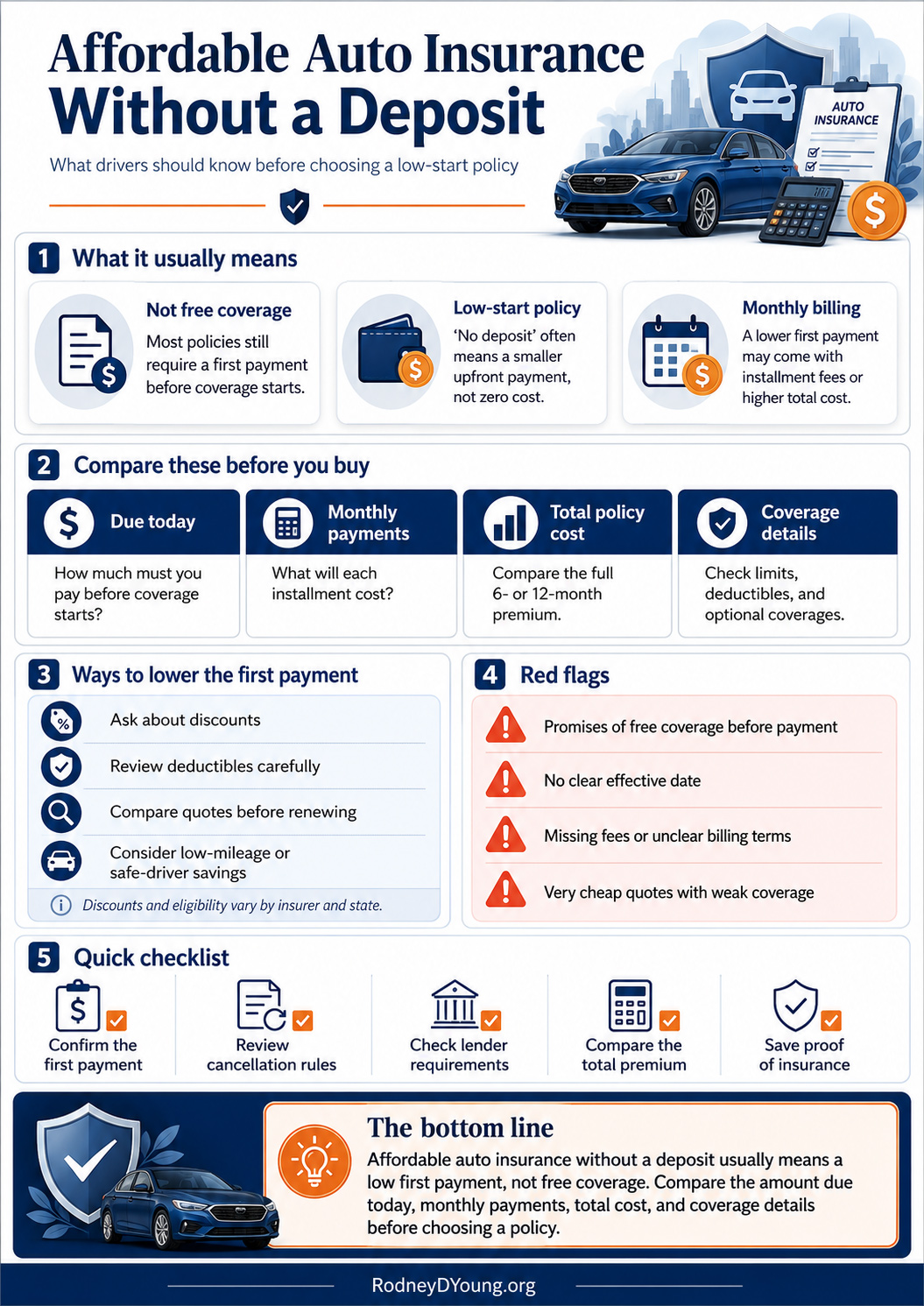
In auto insurance, the word “deposit” can be confusing. Some websites use it to describe a separate upfront fee. Others use it to describe the first payment needed to start the policy. Reputable insurers generally do not activate a policy without some form of payment, because the company is taking on risk as soon as coverage begins.
No true free start
A policy usually requires a first payment before it becomes active. “No deposit” often means no extra deposit beyond the required first installment.
Low down payment
This usually means the insurer or agency allows the policy to start with a smaller first payment instead of requiring a larger portion of the premium upfront.
Monthly billing
Monthly payments can reduce the amount due today, but the total cost may be higher if installment fees or billing fees apply.
The safest way to understand an offer is to ask: “How much is due today, when does coverage begin, what will I pay each month, and what happens if I miss a payment?” Those questions are more useful than relying on the phrase “no deposit” by itself.
Watch the wording: If a quote says “no deposit,” confirm whether it means no separate deposit, low first payment, first month only, or a special billing plan. You should also confirm whether the quoted price includes fees, state charges, SR-22 filing costs if applicable, and any required coverage for a financed or leased vehicle.
No Deposit vs. Low Down Payment vs. Monthly Payments
These terms are often used interchangeably, but they are not identical. Understanding the difference can help you avoid buying a policy that looks cheap today but costs more over the full term.
| Term | What it usually means | What to verify before buying | Potential risk |
|---|---|---|---|
| “No deposit” auto insurance | No separate deposit beyond the first payment, or a marketing phrase for a low-start policy. | Ask exactly how much is due before coverage starts and whether the policy is active immediately after payment. | The phrase may be misleading if it implies coverage starts before payment. |
| Low down payment auto insurance | A smaller initial payment to start the policy, followed by installments. | Compare the first payment, monthly amount, policy term, total premium, and billing fees. | The monthly payments may be higher than a policy with a larger upfront payment. |
| Monthly payment plan | The premium is divided into installments instead of paid in full. | Ask whether installment fees, late fees, or automatic payment requirements apply. | Missing a payment can trigger cancellation or a coverage lapse. |
| Pay-in-full discount | Some insurers may offer savings when the full term is paid upfront. | Compare the paid-in-full price against the installment price. | Lower total cost may require more cash upfront. |
If you are specifically looking for very low startup costs, compare this page with our guide to very cheap car insurance with no deposit. The important point is to separate “cheap to start” from “cheap overall.” A policy can have a low first payment but still be expensive over six or twelve months.
How to Compare Affordable Auto Insurance Without Overpaying
The National Association of Insurance Commissioners advises consumers to compare quotes after deciding what coverages and limits they need, because price comparisons are only useful when the policies being compared are similar.[1] A quote with state-minimum liability only will usually cost less than a quote with collision, comprehensive, rental reimbursement, roadside assistance, and higher liability limits.
- Compare the same limits: Check bodily injury liability, property damage liability, uninsured motorist coverage, and any state-specific coverage requirements.
- Check the deductible: A higher deductible may lower the premium, but you must be able to pay that amount after a covered claim.
- Look at the full policy term: Do not judge the policy only by the first payment. Compare the total six-month or twelve-month cost.
- Ask about billing fees: Monthly plans may include installment fees, late fees, or fees for certain payment methods.
- Review cancellation rules: Missing a payment can create a lapse, which may make future insurance more expensive.
- Confirm the start date: Make sure the policy effective date matches when you need proof of insurance.
For drivers comparing low-start options, the better approach is to review each quote with the same coverage assumptions. Match the same drivers, vehicle, ZIP code, liability limits, deductibles, payment schedule, and total policy cost before choosing based only on the lowest advertised first payment.
Ways to Lower the First Payment Without Weakening Your Coverage Too Much
There is no single trick that guarantees a lower first payment for every driver. Insurers look at many factors, including location, vehicle, driving history, prior coverage, age, policy limits, deductibles, and sometimes credit-based insurance information where allowed by law. Still, there are practical steps that may help reduce either the upfront amount or the total premium.
Ask about discounts
Discounts may be available for safe driving, bundling, automatic payments, paperless billing, defensive driving, vehicle safety features, or low mileage. Availability varies by insurer and state.
Review deductibles
Higher deductibles can reduce premiums, but they also increase what you pay out of pocket after a covered loss. Choose a deductible you can realistically afford.
Compare before renewing
Rates can change over time. Comparing quotes before a renewal may help you find a better fit, especially after a move, vehicle change, or clean driving period.
NAIC notes that revising deductibles and reviewing coverage on older vehicles can reduce auto insurance costs in some situations, but drivers should make sure they can handle the out-of-pocket cost after a claim.[2] The Insurance Information Institute also recommends shopping around, comparing insurance costs before buying a vehicle, asking about higher deductibles, and reviewing coverage on older cars.[4]
Coverage Choices Matter More Than the “No Deposit” Label
A low first payment can be helpful, but it should not distract from the actual coverage. Liability coverage helps pay for injuries or property damage you cause to others, up to the policy limits. Collision and comprehensive coverage are usually optional unless required by a lender or lessor, but they can matter if you need protection for your own vehicle.
State minimums also vary. For example, Texas requires minimum liability coverage commonly described as 30/60/25: $30,000 for injuries per person, up to $60,000 per accident, and $25,000 for property damage.[4] Drivers comparing low-start coverage with payment flexibility can also review affordable buy now pay later car insurance before choosing a policy based only on the first payment.
Minimum coverage is not always enough: State minimum liability can satisfy legal requirements, but it may not fully protect you after a serious accident. If damages exceed your policy limits, you could still be responsible for the remaining amount. Balance affordability with realistic protection.
Payment Plans, Buy Now Pay Later Language, and Auto Insurance
Some drivers use “buy now, pay later car insurance” to describe monthly billing or low-start coverage. In practice, auto insurance payment plans are not the same as buying a retail item with a consumer installment loan. The insurer or billing company may allow installments, but the policy can still be canceled if required payments are not made on time.
Some insurers offer installment billing, scheduled payments, automatic payment options, or different payment methods, but the rules vary by company and account. Drivers should not assume that partial payments are accepted unless the insurer or billing provider confirms it directly. If you are comparing this type of option, our guide to buy now pay later car insurance can help you understand the difference between marketing language, installment billing, and the real cost of keeping coverage active.[5]
| Question to ask | Why it matters |
|---|---|
| How much is due before the policy starts? | This confirms whether the offer is truly low-start or just advertised as “no deposit.” |
| Are there installment fees? | A low first payment may come with higher total cost if monthly billing fees apply. |
| What happens if I miss a payment? | A missed payment can cause cancellation, a lapse, and higher future premiums. |
| Does the quote include the coverage my lender requires? | Financed or leased vehicles often require comprehensive and collision coverage. |
| Can the first payment change after underwriting? | Some quotes can change if driving history, garaging address, prior coverage, or vehicle information is updated. |
Red Flags to Avoid When Shopping for No Deposit Auto Insurance
Because “no deposit” is a popular search term, it can attract aggressive or unclear advertising. Be cautious if a website promises guaranteed approval, free coverage before payment, or a price that seems far below every other quote. Auto insurance rates are regulated and risk-based, so a quote that looks unusually cheap may exclude important coverage or may not include all fees.
- Guaranteed coverage language: Most insurers still review driver, vehicle, address, and prior insurance details before finalizing a policy.
- No clear effective date: You need to know exactly when coverage starts and when proof of insurance becomes available.
- Missing coverage limits: A quote should show the liability limits, deductibles, and optional coverages included.
- Unclear fees: Ask whether the first payment includes policy fees, installment fees, state fees, or filing fees.
- Pressure to buy immediately: Same-day coverage can be useful, but you should still understand what you are buying.
- Only one quote: Comparing multiple options can help you spot whether one quote is unusually high, low, or incomplete.
Example: Cheap to Start vs. Cheap Overall
Imagine two quotes with similar coverage limits. Quote A requires $85 today and then $210 per month for five months. Quote B requires $180 today and then $175 per month for five months. Quote A looks cheaper at the start, but Quote B may cost less over the full term. That is why the first payment should be only one part of the decision.
| Quote example | Due today | Monthly payments | Estimated total over six months | What to notice |
|---|---|---|---|---|
| Quote A | $85 | $210 x 5 | $1,135 | Lower first payment, higher total cost. |
| Quote B | $180 | $175 x 5 | $1,055 | Higher first payment, lower total cost. |
This example is simplified and not a real quote, but it shows why drivers should compare the total policy cost, not only the amount due today. If you need coverage immediately, compare effective dates and proof-of-insurance timing as well.
Checklist Before You Buy Affordable Auto Insurance Without a Deposit
Before submitting payment, use this quick checklist to make sure the policy fits your needs and budget.
- Confirm the first payment: Know the exact amount required to activate coverage.
- Confirm the effective date: Make sure coverage starts when you need it.
- Review the declarations page: Check drivers, vehicles, address, limits, deductibles, and listed coverages.
- Compare total premium: Look at the full policy term, not only today’s payment.
- Check cancellation terms: Understand grace periods, late fees, and reinstatement rules.
- Ask about discounts: Safe driver, low mileage, multi-policy, automatic payment, and paperless discounts may help.
- Verify lender requirements: If your car is financed or leased, liability-only coverage may not be enough.
- Keep proof of insurance: Save your ID card or proof documents after the policy is active.
FAQ About Affordable Auto Insurance Without a Deposit
Can I really get auto insurance with no money down?
Usually, no. Most reputable insurers require at least a first payment before coverage becomes active. “No deposit” normally means no separate deposit beyond the first installment, or it describes a low down payment policy.
Is low down payment auto insurance the same as cheap auto insurance?
Not always. A low first payment can make the policy easier to start, but the monthly payments or total premium may be higher. Compare both the amount due today and the full policy-term cost.
Can I get same-day coverage with a low first payment?
In some cases, yes. Many insurers and quote platforms can provide same-day options, but coverage usually starts only after the application is approved and the required payment is made.
Will choosing minimum coverage lower my payment?
Minimum liability coverage often costs less than broader coverage, but it may not provide enough protection after a serious accident. Drivers should compare affordability with the financial risk of low limits.
Do monthly payment plans cost more?
They can. Some insurers charge installment fees or offer discounts for paying in full. Always compare the total policy cost under each billing option.
What information do I need for a quote?
You may need your ZIP code, vehicle details, driver information, prior insurance status, desired coverage limits, and sometimes information about household drivers. The final price can change if any information is incomplete or inaccurate.
The Bottom Line
Affordable auto insurance without a deposit is best understood as low-start auto insurance, not free coverage. The smartest approach is to compare the first payment, monthly payments, total policy cost, coverage limits, deductibles, fees, and cancellation rules before choosing a policy. A lower first payment can help when money is tight, but it should not come at the expense of valid coverage or realistic protection.
RodneyDYoung.org is designed as an informational resource and quote-comparison starting point. Before choosing a policy, review the amount due today, the full policy-term cost, the coverage details, and the cancellation rules.
References
Explore Auto Insurance Quote Options With More Clarity
Enter your ZIP code to continue comparing available auto insurance options and review quote paths that may fit your coverage needs and budget.