
Buying car insurance for the first time can feel confusing because a new driver is choosing coverage, limits, deductibles, payment terms, and discounts without much insurance history. The best approach is not simply to pick the lowest monthly payment. A first-time driver should understand what the policy covers, what it excludes, how the deductible works, and which discounts may apply.
This guide focuses on auto insurance options and discount opportunities for first-time drivers. It does not cover home, renters, condo, or life insurance. If you are also comparing coverage as a young driver, you may want to review this related guide on choosing car insurance for young drivers after you understand the basics below.
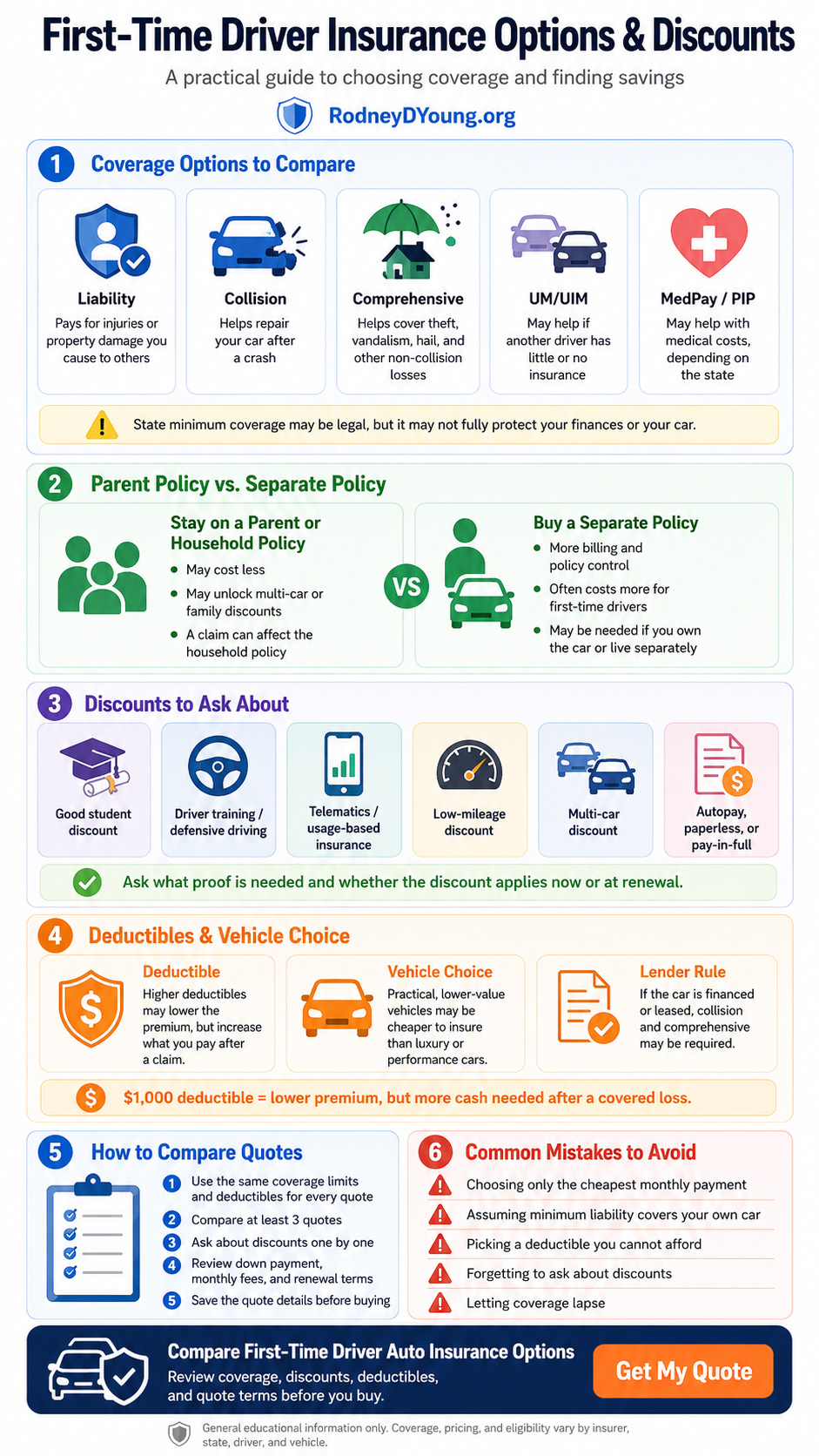
- First-time drivers should compare liability, collision, comprehensive, uninsured/underinsured motorist, medical coverage options, and deductibles before buying.
- State minimum coverage may let you drive legally, but it may not protect your own car or fully protect your finances after a serious accident.
- Teen drivers may often pay less when added to a family policy than when buying a separate policy, depending on the household, vehicle, and insurer [1].
- Discounts may be available for good students, driver education, defensive driving, low mileage, telematics, multi-car policies, autopay, paperless billing, or safe driving.
- New drivers should compare quotes using the same coverage limits and deductibles so the cheapest quote is not simply the weakest coverage.
What First-Time Driver Insurance Really Means
First-time driver insurance is not a special type of policy. It usually means a standard auto insurance policy for someone who is newly licensed, newly insured, or buying a policy for the first time. That driver may be a teenager, college student, young adult, immigrant driver, adult learner, or someone who recently started driving after years without a car.
Insurers may treat first-time drivers as higher risk because they have limited driving and insurance history. NHTSA identifies inexperience, speeding, distraction, and passenger risk as common safety concerns for novice teen drivers, which helps explain why new drivers are often priced carefully by insurers [2].
For a driver who is both young and new, the pricing impact can be stronger. If budget is your biggest concern, compare this article with young driver car insurance discounts, but remember that lower cost should not come from misunderstanding coverage.
First-Time Driver Coverage Options to Compare
Before looking for discounts, first-time drivers need to understand coverage. A discount on a weak policy is not always a good deal. The goal is to compare coverage that fits the state requirement, the vehicle, the driver’s budget, and the driver’s ability to handle an accident out of pocket.
| Coverage option | What it usually does | Why it matters for first-time drivers |
|---|---|---|
| Liability coverage | Pays for injuries or property damage you cause to others, up to your policy limits. | Usually required by state law. Minimum limits may not be enough after a serious accident. |
| Collision coverage | Helps repair or replace your car after a crash, subject to your deductible. | Useful for newer, financed, leased, or hard-to-replace vehicles. |
| Comprehensive coverage | Helps with non-collision losses such as theft, vandalism, fire, hail, or certain weather damage. | Important if you park outside, live in an area with theft or weather risk, or cannot replace the car easily. |
| Uninsured/underinsured motorist coverage | May help if another driver causes a crash and has no insurance or not enough insurance. | Worth reviewing carefully because liability-only coverage does not solve every accident scenario. |
| Medical payments or PIP | May help with medical expenses after a covered accident, depending on the state and policy. | Rules vary by state, so first-time drivers should ask how it works where they live. |
| Rental reimbursement or roadside assistance | May help with temporary transportation or roadside events if added to the policy. | Optional, but useful if you rely on the car for work, school, or family transportation. |
| Gap coverage | May help with the difference between what you owe and what the car is worth after a total loss. | Especially relevant for first-time buyers who finance a vehicle with a small down payment. |
State minimum liability requirements vary. For example, Texas minimum liability coverage is commonly described as 30/60/25: $30,000 for injuries to one person, $60,000 total for injuries in one accident, and $25,000 for property damage [3]. Drivers outside Texas should check their own state insurance department or policy documents.
If you need a deeper breakdown of policy choices, this overview of auto policy options can help you compare liability, full coverage, uninsured motorist, and add-on coverage before asking for quotes.
Parent Policy vs. Separate Policy
One of the biggest decisions for a teen or young first-time driver is whether to join a parent or household policy or buy a separate policy. The Insurance Information Institute says it is generally cheaper to add a teenage driver to the family policy than for the teen to buy a separate policy, although companies differ in how they price young drivers [1].
That does not mean every driver can or should be added to a parent policy. The answer depends on who owns the car, where the car is kept, who drives it most often, whether the student lives away from home, and how the insurer defines household drivers. The primary driver and garaging address should be accurate.
| Option | Possible advantage | Possible drawback |
|---|---|---|
| Added to parent or household policy | May qualify for multi-car, household, student, or bundling-related discounts. | The family premium may rise, and a claim can affect the household policy. |
| Separate first-time driver policy | Can give the driver separate billing, policy control, and insurance history. | Often more expensive for a new driver with little or no insurance record. |
| Listed driver on a shared vehicle | May fit a new driver who only uses a family vehicle sometimes. | The insurer still needs accurate information about driver use and vehicle location. |
Smart Discounts First-Time Drivers Should Ask About
Smart first-time driver insurance discounts start with one simple step: ask about discounts directly and get the requirements in writing when possible. Discounts vary by insurer and state. Some apply immediately, while others apply only after a renewal, a clean driving period, course completion, or proof of eligibility.
For more discount-focused guidance, compare these young driver car insurance discounts with the options below.
| Discount type | Who may qualify | What to ask for |
|---|---|---|
| Good student discount | Students who meet an insurer’s academic requirement. | Ask whether a report card, transcript, or school documentation is needed. |
| Driver education or defensive driving | New drivers who complete an approved course. | Ask whether the course must be state-approved or insurer-approved. |
| Telematics or usage-based insurance | Careful drivers willing to let the insurer review driving behavior or mileage. | Ask what is tracked and whether results can increase as well as decrease the rate. |
| Low-mileage discount | Drivers who do not use the car often or drive short distances. | Ask how mileage is verified and whether the estimate affects future renewals. |
| Multi-car discount | Households insuring more than one vehicle with the same insurer. | Ask whether adding the first-time driver’s car changes the household discount. |
| Autopay, paperless, or pay-in-full | Drivers who choose certain billing methods. | Ask whether lower billing fees or premium discounts apply. |
| Safe driver discount | Drivers who avoid tickets, at-fault accidents, and claims over time. | Ask when a new driver becomes eligible and how long the clean period must be. |
- Ask for every discount by name instead of assuming it was included.
- Ask what proof is needed for student, course, or mileage discounts.
- Ask whether the discount applies today, at renewal, or only after a monitoring period.
- Ask whether a telematics program can raise the premium if driving behavior is risky.
- Ask whether payment plan fees reduce the value of a monthly-payment quote.
Why First-Time Drivers Often Pay More
First-time drivers usually have limited driving history, limited insurance history, or both. Insurers may also consider the driver’s age, ZIP code, vehicle type, annual mileage, coverage choices, deductible, claims history, and state rules. For teen drivers, NHTSA emphasizes that inexperience is a major safety issue during the first months of independent driving [2].
The good news is that the first quote is not permanent. A new driver can often improve future pricing by keeping a clean record, avoiding lapses, driving a practical vehicle, reviewing discounts, and comparing quotes at renewal.
Because driving history matters so much, it is worth understanding how tickets and claims can change future premiums. This guide on how driving history affects young drivers insurance explains why the first year of driving can be especially important.
Choosing Liability, Full Coverage, and Deductibles
Liability-only insurance may cost less, but it usually does not repair or replace your own car after an at-fault crash. Full coverage usually means liability plus collision and comprehensive, but it does not mean every possible loss is covered. Deductibles, exclusions, limits, and claim rules still apply.
If the vehicle is financed or leased, the lender or leasing company may require collision and comprehensive. The Texas Department of Insurance explains that if you still owe money on your car, your lender will require collision and comprehensive coverages [4]. Even outside Texas, this is a common lender requirement for financed vehicles.
A $1,000 deductible may lower the premium compared with a $500 deductible, but it also means the first-time driver needs $1,000 available after a covered collision or comprehensive claim. A deductible should match real emergency savings, not just the desire for a lower monthly payment.
Vehicle Choice Can Affect the First Policy
The car itself can make a first-time driver policy more or less expensive. A high-value, luxury, performance, frequently stolen, or expensive-to-repair vehicle can raise the cost of coverage. A practical vehicle with strong safety features and reasonable repair costs may be easier to insure affordably.
First-time drivers should compare insurance before buying or financing a vehicle. The monthly car payment is only one part of the cost. Insurance, deductible, maintenance, fuel, registration, and possible lender requirements can all affect the total cost of ownership.
- Get an insurance quote using the exact year, make, model, trim, and VIN if available.
- Ask whether collision and comprehensive are required by the lender.
- Compare deductibles before choosing the lowest monthly premium.
- Check whether the car qualifies for safety or anti-theft discounts.
- Think about whether you could replace the car if it were totaled.
Low-Mileage, Telematics, and Usage-Based Options
Some first-time drivers do not drive very much. A college student, remote worker, shared-car household, or new driver who only drives locally may want to ask about low-mileage discounts or usage-based insurance. NAIC explains that usage-based insurance programs may use devices, apps, or vehicle systems to measure driving behavior or mileage [5].
These programs can be useful for careful drivers, but they are not automatically the best choice for everyone. Before enrolling, ask what data is collected, how long it is monitored, whether other household drivers are included, and whether poor driving patterns can increase your rate.
If you drive only occasionally, compare the details of low-mileage car insurance discounts before choosing a standard policy without asking about usage-based options.
How First-Time Drivers Should Compare Quotes
First-time drivers should not compare one minimum-liability quote against another quote that includes collision, comprehensive, uninsured motorist, and higher limits. That is not a fair comparison. Every quote should use the same driver information, garaging address, vehicle, coverage limits, deductible, and payment assumptions.
- Gather the driver’s license information, VIN, garaging address, estimated annual mileage, and current household policy details if available.
- Choose a realistic set of coverage limits before requesting quotes.
- Decide whether collision and comprehensive are needed before comparing prices.
- Use the same deductible for every full coverage quote.
- Ask about discounts one by one.
- Review down payment, monthly fees, cancellation rules, and renewal terms.
- Save the quote summary before buying so you can confirm what was offered.
For a broader shopping process, use this guide to compare auto insurance policies by key features and avoid choosing a policy based on monthly price alone.
Common Mistakes First-Time Drivers Should Avoid
- Choosing the cheapest monthly payment without checking coverage limits.
- Assuming state minimum liability will repair your own vehicle.
- Picking a deductible you could not actually pay after a claim.
- Forgetting to ask about good student, driver training, low-mileage, and telematics discounts.
- Not listing the correct primary driver or garaging address.
- Using a personal policy for delivery, rideshare, or business use without asking whether that use is covered.
- Letting the policy lapse because of a missed payment or misunderstood billing schedule.
- Buying or financing a car before checking how much it will cost to insure.
What About Low Down Payment or No-Deposit Options?
Some first-time drivers look for low down payment, no-deposit, or pay-later language because starting a policy can be expensive. Be careful with those terms. In many cases, a “low down payment” policy still requires an initial payment, and monthly billing may include fees or a higher total cost than paying in full.
Compare the total policy cost, not just the first payment. Ask whether the quote includes the full premium, down payment, installment fees, cancellation rules, and renewal terms. If you need a budget-focused option, review affordable auto insurance without a deposit carefully and avoid assuming that “no deposit” means free coverage.
When to Review the Policy Again
A first-time driver’s first policy should not be treated as permanent. Review coverage before renewal, after six to twelve months of safe driving, after completing a driver course, after improving grades, after moving, after changing vehicles, or after a major life change. A clean driving record and better documentation may improve future options.
Drivers who need quick proof of insurance should still compare carefully. Same-day coverage can be helpful, but it should not mean skipping coverage review. First-time drivers who need a policy to begin quickly can review our guide to same-day car insurance for new drivers to understand the documents, approval factors, effective-date details, and proof requirements to confirm before driving.
Compare First-Time Driver Auto Insurance Options
Enter your ZIP code to compare available auto insurance options. Review coverage limits, discounts, deductibles, down payment, and quote terms before choosing a policy.
Entering a ZIP code does not guarantee approval, pricing, or availability. Coverage options vary by state, driver, insurer, vehicle, and underwriting rules.
Frequently Asked Questions
Is car insurance more expensive for first-time drivers?
Often, yes. First-time drivers may have limited driving or insurance history, which can make them more expensive to insure. The final price depends on age, state, vehicle, ZIP code, coverage choices, driving record, discounts, and insurer rules.
Can a first-time driver stay on a parent’s insurance policy?
Many teen or young first-time drivers can be added to a parent or household policy, and this is often cheaper than buying a separate policy. The driver, vehicle ownership, garaging address, and primary use must be listed accurately.
What discounts should first-time drivers ask about?
Ask about good student, driver education, defensive driving, low-mileage, telematics, multi-car, autopay, paperless billing, pay-in-full, and safe driver discounts. Requirements vary by insurer and state.
Does minimum liability coverage protect my own car?
Usually, no. Liability coverage generally pays for injuries or property damage you cause to others, up to your policy limits. Collision and comprehensive are the coverages more commonly used to protect your own vehicle from covered physical damage losses.
Should a first-time driver buy full coverage?
Full coverage may be worth considering if the car is financed, leased, newer, valuable, or hard to replace. It may be less attractive for an older paid-off vehicle with low value, depending on the premium, deductible, and your savings.
Can a first-time driver get same-day car insurance?
In many cases, yes, if the driver has the required information ready and qualifies for coverage. However, first-time drivers should still review limits, deductibles, exclusions, down payment, fees, and effective date before buying.
Conclusion
First-time driver insurance should be chosen with more than one goal in mind. The policy should satisfy legal requirements, fit the vehicle, protect against realistic accident costs, and leave room for discounts as the driver builds experience. A low monthly payment may look attractive, but it can become expensive if the coverage is too weak or the deductible is too high.
The smartest path is to compare coverage options first, then compare discounts. Ask about good student, driver training, telematics, low-mileage, multi-car, and billing discounts, but also review liability limits, collision, comprehensive, uninsured motorist options, and payment terms. A first-time driver who starts with accurate information and a clean record may have better options at renewal.
References
- Insurance Information Institute. “Students.” III guidance on student drivers, family policies, and separate coverage considerations. ↩
- National Highway Traffic Safety Administration. “Teen Driving.” NHTSA teen and novice driver safety information. ↩
- Texas Department of Insurance. “Auto Insurance Guide.” Texas minimum auto liability limits and coverage guidance. ↩
- Texas Department of Insurance. “Auto Insurance Guide.” TDI guidance on lender-required collision and comprehensive coverage. ↩
- National Association of Insurance Commissioners. “Insurance Topics: Auto Insurance.” NAIC auto insurance coverage and usage-based insurance overview. ↩