

Auto insurance and home insurance protect different parts of your financial life. Auto insurance focuses on vehicles, driving-related liability, accidents, and covered damage to your car. Home insurance focuses on the structure of your home, personal belongings, liability at the residence, and additional living expenses after certain covered losses.
The key is to compare more than the premium. A lower price can reflect different limits, higher deductibles, missing endorsements, actual cash value rather than replacement cost, or other differences in coverage. A useful comparison looks at protection, exclusions, deductibles, lender requirements, discounts, and claim support before deciding whether separate policies or a bundle makes more sense.
- Auto insurance and home insurance should be evaluated separately before deciding whether to bundle them.
- Auto coverage may include liability, collision, comprehensive, medical payments, and uninsured/underinsured motorist coverage [1].
- Homeowners coverage may include dwelling, personal property, liability, medical payments, and additional living expenses. Flood insurance is generally separate, while earthquake protection may require an endorsement or separate policy depending on the insurer and location [2].
- Bundling may reduce the combined cost, but a discounted package is not automatically the best overall value.
- Compare equivalent limits, deductibles, valuation methods, endorsements, and policy details before choosing.
Auto Insurance vs. Home Insurance: What Each Policy Protects
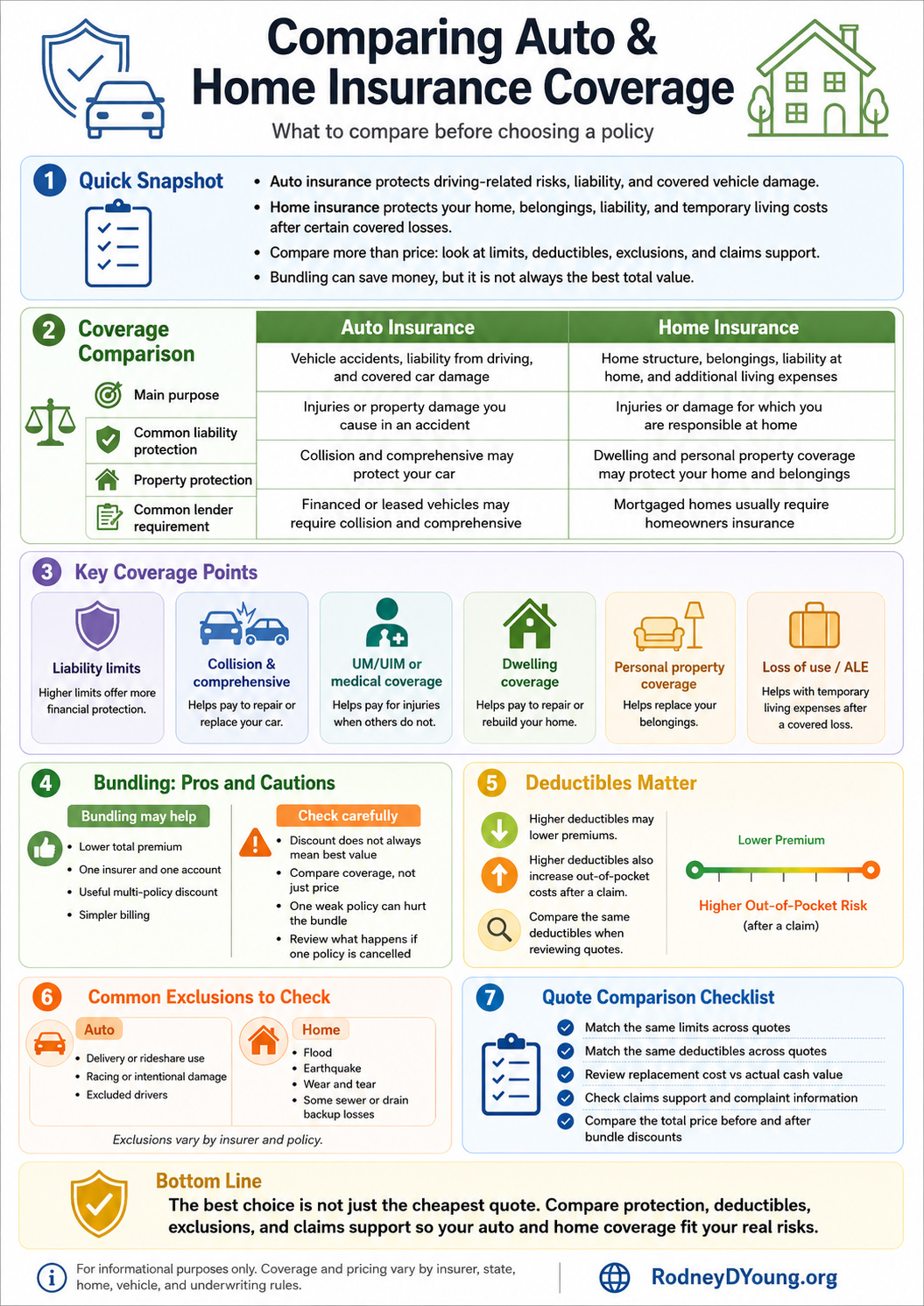
Auto and home insurance use many of the same terms, including limits, deductibles, exclusions, claims, and liability, but the policies address different risks. Auto insurance is tied primarily to drivers, vehicles, accidents, and state financial responsibility rules. Home insurance is tied to property, belongings, liability at the residence, and covered causes of loss.
For auto insurance, liability coverage generally helps pay for injuries or property damage you cause to others, while collision and comprehensive coverage may help protect your own vehicle from covered physical damage losses. For a deeper auto-only breakdown, review these auto policy options before comparing quotes.
For home insurance, important considerations include the amount of dwelling coverage, how personal property is valued, liability protection, and whether additional living expenses are included. NAIC explains that additional living expenses can help with temporary housing and certain extra costs if a covered loss makes the home uninhabitable [3].
| Comparison point | Auto insurance | Home insurance |
|---|---|---|
| Main purpose | Helps protect against driving-related liability and covered damage to the insured vehicle. | Helps protect the home structure, belongings, liability, and certain living expenses after covered losses. |
| Liability protection | Bodily injury and property damage liability when you are responsible for a covered accident. | Personal liability for certain injuries or property damage for which you are legally responsible. |
| Property protection | Collision and comprehensive may protect the insured vehicle, subject to policy terms and deductibles. | Dwelling and personal property coverage may protect the home and belongings, subject to limits, exclusions, and deductibles. |
| Lender considerations | A lender or leasing company may require collision and comprehensive coverage. | A mortgage lender commonly requires homeowners insurance on the property securing the loan. |
| Common mistake | Assuming state minimum liability coverage also repairs your own vehicle. | Assuming a standard homeowners policy covers flood, earthquake, or all personal property without limits or exclusions. |
Coverage Details to Compare Side by Side
Start with the declarations page or quote summary. Compare policies using equivalent information rather than looking only at the final premium. For auto coverage, that means checking the same drivers, vehicles, liability limits, deductibles, and optional protections. For home coverage, compare the same dwelling amount, personal property valuation method, liability limit, deductible structure, and endorsements.
| Coverage area | What to review | Why it matters |
|---|---|---|
| Auto liability | Bodily injury and property damage limits. | State minimum limits may provide less protection than a household wants after a serious crash. |
| Collision and comprehensive | Whether each is included and the deductible that applies. | These coverages address different types of physical damage to the insured vehicle. |
| UM/UIM and medical coverage | Whether uninsured/underinsured motorist, MedPay, or PIP applies or is available. | Availability and requirements vary by state and policy. |
| Dwelling coverage | The insured amount and whether it reflects estimated rebuilding needs. | An inadequate dwelling limit can create a significant coverage gap after a major covered loss. |
| Personal property | Limits, sublimits, and replacement cost versus actual cash value. | NAIC explains that actual cash value accounts for depreciation, while replacement cost coverage is structured differently [4]. |
| Additional living expenses | Limits and conditions for temporary housing and related extra costs. | This coverage can matter if a covered loss temporarily makes the home uninhabitable. |
Home insurance does not insure a car as a vehicle, and auto insurance generally does not provide the same personal property protection as a homeowners, renters, or condo policy. For example, a covered vehicle theft claim and a claim involving personal belongings inside the vehicle may involve different parts of your insurance program.
Requirements and Lender Rules Are Different
Auto insurance is influenced by state financial responsibility laws, while homeowners insurance is generally tied more closely to property protection and mortgage requirements. As one example, the Texas Department of Insurance explains that liability coverage pays for certain injuries and damage you cause to others, while lenders may require collision and comprehensive coverage when money is still owed on a vehicle [5]. Requirements vary by state and lender, so compare policies using the rules that apply where you live rather than assuming the same setup works everywhere.
If you are reviewing Texas-specific auto coverage, this guide on whether full coverage is worth it in Texas explains additional considerations involving liability limits, vehicle protection, lender requirements, and deductibles.
Should You Bundle Home and Auto Insurance?
Bundling means buying more than one policy from the same insurer, such as auto plus homeowners, condo, or renters insurance. It can simplify billing and sometimes qualify a household for a multi-policy discount. The discount alone, however, does not tell you whether the combination offers the best value.
- The combined premium is lower than comparable separate policies.
- Both policies provide the coverage limits and protections you actually need.
- The deductible structure remains affordable after the discount is applied.
- You value having one insurer, account, or agent relationship.
- The home policy includes appropriate endorsements for your property and local risks.
- One insurer is competitive for auto but significantly weaker or more expensive for home coverage.
- A different home insurer offers better replacement cost provisions or needed endorsements.
- The bundle discount is offset by a higher underlying premium.
- Bundling requires higher deductibles or lower limits to reach the advertised price.
- You expect to switch one policy and would lose the multi-policy discount.
| Situation | Bundling may be better if | Separate policies may be better if |
|---|---|---|
| Homeowner with multiple vehicles | The same insurer offers competitive protection on both sides with a meaningful multi-policy discount. | Another company provides materially better home coverage, roof terms, or local claim support. |
| Renter with one vehicle | Auto plus renters insurance is competitively priced and the renters policy provides adequate personal property and liability limits. | The bundled renters coverage has weak limits or does not fit the household’s needs. |
| Financed vehicle and mortgaged home | The policies satisfy applicable lender requirements and remain competitive after comparing equivalent coverage. | Separate insurers satisfy those requirements at a better overall value. |
| Older vehicle and higher-value home | The auto coverage can be adjusted appropriately without weakening the home policy. | The home requires specialized protection that the auto insurer does not offer competitively. |
Deductibles Work Differently Across Policies
Deductibles can lower the quoted premium, but they also change how much you may need to pay after a covered loss. Auto collision and comprehensive coverage commonly have deductibles. Home policies may have a primary property deductible and, depending on the policy and location, separate wind, hail, hurricane, or named-storm deductibles.
Before selecting a higher deductible, consider whether you could comfortably pay it after an unexpected claim. For a more detailed auto-focused explanation, review the impact of deductibles on insurance.
| Deductible question | Auto policy | Home policy |
|---|---|---|
| Where is a deductible common? | Collision and comprehensive coverage. | Many property claims, with possible special deductibles for certain perils. |
| What happens if you raise it? | The premium may decrease, but your out-of-pocket cost after a covered claim increases. | The premium may decrease, but a property claim can require more cash from the homeowner. |
| What should stay consistent when comparing? | Liability limits, physical damage deductibles, vehicle information, and optional coverage choices. | Dwelling limit, valuation method, endorsements, liability limit, and deductible structure. |
Replacement Cost vs. Actual Cash Value
One of the most important home insurance comparison points is how damaged property is valued. NAIC explains that actual cash value considers depreciation, while replacement cost coverage is designed differently and may help pay to replace covered property without applying depreciation in the same way, subject to policy terms [4].
This means two home quotes with similar premiums may provide very different claim outcomes. A lower premium can sometimes reflect actual cash value coverage, lower personal property limits, or fewer endorsements, so review how the policy values the home and belongings rather than comparing only price.
If a covered loss damages older furniture, electronics, or building materials, actual cash value may reflect depreciation. Replacement cost coverage may provide broader protection, but policy conditions, limits, and settlement rules still apply.
Exclusions and Coverage Gaps to Check
Every insurance policy has exclusions and limitations. Auto policies may restrict or exclude certain commercial, delivery, rideshare, racing, intentional, or otherwise prohibited uses. Home policies commonly require separate consideration for risks such as flood and earthquake and may contain limits for sewer backup, high-value property, business equipment, or other exposures.
NAIC notes that flood insurance is generally provided through separate coverage, while earthquake protection may be available through an endorsement or separate policy depending on the insurer and area [2]. Local risks should therefore be part of the comparison rather than assuming the standard home policy covers every type of loss.
- Does the auto policy cover the way the vehicle is actually used?
- How does the home policy address flood, earthquake, sewer backup, wind, or hail?
- Are jewelry, electronics, collectibles, tools, or business equipment subject to special limits?
- Does the policy use replacement cost or actual cash value?
- Are any drivers, vehicles, properties, or activities specifically excluded?
Claims and Customer Support Matter Too
Insurance should also be evaluated based on what happens after a loss. When comparing providers, review how claims can be reported, what documentation may be required, whether online or mobile claim tools are available, how repair or contractor choices work, and what consumer complaint information is available through your state insurance department.
Claim service can matter just as much as a small difference in premium when a serious loss occurs. For an auto-focused look at preparing for the process, review this guide to stress-free auto claims.
- Can a claim be reported online, by phone, through an app, or through an agent?
- What photos, receipts, estimates, reports, or other documentation may be required?
- Can you choose your own repair shop or contractor, subject to policy terms and state law?
- Does the policy include relevant temporary assistance such as rental reimbursement or additional living expenses?
How to Compare Home and Auto Quotes Fairly
The most useful comparison is apples-to-apples. For auto insurance, keep the same drivers, vehicles, liability limits, collision and comprehensive deductibles, UM/UIM choices, medical coverage options, and estimated mileage across quotes. For home insurance, use the same dwelling amount, personal property valuation method, liability limit, deductible, endorsements, roof details, and relevant local hazard protection.
For auto-specific shopping, use this guide to compare auto insurance policies by key features. Then review home coverage with accurate property information so that a lower quote is not simply the result of weaker coverage assumptions.
- Use the same auto liability limits on every auto quote.
- Use the same collision and comprehensive deductibles.
- Use the same dwelling amount, personal property valuation method, and home deductible structure.
- Check whether flood, earthquake, sewer backup, wind/hail, or high-value property protection is included, excluded, or separate.
- Compare the total cost before and after multi-policy discounts.
- Review claim support, complaint information, and insurer financial strength where available.
- Save the quote summaries so you can compare the actual policy details before buying.
Common Mistakes When Comparing Home and Auto Insurance
- Choosing the lowest premium without checking limits and exclusions.
- Assuming a bundle discount guarantees the lowest total cost.
- Comparing policies with different deductibles as though they provide the same value.
- Assuming a standard home policy automatically includes flood or earthquake protection.
- Assuming auto liability coverage repairs your own vehicle.
- Ignoring replacement cost versus actual cash value.
- Overlooking mortgage, finance, or lease requirements.
- Forgetting that homeowners, renters, and condo policies protect property differently.
What About Auto + Renters or Auto + Condo Insurance?
Not every driver owns a house. Renters insurance may protect personal belongings and liability and can sometimes be bundled with auto coverage. NAIC explains that renters insurance can provide personal property protection and liability coverage for renters [6].
Condo insurance works differently from a standard homeowners policy because the condominium association’s master policy may cover portions of the building while an HO-6 policy addresses the unit owner’s interior property, personal belongings, liability, loss assessment, and other covered exposures. Condo owners should review both the master policy and their individual policy before deciding whether an auto-plus-condo bundle provides good value.
Start by Comparing Auto Insurance Options
Enter your ZIP code to begin comparing available auto insurance quote options based on your location. If you also need homeowners, renters, or condo insurance, compare those policies separately using the correct property details, limits, deductibles, and endorsements before deciding whether to bundle.
Entering a ZIP code does not guarantee approval, pricing, or availability. Auto coverage options vary by state, driver, insurer, vehicle, selected coverage, and underwriting rules. Home, renters, or condo coverage should be reviewed separately using accurate property information.
Frequently Asked Questions
Is bundling auto and home insurance always cheaper?
No. Bundling may reduce the combined cost or simplify billing, but it is not automatically the best value. Compare equivalent limits, deductibles, endorsements, exclusions, and total premiums against separate policies before deciding.
Does home insurance cover my car?
Home insurance generally does not cover a car as a vehicle. Collision and comprehensive are the auto coverages commonly associated with covered physical damage to your own vehicle. Personal belongings inside the car may involve homeowners, renters, or condo coverage depending on the policy and circumstances.
Does auto insurance cover items stolen from my car?
Comprehensive coverage may address covered damage to or theft of the vehicle itself, but personal belongings inside the car are often treated differently. Review the personal property provisions of your homeowners, renters, or condo policy.
What should I compare before bundling?
Compare auto liability limits, physical damage deductibles, home dwelling coverage, personal property valuation, liability limits, deductibles, exclusions, endorsements, claim support, and the total cost before and after the bundle discount.
Should renters compare auto and renters insurance together?
It can be useful when the insurer offers both. A bundle may provide convenience or a discount, but the renters policy should still provide appropriate personal property and liability protection for the household.
What is the biggest mistake when comparing home and auto insurance?
Comparing only the premium. A lower price can reflect lower limits, higher deductibles, different property valuation, fewer endorsements, or exclusions that create a meaningful difference after a claim.
Conclusion
Home and auto insurance protect different risks, so the strongest comparison begins by evaluating each policy on its own. Auto insurance should be reviewed for liability limits, vehicle protection, uninsured or underinsured motorist options, deductibles, driver information, and claim support. Home insurance should be reviewed for dwelling coverage, personal property valuation, liability, additional living expenses, local hazards, exclusions, and lender requirements.
Bundling can be convenient and may reduce the combined premium, but the discount should not replace a careful coverage comparison. The better choice is the combination of policies that provides appropriate protection, affordable deductibles, useful claim support, and a competitive total cost for your vehicle, property, household, and location.
References
- National Association of Insurance Commissioners. “Auto Insurance.” NAIC overview of auto policy coverage types and declarations pages. ↩
- National Association of Insurance Commissioners. “Homeowners Insurance.” NAIC homeowners insurance overview. ↩
- National Association of Insurance Commissioners. “What are Additional Living Expenses and How Can Insurance Help?” NAIC explanation of additional living expenses. ↩
- National Association of Insurance Commissioners. “What’s the Difference Between Actual Cash Value Coverage and Replacement Cost Coverage?” NAIC explanation of actual cash value and replacement cost. ↩
- Texas Department of Insurance. “Insurance 101: How to Buy Insurance for the First Time.” TDI guidance on liability and lender-required vehicle coverage. ↩
- National Association of Insurance Commissioners. “For Rent: Protecting Your Belongings With Renters Insurance.” NAIC renters insurance overview. ↩