
Buy now pay later car insurance is usually not a separate type of auto policy. Most drivers use the phrase to describe car insurance that can be started with a first payment and then paid monthly, biweekly, or through another installment schedule. The important question is not only whether the first payment is low, but whether the total premium, fees, discounts, coverage limits, and cancellation terms still make sense.
This guide explains how discounts may work when you choose a monthly or low-down-payment auto insurance plan, which savings are commonly available, which discounts may conflict with paying later, and how to compare quotes without mistaking a smaller first payment for a cheaper policy.
Quick Summary
- “Buy now pay later car insurance” usually means installment billing, monthly payments, or a low first payment rather than a separate insurance product.
- A discount lowers the premium; a payment plan changes when you pay. They are not the same thing.
- Safe-driver, multi-policy, multi-car, low-mileage, defensive-driving, paperless, autopay, and telematics discounts may still apply depending on the insurer.
- A pay-in-full discount may not be available if you choose monthly payments, so compare the total policy cost, not just the first payment.
- Installment fees, late fees, cancellation risk, and coverage limits can matter as much as the advertised monthly price.
- Review liability limits, deductibles, optional coverages, and policy terms before choosing the lowest down payment.
What Buy Now Pay Later Car Insurance Really Means
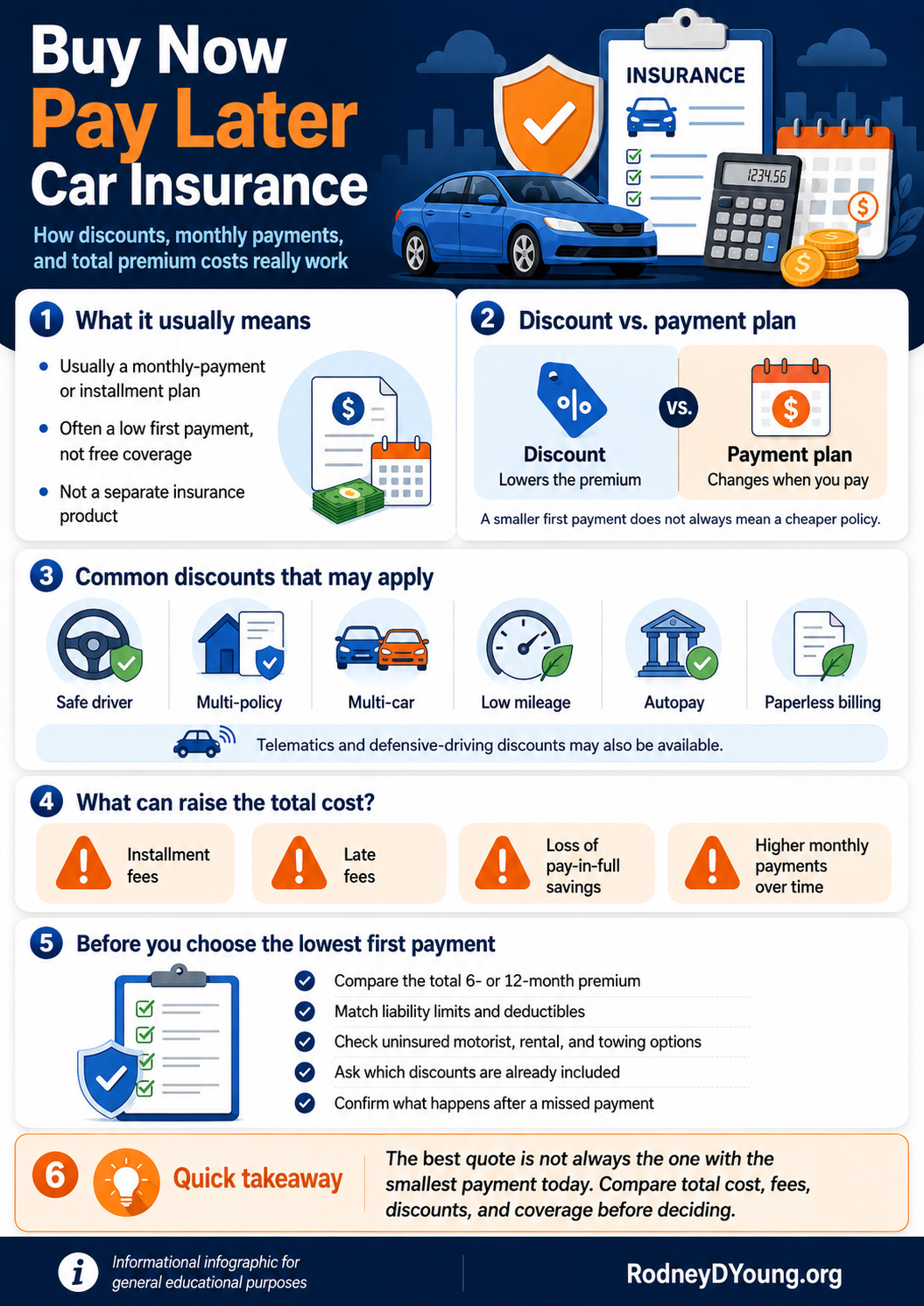
In everyday searches, buy now pay later car insurance often refers to a policy that can be started with a smaller first payment and paid over time. In insurance terms, this is usually an installment plan or monthly billing option. It does not automatically mean free coverage, no first payment, guaranteed approval, or full coverage.
Auto insurance pricing depends on the coverage selected and how the insurer evaluates risk. NAIC explains that the amount a driver pays for insurance depends on how much coverage is chosen and how risky the company believes the driver is to insure.[1] That means two drivers can see very different prices even if both are looking for a low first payment.
Important coverage note
A payment plan does not determine your protection. Liability-only, comprehensive, collision, uninsured motorist, rental reimbursement, towing, and other coverages depend on the policy you choose. Do not assume that a monthly-payment policy includes “full coverage” unless the declarations page clearly lists the coverage types, limits, and deductibles you need.
Discounts, Down Payments, and Payment Plans Are Different
The biggest mistake with buy now pay later insurance is treating every lower payment as a discount. A lower first payment can make a policy easier to start, but it may not reduce the premium. In some cases, paying over time can add billing fees or remove a pay-in-full discount.
| Term | What it means | What to check before buying |
|---|---|---|
| Discount | A reduction in the premium because you qualify for a savings category, such as safe driving, bundling, low mileage, or autopay. | Ask whether the discount is already included, how long it lasts, and whether it can be removed later. |
| Down payment | The first amount due to start or bind the policy. | Confirm whether coverage starts only after payment is accepted and whether the first payment includes fees. |
| Installment plan | A billing schedule that divides the premium into monthly or other periodic payments. | Compare the total policy cost with monthly billing versus paying in full. |
| Installment fee | A fee charged for spreading payments over time. | Ask whether autopay, paperless billing, or a different payment schedule can reduce the fee. |
| Pay-in-full discount | A savings option some insurers may offer when the full policy premium is paid upfront. | Check whether choosing monthly payments removes this savings. |
If you are comparing low-start options, review buy now pay later car insurance to understand why payment flexibility usually means a first payment plus scheduled installments, not free coverage or guaranteed approval.
Common Discounts That May Apply to Monthly Car Insurance
Discount availability varies by company and state, but many common savings categories can still apply even when you pay monthly. The Insurance Information Institute lists several ways drivers may lower auto insurance costs, including shopping around, comparing insurance costs before buying a car, using higher deductibles carefully, bundling, maintaining a good credit record where allowed, and asking about low-mileage or group discounts.[2]
| Discount type | Can it apply with monthly payments? | What to ask the insurer |
|---|---|---|
| Safe-driver discount | Often possible | Ask how tickets, accidents, claims, and lookback periods affect eligibility. |
| Multi-policy discount | Often possible | Ask whether bundling auto with renters, condo, or home coverage actually lowers the total cost. |
| Multi-car discount | Often possible | Ask whether all vehicles and drivers must be on the same policy or household account. |
| Low-mileage discount | Sometimes possible | Ask how mileage is verified and whether commuting changes can affect the price later. |
| Autopay discount | Often possible | Ask whether automatic payments reduce the premium, billing fee, or both. |
| Paperless billing discount | Sometimes possible | Ask whether electronic documents or email billing qualify for savings. |
| Defensive-driving discount | State and insurer dependent | Ask which courses qualify, how long the discount lasts, and whether age restrictions apply. |
| Telematics discount | Sometimes possible | Ask what driving behavior is tracked and whether the program can increase or reduce your premium. |
| Pay-in-full discount | Usually not compatible with paying later | Compare the savings from paying in full with the cash-flow benefit of monthly payments. |
For a closer look at stacking savings with payment flexibility, review car insurance discounts with buy now pay later before choosing a billing plan.
How to Ask for Discounts Without Weakening Your Coverage
Asking about discounts is smart, but reducing coverage only to lower the monthly bill can create problems later. TDI advises drivers to ask their insurance company about discounts such as good driver, safe car, multi-car, and low-mileage savings, while also noting that companies do not always offer the same discounts.[3]
Ask about safe driver, multi-policy, multi-car, low mileage, autopay, paperless billing, student, defensive-driving, and anti-theft savings before reducing coverage.
A policy with a lower first payment can still cost more over six or twelve months if fees are higher or discounts are smaller.
Review liability limits, deductibles, collision, comprehensive, uninsured motorist, rental, and towing before accepting the cheapest monthly quote.
If you are unsure whether the savings are real, review auto insurance discounts and compare whether the lower price comes from a true discount, a weaker coverage setup, a higher deductible, or a different payment schedule.
Why Monthly Payments Can Cost More Than Paying in Full
Monthly billing can help drivers who do not want to pay the entire premium upfront. However, the cheapest first payment is not always the cheapest policy. A monthly plan may include installment fees, processing fees, or a higher total cost than a pay-in-full option.
Example of the difference
One quote may require $120 today and $180 per month after that. Another may require $260 today but offer a lower total six-month premium. The first option may feel easier upfront, but the second option may be cheaper overall. Always compare the total policy premium, total fees, payment schedule, and coverage limits side by side.
Buy now pay later is also a consumer-credit term outside insurance. CFPB has noted that buy now pay later repayment data may be furnished to credit reporting companies.[4] Auto insurance installment billing is not always the same as retail BNPL credit, but drivers should still read payment terms carefully and understand whether missed payments, late fees, or cancellation could affect them.
Factors That Affect Buy Now Pay Later Car Insurance Discounts
Discounts are only one part of the final price. TDI explains that common auto insurance cost factors can include driving record and claims history, where you live, how much you drive, age, gender, marital status, occupation, replacement cost of the car, and credit score where allowed.[5] State rules can limit or change how some factors are used.
| Factor | How it can affect discounts or price | What you can review |
|---|---|---|
| Driving record | Tickets, accidents, and claims can reduce safe-driver eligibility. | Ask when violations or claims stop affecting the quote. |
| ZIP code | Location can affect theft risk, claim frequency, repair costs, and available carriers. | Compare quotes using the exact garaging ZIP code. |
| Vehicle | Repair cost, safety features, theft risk, and vehicle value can affect premium. | Check whether safety or anti-theft features qualify for savings. |
| Coverage limits | Higher limits usually cost more, but very low limits can expose you after a serious accident. | Compare the same limits across every quote. |
| Deductible | A higher deductible may lower premium, but it increases what you may pay after a covered claim. | Choose a deductible you could realistically afford. |
| Payment method | Autopay or paperless billing may qualify for savings with some insurers. | Ask whether payment method affects fees, premium, or both. |
Before choosing a lower monthly payment, review best buy now pay later car insurance deals so you compare the first payment, installment schedule, fees, total premium, discounts, and coverage terms together.
How to Compare Buy Now Pay Later Insurance Quotes
To compare quotes fairly, match the details instead of focusing only on the advertised monthly payment. A quote with lower coverage, a higher deductible, fewer drivers, missing vehicles, or fewer optional protections is not the same offer.
Quote comparison checklist
- Compare the total six-month or twelve-month premium.
- Compare the first payment due today.
- Check every monthly payment after the first one.
- Ask about installment, billing, late, reinstatement, or cancellation fees.
- Match liability limits across all quotes.
- Match comprehensive and collision deductibles.
- Confirm whether uninsured or underinsured motorist coverage is included.
- Check rental reimbursement, towing, roadside, or gap-related options if needed.
- Ask which discounts are already included and which require action later.
- Confirm the policy start date and avoid any lapse in coverage.
For a broader payment-focused comparison, review best buy now pay later car insurance deals before choosing a low-start payment plan based only on the amount due today.
Discounts That Can Disappear or Change Later
Some discounts are stable for the policy term, while others can change at renewal or after new information is reviewed. A telematics discount may depend on driving behavior. A low-mileage discount may depend on updated mileage. A multi-policy discount may disappear if the related home or renters policy is canceled. A good-student or defensive-driving discount may require proof.
Discount questions to ask before enrolling
- Is this discount already included in the quote?
- Do I need to submit documents to keep it?
- Can the discount be removed mid-policy or only at renewal?
- Will the discount change if I miss a payment?
- Does monthly billing remove any pay-in-full savings?
- Will telematics participation affect only discounts or also the base premium?
- Does the discount apply to the whole policy or only part of the premium?
Risks to Avoid With Low First Payment Car Insurance
A low first payment can be useful when cash is tight, but it should not distract from coverage quality. If the policy has weak liability limits, a deductible you cannot afford, missing physical damage coverage, or strict cancellation terms, the lower start cost may not be worth it.
Common mistakes
- Choosing the smallest first payment without checking the total premium.
- Assuming “buy now pay later” means coverage starts without any payment.
- Confusing a payment plan with an actual premium discount.
- Ignoring installment fees or late-payment rules.
- Removing uninsured motorist, comprehensive, collision, rental, or towing coverage without understanding the tradeoff.
- Raising deductibles beyond what you could afford after an accident.
- Not asking whether autopay or paperless billing can reduce fees.
- Canceling an old policy before the new one is active.
FAQ
Is buy now pay later car insurance a real insurance product?
Usually, it is a consumer phrase for monthly-payment, installment, or low-down-payment car insurance. The actual policy is still an auto insurance policy with specific coverage limits, deductibles, terms, and payment rules.
Can I get discounts if I pay monthly?
Yes, some discounts may still apply when you pay monthly. Safe-driver, multi-policy, multi-car, low-mileage, defensive-driving, autopay, paperless, and telematics discounts may be available depending on the insurer and state.
Does paying monthly make car insurance more expensive?
It can. Monthly billing may include installment fees or may remove a pay-in-full discount. Compare the total policy cost, not only the first payment or monthly amount.
Is no-deposit car insurance the same as buy now pay later insurance?
Not exactly. No-deposit insurance is often marketing language for a low first payment. Most policies require some payment before coverage starts.
What discount is most useful for monthly car insurance?
Autopay and paperless billing can be especially relevant because they may reduce billing friction or fees. However, safe-driver, bundling, multi-car, and low-mileage discounts may provide larger savings for some drivers.
Should I choose the quote with the lowest first payment?
Not automatically. Compare the total premium, all fees, monthly schedule, liability limits, deductibles, and optional coverages before choosing.
Can telematics help lower my premium?
Possibly. Telematics programs may offer savings based on driving behavior or mileage, but rules vary by insurer. Ask what is tracked and whether participation can increase or decrease your price.
Can discounts change after I buy the policy?
Yes. Some discounts can change at renewal, after proof is reviewed, after a payment issue, or when household, vehicle, mileage, or policy details change.
What should I ask before starting a monthly-payment policy?
Ask when coverage starts, how much is due today, how many payments remain, whether fees apply, which discounts are included, what happens after a missed payment, and whether the quote matches the coverage you need.
Can I switch later if I find a better discount?
You can usually compare and switch later, but do not create a lapse. Make sure the new policy is active before canceling the old one and ask whether cancellation fees or refunds apply.
Conclusion
Buy now pay later car insurance discounts are best understood as two separate issues: how you pay and how the insurer calculates savings. Monthly payments can make coverage easier to start, but they do not automatically reduce the premium. Real discounts usually come from safe driving, bundling, multi-car policies, low mileage, autopay, paperless billing, defensive driving, telematics, or other insurer-specific programs.
Before choosing a low first payment, compare the full policy cost, installment fees, coverage limits, deductibles, cancellation rules, and discounts included in each quote. The best option is not always the smallest payment today. It is the policy that balances affordability, coverage, and reliable terms over the full policy period.
Compare Monthly Car Insurance Options
Use your ZIP code to begin comparing auto insurance quote paths. Match coverage limits, deductibles, drivers, vehicles, payment schedules, and discounts before deciding whether a low first payment is truly the better deal.
References
- National Association of Insurance Commissioners, “Auto Insurance.” ↩
- Insurance Information Institute, “Nine Ways to Lower Your Auto Insurance Costs.” ↩
- Texas Department of Insurance, “Ask for Discounts to Lower Your Auto Insurance Premium Amount.” ↩
- Consumer Financial Protection Bureau, “Buy Now, Pay Later and Credit Reporting.” ↩
- Texas Department of Insurance, “How Are Your Auto and Homeowners Insurance Costs Calculated?” ↩