
Best buy now pay later car insurance deals are usually not “free coverage now and payment later.” In auto insurance, the phrase commonly refers to monthly billing, installment payments, or a lower first payment. Drivers should compare the amount due today, monthly payments, billing fees, late-payment consequences, coverage limits, and total policy cost before choosing a payment plan.[1]
Buy now pay later car insurance can sound attractive when you need coverage quickly and do not want a large upfront bill. The real question is whether the payment structure helps your budget without weakening coverage or increasing the total cost more than expected. A policy with a low first payment may still cost more over the full term if monthly installments include fees or if the quote uses lower limits.
This guide explains how to evaluate buy now pay later car insurance options in a practical way. It also shows how to separate actual savings from payment timing, how to compare low-start quotes, and what red flags to avoid before submitting payment.
What Buy Now Pay Later Car Insurance Deals Usually Mean
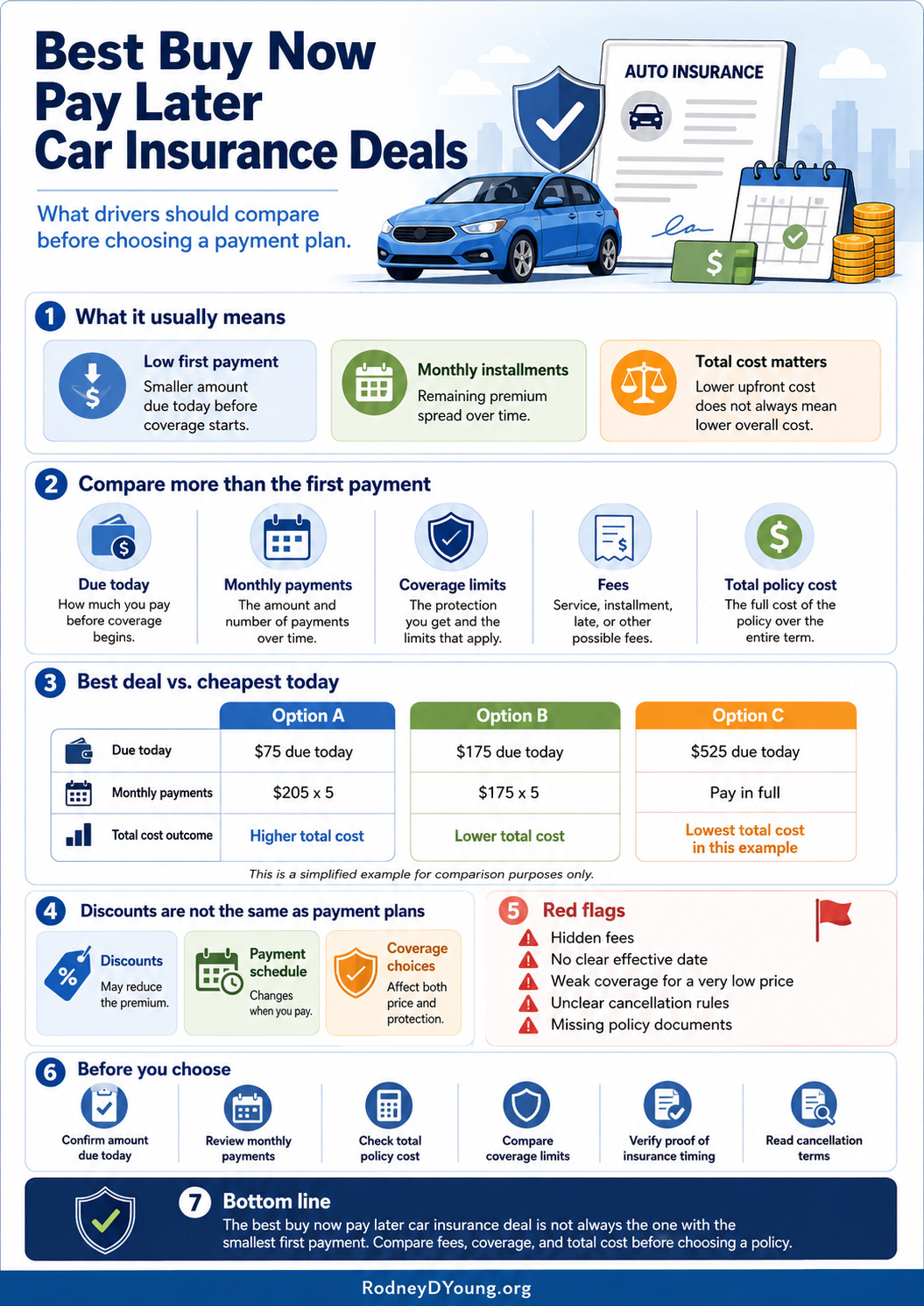
In most auto insurance shopping contexts, “buy now pay later” is a marketing phrase for installment billing or low-start coverage. The insurer or billing provider may allow the premium to be divided into monthly payments instead of requiring the full policy term upfront. That can make the policy easier to start, but it does not automatically mean the policy is cheaper.
Lower amount due today
The first payment may be smaller than paying the entire policy term upfront, which can help with short-term budgeting.
Monthly installments
The remaining premium is paid over time, often monthly, subject to billing rules, due dates, and possible fees.
Total cost still matters
A lower first payment is not the same as a lower overall premium. Always compare the full policy-term cost.
Do not rely on the label alone: Ask exactly how much is due before coverage starts, whether installment fees apply, what happens if a payment is late, and when proof of insurance becomes available.
Best Deal: Low First Payment or Lowest Total Cost?
The best deal is not always the quote with the lowest amount due today. A low-start policy can be useful if cash is tight, but drivers should compare the total premium, coverage limits, deductibles, optional coverages, and fees. NAIC recommends comparison shopping and giving complete, correct information when seeking auto insurance because quotes can vary based on the driver, vehicle, coverage choices, and insurer.[2]
| Option to compare | What may look attractive | What to verify | Possible downside |
|---|---|---|---|
| Low first payment | Less money due before coverage starts. | Monthly payments, fees, cancellation rules, and total cost. | May cost more over the full policy term. |
| Monthly billing | Premium is easier to fit into a monthly budget. | Installment fees, payment due dates, and automatic payment rules. | Missed payments can cause cancellation or a lapse. |
| Pay-in-full | May reduce billing complexity and sometimes lowers total cost. | Whether a paid-in-full discount exists and whether you can afford the upfront amount. | Requires more money today. |
| Higher deductible | May lower the premium for collision or comprehensive coverage. | Whether you can afford the deductible after a covered claim. | You pay more out of pocket after a loss. |
If you are comparing low-start policies, our guide to very cheap car insurance with no deposit may also help because “no deposit,” “low down payment,” and “buy now pay later” are often used to describe similar shopping concerns. The key is to confirm the actual payment terms, not just the marketing wording.
Discounts Are Different From Payment Plans
A discount can reduce the premium. A payment plan usually changes when you pay the premium. Those are not the same thing. For example, a safe-driver discount may reduce the cost of the policy, while monthly billing may simply divide the premium into installments. Drivers should look for both, but should not assume that monthly payments create savings by themselves.
Discounts
May reduce the premium if you qualify. Examples can include safe driver, multi-policy, paperless billing, good student, or low mileage discounts.
Payment schedule
Determines when you pay. Monthly installments can help cash flow but may include extra billing or installment fees.
Coverage choices
Limits, deductibles, collision, comprehensive, and optional add-ons can affect both the premium and your claim protection.
III recommends shopping around, reviewing insurance costs before buying a vehicle, asking about higher deductibles, reviewing coverage on older cars, and asking about discounts as ways to manage auto insurance costs.[3] These strategies are more reliable than assuming a “pay later” label automatically means a better deal.
How to Compare Buy Now Pay Later Car Insurance Deals
A fair comparison uses the same driver information, vehicle information, coverage limits, deductibles, garaging address, and policy term across quotes. If one quote is much cheaper, check whether it includes lower liability limits, a higher deductible, fewer optional coverages, or fees that are not obvious at first.
- Amount due today: Confirm the exact first payment required before coverage starts.
- Monthly payment: Compare the installment amount and how many payments remain.
- Total policy cost: Compare the full six-month or twelve-month cost, not only the first payment.
- Billing fees: Ask about installment fees, late fees, processing fees, and payment method fees.
- Coverage limits: Make sure liability limits, deductibles, and optional coverages are similar across quotes.
- Effective date: Confirm when coverage starts and when proof of insurance will be available.
For a broader low-start shopping process, review our guide to affordable auto insurance without a deposit. The goal is to compare similar coverage, not just whichever monthly payment looks lowest.
Example: Cheaper Today Can Cost More Later
This simplified example is not a real quote, but it shows why the first payment alone does not determine the best deal.
| Quote example | Due today | Monthly payments | Estimated total term cost | What to notice |
|---|---|---|---|---|
| Option A | $75 | $205 x 5 | $1,100 | Lower first payment, higher total cost. |
| Option B | $175 | $175 x 5 | $1,050 | Higher first payment, lower total cost. |
| Option C | $525 | $0 x 5 | $525 | Lowest total cost in this example, but highest upfront amount. |
The right choice depends on cash flow, coverage needs, risk tolerance, and whether the policy provides enough protection. If the car is financed or leased, the lender may require collision and comprehensive coverage, so a liability-only quote may not be enough.
Late Payments, Cancellation, and Coverage Lapses
Payment flexibility only helps if the policy stays active. Missing an installment can lead to cancellation or a lapse in coverage, depending on the insurer and state rules. The Texas Department of Insurance explains that cancellation means the company stops the policy before its end date and that companies must give notice before cancellation under Texas rules.[4] Rules vary by state, so drivers should review their own policy documents and notices carefully.
Coverage lapse warning: A lapse can create legal, financial, and future insurance problems. Before choosing monthly payments, make sure the due dates and payment method fit your budget reliably.
Red Flags in Pay-Later Car Insurance Offers
Some offers use attractive wording but do not clearly explain coverage, fees, or cancellation terms. Avoid choosing a policy until you can review the actual quote details and policy documents.
- “Free coverage before payment” claims: Most policies require payment before coverage becomes active.
- No clear effective date: You should know exactly when coverage starts.
- Fees hidden from the quote: Ask about installment, late, processing, and cancellation-related fees.
- Very low price with weak coverage: Check whether the quote includes low limits or missing protections.
- No policy documents: Save the declarations page, ID card, payment confirmation, and billing schedule.
- Pressure to buy immediately: Same-day coverage can be useful, but you should still understand the terms.
Documents and Details to Have Ready
Having accurate information ready can help you compare quotes faster and reduce the chance that a quote changes later. NAIC advises consumers to provide complete and correct information when shopping for auto insurance.[2]
Driver information
Names, dates of birth, license information, driving history, and household driver details may be requested.
Vehicle information
VIN, year, make, model, mileage, ownership, garaging address, and vehicle use can affect the quote.
Coverage preferences
Desired limits, deductibles, optional coverages, proof timing, and lender requirements should be reviewed before purchase.
If you need coverage quickly, an instant car insurance quote path can help you start the comparison process, but you should still review the policy details before deciding.
When a Buy Now Pay Later Deal May Make Sense
A monthly payment option may make sense when you need coverage now, cannot pay the full term upfront, and can reliably make each installment on time. It may also help if you are switching policies and need to manage timing between cancellation, new coverage, and proof of insurance.
However, a pay-later structure may be less attractive if fees make the policy more expensive, if the due dates do not fit your income schedule, or if the lower upfront price comes from reducing coverage too much. Drivers can also review the Rodney D. Young auto insurance guide to compare payment flexibility alongside coverage strength, limits, deductibles, and policy terms.
FAQ About Buy Now Pay Later Car Insurance Deals
What is buy now pay later car insurance?
It usually refers to monthly billing, installment payments, or low-start auto insurance. It does not normally mean you can get active coverage without making a required first payment.
Are buy now pay later car insurance deals cheaper?
Not always. A lower first payment can help with cash flow, but the total policy cost may be higher if installment fees or higher monthly payments apply.
Can I get proof of insurance right away?
In some cases, proof may be available after the application is approved and the required payment is made. Confirm the effective date and proof timing before relying on the policy.
What happens if I miss an installment?
A missed payment can lead to late fees, cancellation notices, or a lapse in coverage, depending on the insurer, state rules, and policy terms. Review your billing schedule carefully.
Are discounts the same as buy now pay later?
No. Discounts may reduce the premium if you qualify. Buy now pay later or monthly billing usually changes when you pay, not necessarily how much the policy costs overall.
What should I compare before choosing a deal?
Compare the amount due today, monthly payments, total policy cost, fees, coverage limits, deductibles, effective date, cancellation rules, and lender requirements.
The Bottom Line
The best buy now pay later car insurance deals are not always the options with the smallest first payment. A better comparison looks at the full policy-term cost, fees, monthly payment schedule, cancellation rules, coverage limits, deductibles, and whether proof of insurance becomes available when you need it.
RodneyDYoung.org is designed as an informational resource and quote-comparison starting point. Before choosing a policy, compare both payment flexibility and coverage strength so you do not trade short-term affordability for long-term risk.
References
Explore Auto Insurance Quote Options With More Clarity
Enter your ZIP code to compare available auto insurance quote paths and review payment options that may fit your coverage needs and budget.