
Choosing car insurance for a young driver starts with the driver’s real situation, not with the first price shown online. The correct policy structure can depend on who owns the vehicle, where it is kept, who drives it most often, whether it is financed, and whether the driver can remain on a parent or household policy.
This guide provides a step-by-step framework for making those decisions. It explains how to compare household and individual policies, choose limits and deductibles, decide whether collision and comprehensive coverage make sense, and evaluate discounts without treating the lowest monthly payment as the only goal.
- Start by confirming who owns the vehicle, where it is garaged, and who drives it most often.
- Compare a parent or household policy with an individual policy when both options are available.
- Review liability limits separately from collision and comprehensive coverage.
- Choose a deductible based on money the driver or household could actually pay after a loss.
- Compare identical limits, deductibles, drivers, vehicles, and payment assumptions across quotes.
- Ask about discounts only after deciding what coverage the young driver needs.
Start With the Young Driver’s Situation
A young driver should not begin by asking only, “Which company is cheapest?” The better first question is, “How will this driver and vehicle actually be insured?” A teenager who occasionally drives a family vehicle has different needs from a college student keeping a car in another city or a young adult financing a first vehicle.
The National Association of Insurance Commissioners recommends comparing policy types, coverage limits, deductibles, and insurer information before purchasing auto insurance.[1] Young drivers can use the following table to identify the first decision they should investigate.
| Young driver situation | Policy structure to compare | Main decision to confirm |
|---|---|---|
| Teen driving a family vehicle | Being added to the parent or household policy | Whether the driver is correctly listed and which vehicle the teen regularly uses. |
| Young driver who owns a car but lives with parents | Household policy versus an individual policy | Vehicle ownership, primary driver, garaging address, and insurer eligibility rules. |
| Student living away from home | Remaining on the household policy versus obtaining separate coverage | Where the vehicle is kept, how often it is used, and whether the student remains part of the household. |
| Young adult financing a first vehicle | Individual or household policy with lender-required coverage | Collision, comprehensive, deductible limits, and lienholder information. |
| Young driver with an older paid-off vehicle | Liability-only versus liability with collision and comprehensive | Vehicle value, replacement cost, premium difference, and available savings. |
| Low-mileage or occasional driver | Standard rating versus low-mileage or usage-based options | How mileage and driving behavior are measured and whether rates can rise or fall. |
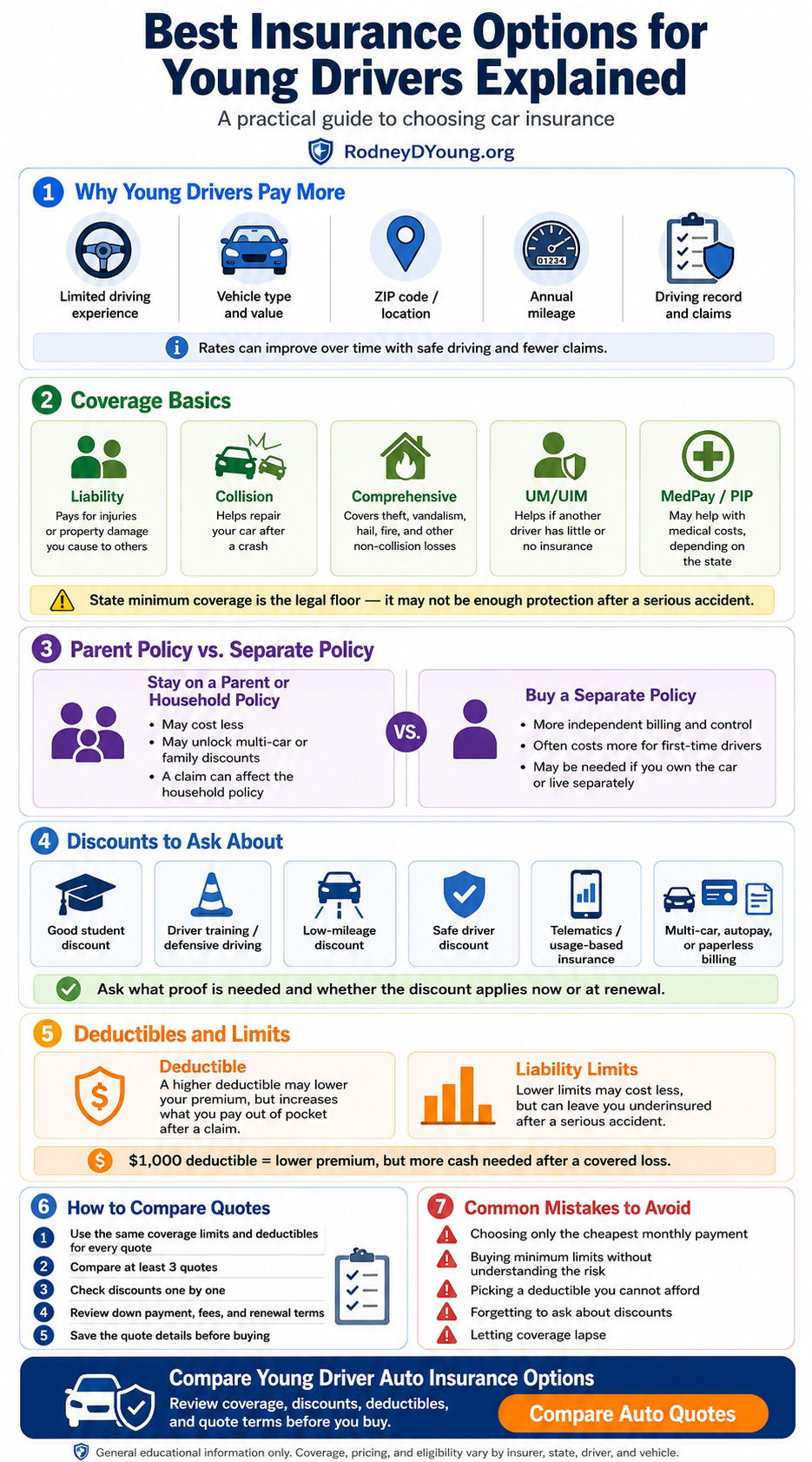
Step 1: Decide Between a Household Policy and an Individual Policy
For many young drivers, the first major decision is whether to join or remain on a parent or household policy. The Insurance Information Institute notes that adding a teenage driver to the family policy is generally less expensive than purchasing a separate policy for the teen, although pricing and eligibility vary by insurer.[3]
A household policy is not automatically correct in every situation. The insurer needs accurate information about vehicle ownership, the primary driver, household members, school location, vehicle use, and the address where the car is normally kept.
| Option | When it may fit | What to verify |
|---|---|---|
| Added to a parent or household policy | The driver lives in the household or regularly uses a family vehicle. | Driver listing, vehicle assignment, garaging address, student status, and applicable household discounts. |
| Separate individual policy | The young driver owns the vehicle, lives independently, or does not qualify for the household policy. | Higher first-policy costs, down payment, billing fees, coverage limits, and proof requirements. |
| Student away from home | The student remains connected to the household but keeps or does not keep a vehicle at school. | School address, vehicle location, annual mileage, occasional-driver status, and student-away discounts. |
Do not choose a household or individual policy only because one quote is cheaper. The vehicle owner, regular driver, garaging address, and household drivers should be disclosed accurately. Incorrect information can change pricing, delay approval, or create policy problems later.
Drivers purchasing their first policy can also review these first-time driver insurance options for a broader explanation of policy setup, coverage categories, discounts, and first-policy preparation.
Step 2: Choose Liability Limits Before Comparing Prices
Liability coverage generally helps pay for covered injuries or property damage a driver causes to others, up to the policy limits. State minimum liability limits may satisfy a legal requirement, but they are not automatically the right financial choice for every household.
Young drivers should compare liability limits before comparing premiums. A quote with lower limits may look cheaper simply because it provides less protection. The driver or household should consider available savings, income, assets, vehicle use, and the potential financial consequences of a serious accident.
- What liability limits does the state require?
- How much more would higher limits cost?
- Could the household manage expenses that exceed the policy limits?
- Does the quote include uninsured or underinsured motorist coverage?
- Are medical payments or personal injury protection required or available?
Step 3: Decide Whether the Vehicle Needs Collision and Comprehensive
Collision and comprehensive coverage protect different risks involving the insured vehicle. Collision may help after a covered crash, while comprehensive may help with covered non-collision losses such as theft, vandalism, hail, fire, falling objects, or animal damage, subject to policy terms and deductibles.
The decision should be based on vehicle ownership, lender requirements, vehicle value, repair cost, premium, deductible, and the driver’s ability to replace the car. The Texas Department of Insurance notes that lenders may require collision and comprehensive when money is still owed on a vehicle.[5] Drivers should verify the exact requirements with their own lender and insurer.
| Vehicle situation | Coverage decision | Questions to ask |
|---|---|---|
| Financed or leased vehicle | Collision and comprehensive may be required. | What coverages and maximum deductibles does the lender require? |
| Newer or higher-value paid-off vehicle | Physical damage coverage may still be valuable. | Could the driver or household repair or replace the vehicle without insurance? |
| Older low-value vehicle | Compare the premium and deductible with the vehicle’s realistic value. | Would the potential claim payment justify the additional premium? |
| Vehicle exposed to theft or weather risk | Comprehensive coverage may deserve additional consideration. | Where is the vehicle parked and how difficult would it be to replace? |
Step 4: Select a Deductible the Driver Could Actually Pay
A deductible is the amount the policyholder pays before certain collision or comprehensive benefits apply. Higher deductibles may reduce the premium, but they also increase the amount needed after a covered loss.
A young driver should not choose a $1,000 or $2,000 deductible only because it produces a lower monthly price. The practical question is whether that amount would be available immediately after an accident, theft, or weather-related loss.
Before selecting a deductible, ask: “Could the driver or household pay this amount tomorrow without missing rent, tuition, loan, or other essential payments?” If not, the premium savings may not justify the higher financial risk.
| Deductible option | Potential effect | Young-driver consideration |
|---|---|---|
| Lower deductible | May produce a higher premium but lower claim-time cost. | May be easier for a student or new worker with limited emergency savings. |
| Higher deductible | May reduce the premium but raises the amount paid after a loss. | Should be supported by actual savings, not an assumption that a claim will never happen. |
Step 5: Review Young-Driver Discounts After Choosing Coverage
Discounts can help lower costs, but they should be compared after deciding on the policy structure, liability limits, physical damage coverage, and deductibles. Otherwise, a discounted policy may still provide weaker coverage than another option.
Potential discounts may include good student, driver education, defensive driving, low mileage, multi-car, paperless billing, autopay, pay-in-full, safe driver, and telematics discounts. Availability and eligibility vary by insurer and state.
- Ask whether the discount is already included in the quote.
- Confirm what documentation is required.
- Ask whether the discount applies immediately or at renewal.
- Check whether the discount can expire.
- Compare the final premium after all fees and payment-plan charges.
For a more detailed list of savings opportunities and eligibility questions, review the guide to car insurance discounts for young drivers.
Should a Young Driver Choose Telematics?
Telematics and usage-based insurance programs may use an app, device, or vehicle system to evaluate mileage or driving behavior. Depending on the program, factors may include braking, acceleration, speed, time of day, mileage, or phone distraction. The Insurance Information Institute explains that telematics can be used to tailor pricing based on driving habits, although programs differ.[4]
These programs may benefit careful or low-mileage young drivers, but the details should be reviewed before enrolling.
| Question | Why it matters |
|---|---|
| What information is collected? | The program may track more than mileage. |
| Can the rate increase? | Some programs may reward safer driving, while others may also respond to riskier patterns. |
| Who is monitored? | Driving by parents, siblings, or other household members may affect results if they use the insured vehicle. |
| How long does monitoring last? | The program may monitor for a limited period or continue throughout the policy. |
| How is mileage verified? | Low-mileage estimates should match the vehicle’s actual use. |
Step 6: Compare Quotes Using the Same Policy Design
A fair comparison requires every quote to use the same driver information, vehicle information, garaging address, coverage limits, deductibles, optional coverages, and effective date. Comparing different policy designs can make a weaker quote appear artificially inexpensive.
- Confirm every licensed household driver who must be disclosed.
- Use the correct VIN, ownership information, vehicle use, and garaging address.
- Select the same liability limits for every quote.
- Use the same collision and comprehensive deductibles.
- Include or exclude the same optional coverages.
- Ask about discounts using the same eligibility information.
- Compare the amount due today, installment fees, monthly payments, and total policy cost.
- Review the effective date, cancellation rules, and renewal terms.
One quote may look cheaper because it has lower liability limits, a higher deductible, fewer optional coverages, a different payment schedule, or more installment fees. Compare the full policy design and total cost.
How Driving History Changes the Decision
Young drivers often begin with limited driving history. NHTSA identifies inexperience, speeding, distraction, and passenger-related risk as important concerns for novice teen drivers.[2] Tickets, at-fault accidents, claims, policy lapses, and inaccurate application information can also affect future options and pricing.
A young driver with a clean record may have better choices over time, but a serious violation can change insurer eligibility, discounts, and premium. This guide explains more about how driving history affects young-driver insurance.
When Low Price Should Not Be the Only Goal
Young-driver premiums can be difficult for students, new workers, and families to manage. Looking for a lower price is reasonable, but cost reductions should be evaluated carefully.
| Lower-cost choice | Potential benefit | Risk to review |
|---|---|---|
| State-minimum liability limits | May reduce the premium. | Limits may be insufficient after a serious accident. |
| Higher deductible | May lower collision or comprehensive premium. | The driver needs more money after a claim. |
| Dropping collision or comprehensive | May reduce the cost for an older paid-off vehicle. | The driver may receive no payment for certain damage to their own car. |
| Household policy | May cost less than a separate policy. | The driver and vehicle still need to qualify and be listed accurately. |
| Telematics | May help careful or low-mileage drivers. | Driving data and program rules may affect the final result. |
Drivers who need additional budget-focused guidance can review affordable car insurance options for young drivers while keeping coverage limits, deductibles, and total policy cost in view.
Final Checklist Before Choosing the Policy
- The correct young driver and household drivers are listed.
- The vehicle owner, primary driver, and garaging address are accurate.
- The liability limits match the intended level of protection.
- Collision and comprehensive are included or excluded intentionally.
- The selected deductibles are affordable after a loss.
- Lender or lease requirements are satisfied.
- Discounts and documentation requirements are confirmed.
- The payment due today, monthly installments, fees, and total cost are clear.
- The effective date and proof-of-insurance timing meet the driver’s needs.
If a young or first-time driver needs coverage to begin quickly, review the guide to same-day car insurance for new drivers before relying on a quote or driving the vehicle.
When to Review the Policy Again
A young driver’s first policy should not be treated as permanent. Review the policy after a clean driving period, at renewal, after moving, after changing vehicles, after completing a driver course, after improving grades, or after a change in household status.
Reviewing the policy every 6 to 12 months can help the driver confirm that the listed information is still accurate, identify new discounts, and compare whether a household or individual policy remains the better option.
Compare Young Driver Auto Insurance Options by ZIP Code
Use your ZIP code to begin reviewing available auto insurance quote paths for young drivers. Compare policy structure, limits, deductibles, discounts, payment terms, and total cost before choosing coverage.
Entering a ZIP code does not guarantee approval, pricing, or availability. Coverage options vary by state, driver, household, insurer, vehicle, and underwriting rules.
Frequently Asked Questions
Should a young driver stay on a parent’s car insurance policy?
A household policy may be less expensive for many teen or young drivers, but the correct choice depends on vehicle ownership, residence, garaging address, school location, primary use, and insurer rules. The driver and vehicle must be listed accurately.
When should a young driver buy an individual policy?
An individual policy may be appropriate when the young driver owns the vehicle, lives independently, no longer qualifies for a household policy, or needs separate billing and policy control. Compare the total cost and coverage carefully.
Does a young driver need collision and comprehensive coverage?
It depends on whether the vehicle is financed or leased, its value, the premium, the deductible, and whether the driver could repair or replace it without insurance. Lenders may require physical damage coverage.
What deductible should a young driver choose?
Choose a deductible the driver or household could realistically pay after a covered loss. A higher deductible may lower the premium, but it should be supported by actual emergency savings.
Are telematics programs good for young drivers?
They may benefit careful or low-mileage drivers, but programs vary. Ask what information is tracked, whether the rate can increase, how long monitoring lasts, and whose driving affects the result.
What discounts should young drivers ask about?
Potential discounts may include good student, driver training, defensive driving, low mileage, telematics, multi-car, autopay, paperless billing, pay-in-full, and safe-driver discounts. Eligibility varies.
Is the cheapest young-driver policy usually the best choice?
No. A cheaper quote may have lower liability limits, higher deductibles, fewer coverages, or additional fees. Compare the same policy design and total cost across quotes.
How often should a young driver compare insurance?
Review the policy at least annually and after changes such as moving, buying a vehicle, completing a course, improving grades, building a clean record, or leaving a household policy.
Conclusion
Choosing car insurance for a young driver requires more than finding the lowest monthly payment. Start with vehicle ownership, household status, primary use, and garaging address. Then choose liability limits, decide whether collision and comprehensive make sense, select an affordable deductible, and verify available discounts.
The strongest comparison uses the same drivers, vehicle, limits, deductibles, optional coverages, and payment assumptions across every quote. A policy that accurately reflects the driver’s situation and provides manageable protection can be more valuable than a cheaper quote built around unclear information or weak coverage.
References
- National Association of Insurance Commissioners. Consumer Shopping Tool for Auto Insurance. ↩
- National Highway Traffic Safety Administration. Teen Driving. ↩
- Insurance Information Institute. Students and Teen Driver Insurance. ↩
- Insurance Information Institute. Pay-As-You-Drive Auto Insurance and Telematics. ↩
- Texas Department of Insurance. Auto Insurance Guide. ↩