
Car insurance discounts for young drivers can help reduce the cost of coverage, but they are not automatic and they do not work the same way at every company. A young driver may qualify for savings based on school performance, driver education, telematics participation, a clean record, multi-car household coverage, low mileage, student-away status, safety equipment, or payment preferences.
This page is the dedicated discounts guide for young drivers. It focuses on eligibility, proof, questions to ask, and common mistakes. If you need the broader young-driver coverage overview, start with cheap car insurance for young drivers. If you are focused on price trends and premium comparison, review the separate guide to young-driver car insurance rates.
Quick Summary
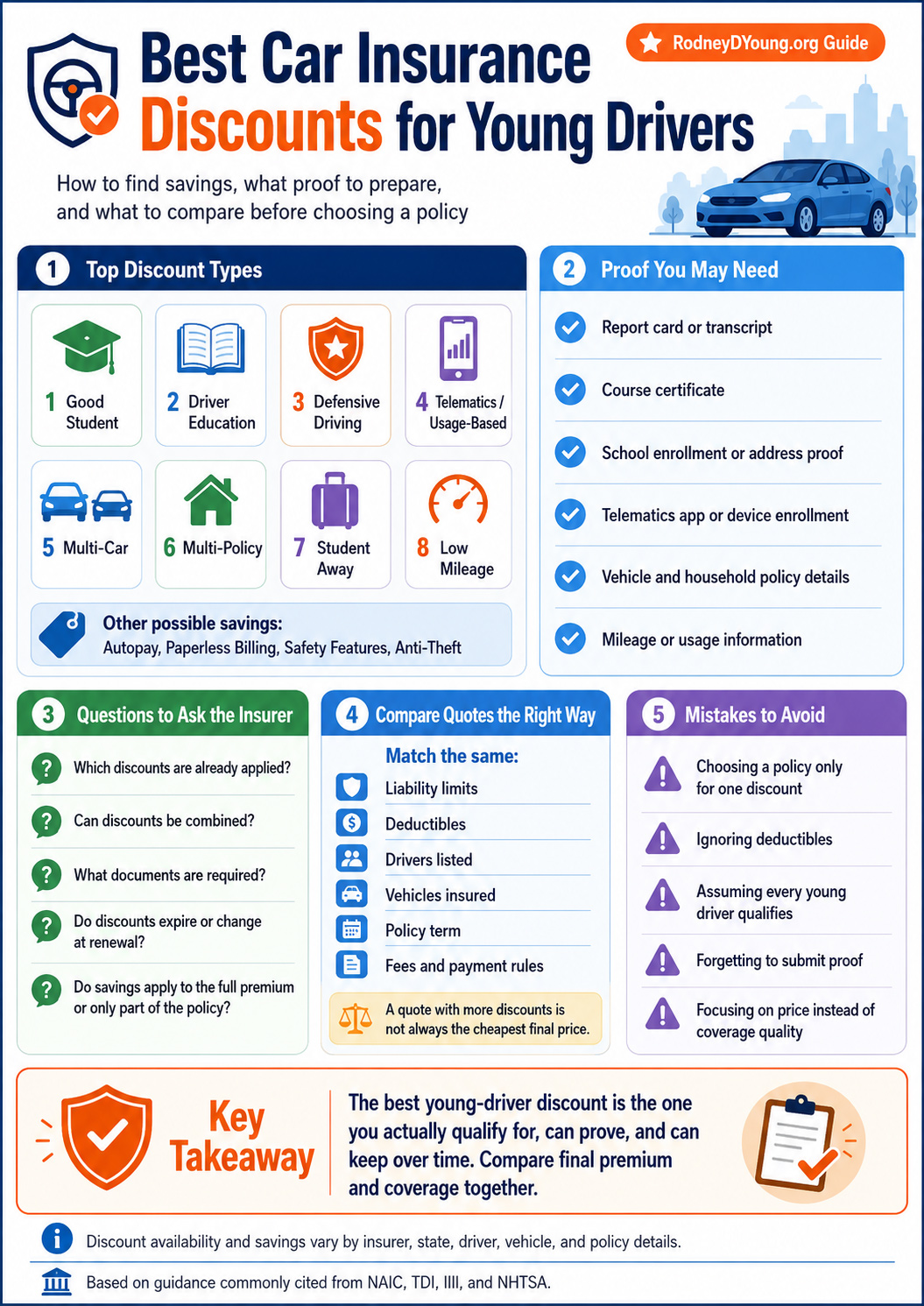
- Young drivers may qualify for good student, driver education, defensive-driving, telematics, multi-car, multi-policy, student-away, low-mileage, safety-feature, autopay, or paperless billing discounts.
- NAIC lists several savings categories that may apply to younger drivers, including driver education courses, good student drivers under age 25, two or more cars on a policy, safety equipment, anti-theft devices, and auto/home combinations.[1]
- Do not rely on fixed percentage claims. Discount amounts vary by insurer, state, driver, vehicle, coverage, and policy terms.
- Ask which discounts are already included in the quote and which require documents such as a transcript, report card, course certificate, school address, or telematics enrollment.
- Discounts can reduce cost, but they should not be used as a reason to choose weak liability limits, unaffordable deductibles, or missing coverage.
What Counts as a Young Driver Discount?
A young driver discount is any insurer-approved savings category that may lower the cost of insuring a teen, student, first-time driver, or young adult driver. Some discounts are built around behavior, such as safe driving or telematics. Others are based on household structure, such as multi-car coverage. Some are based on documentation, such as good grades or course completion.
The important point is that a discount is different from a lower quote. A low quote may come from weaker coverage, a higher deductible, fewer listed drivers, missing optional coverage, or a different rating method. A true discount should be clearly identified by the insurer and applied according to that company’s rules. For the broader discount framework, review auto insurance discounts.
Important discount note
Do not assume a discount applies just because another company, another state, or another driver received it. TDI notes that companies do not always offer the same discounts, and it recommends asking the company to confirm the discounts you qualify for.[2]
Common Car Insurance Discounts for Young Drivers
The discounts below are common categories to ask about. They are not guaranteed. Some may apply only to certain ages, student statuses, vehicles, policy types, or states. Some may apply only to part of the premium, not the entire policy.
| Discount type | Who may qualify | Proof or action to ask about | Important caution |
|---|---|---|---|
| Good student discount | A young driver or student who meets the insurer’s academic rules. | Report card, transcript, dean’s list proof, GPA proof, or school verification. | Age, full-time student status, grade threshold, and renewal proof can vary. |
| Driver education discount | A young driver who completes an approved driver education or training course. | Course certificate or provider verification. | Not every course qualifies, and rules may differ by state and insurer. |
| Defensive-driving discount | A driver who completes an approved defensive-driving or driver-improvement course. | Certificate of completion and insurer approval. | Some programs target specific age groups or exclude court-ordered courses. |
| Telematics or usage-based discount | A driver who enrolls in an app, device, or mileage-based program. | App enrollment, device installation, mileage reporting, or driving-data review. | Ask what is tracked and whether driving behavior can raise or lower the premium. |
| Multi-car discount | A household with more than one insured vehicle on the same policy or account. | Vehicle list, household driver information, and policy setup. | Eligibility may depend on ownership, residence, and how the young driver is listed. |
| Multi-policy discount | A household that combines auto with renters, condo, homeowners, or another policy. | Active related policy with the same company or affiliated company. | Bundling should lower total cost, not just shift cost between policies. |
| Student away at school discount | A student who lives away from home and does not regularly use the insured vehicle. | School address, distance from home, enrollment proof, and vehicle access details. | Distance, age, and vehicle-access rules vary by insurer. |
| Low-mileage discount | A young driver who drives less than the insurer’s mileage threshold. | Odometer reading, annual mileage estimate, or telematics verification. | Mileage changes may affect eligibility at renewal. |
| Safety or anti-theft discount | A vehicle with qualifying safety features, airbags, alarm systems, or anti-theft technology. | Vehicle VIN, feature list, or anti-theft documentation. | Discounts may apply only to specific coverage parts. |
| Autopay or paperless billing discount | A policyholder who uses automatic payments or electronic documents. | Electronic payment setup or paperless billing enrollment. | Missed payments can still cause fees, cancellation, or reinstatement issues. |
Good Student Discounts: What to Ask For
A good student discount is one of the most common young-driver savings categories. NAIC includes “good student driver under age 25” among possible auto insurance savings categories.[1] III also notes that driver education and good student discounts can help offset the cost of insuring teenage drivers.[3]
Good student proof checklist
- Ask what grade average, GPA, class rank, or honor-roll status qualifies.
- Ask whether the student must be full-time.
- Ask whether high school, college, online school, or homeschool students qualify.
- Ask what document is accepted: report card, transcript, dean’s list, school letter, or online portal printout.
- Ask how often proof must be resubmitted.
- Ask whether the discount expires at a specific age or graduation status.
Do not publish or send more student information than the insurer requests. A transcript or report card may contain personal details. Ask whether a limited proof document is acceptable.
Driver Education and Defensive-Driving Discounts
Driver education and defensive-driving discounts reward formal training. NAIC includes participation in driver education courses as a possible auto insurance savings category.[1] These programs can be especially relevant for new drivers, but qualification depends on whether the insurer and state recognize the course.
Usually connected to new-driver training, classroom instruction, behind-the-wheel training, or state-approved licensing education.
Usually focused on improving driving habits, hazard awareness, traffic-law review, and safer decision-making after licensing.
Questions before paying for a course
- Is this course approved for a discount by my insurer?
- Is it approved in my state?
- Does it apply to young drivers, all drivers, or only certain age groups?
- How long does the discount last?
- Can I retake the course later to keep the discount?
- Will the course still qualify if it was court-ordered?
- What certificate or proof do I need to submit?
Telematics and Usage-Based Insurance Discounts
Telematics or usage-based insurance can be useful for some young drivers because the program may consider actual driving behavior or mileage. TDI explains that usage-based insurance may use an app or device to track driving habits and may consider things such as miles driven, time of day, braking, speed, and phone use, depending on the program.[4]
Telematics questions to ask
- What driving behavior is tracked?
- Does the program track mileage, braking, acceleration, speed, phone use, location, or time of day?
- Can participation increase the premium, or only reduce it?
- How long is the monitoring period?
- Who can see the driving data?
- Can the driver leave the program later?
- Does the discount apply immediately or at renewal?
A telematics program can be a good fit for a careful driver with consistent habits, but it is not automatically the best choice for every young driver. Review privacy, data use, and pricing rules before enrolling.
Multi-Car, Multi-Policy, and Student-Away Discounts
Household structure can affect young-driver discounts. III notes that it is generally less expensive for parents to add teenagers to an existing auto policy than for teens to buy a policy on their own, and that insuring a teenager’s car with the same insurer may qualify the household for a multi-vehicle discount.[5]
| Discount | Best-fit situation | What to verify |
|---|---|---|
| Multi-car | Households with more than one insured vehicle. | Whether the young driver must be listed on a specific vehicle or household policy. |
| Multi-policy | Households with auto plus renters, condo, homeowners, or another eligible policy. | Whether the combined price is actually lower than separate policies. |
| Student away at school | A student who lives away from home and does not regularly use the insured vehicle. | School distance, age limit, vehicle access, and proof of enrollment. |
| Occasional driver setup | A young driver who uses the vehicle only occasionally. | How the insurer defines occasional use and whether the driver must still be listed. |
For broader coverage choices such as whether a young driver should stay on a family policy or buy a separate policy, compare the full young-driver coverage picture before deciding which discounts matter most.
How to Compare Discounts Across Quotes
Young drivers should compare discounts across quotes carefully. A quote with many discounts is not always cheaper than a quote with fewer discounts. One insurer may start with a higher base premium and then apply more discounts, while another may start with a lower base premium and apply fewer visible discounts.
Discount comparison checklist
- Ask for the total six-month or twelve-month premium after discounts.
- Ask which discounts are included in the quote.
- Ask which discounts require proof before the policy starts.
- Ask which discounts can disappear at renewal.
- Ask whether discounts apply to the whole policy or only certain coverage parts.
- Ask whether discounts can be combined.
- Ask whether a missed payment, lapse, address change, mileage change, grade change, or vehicle change affects eligibility.
- Compare the same liability limits, deductibles, vehicles, drivers, and policy term before deciding.
For pricing-focused comparisons, use the separate guide to best car insurance rates for young drivers. This discounts page should support that rates page, not duplicate it.
Discounts Should Not Replace Coverage Quality
Discounts can lower the cost of insurance, but they should not push a young driver into weak coverage. A policy with a good discount may still have low liability limits, a deductible that is too high, missing collision or comprehensive coverage, or no rental reimbursement if the driver needs transportation for school or work.
Mistakes to avoid
- Choosing a policy only because it advertises a student discount.
- Comparing discounted prices without matching coverage limits.
- Ignoring deductibles after focusing only on the monthly premium.
- Assuming all young drivers qualify for the same discounts.
- Forgetting to submit required proof before the deadline.
- Not asking whether discounts renew automatically.
- Assuming telematics will always lower the price.
- Canceling old insurance before the new policy is active.
If a young driver qualifies for a safe-driver, telematics, or accident-free discount, compare the renewal rules carefully. This guide on how to maintain a safe driver discount explains why driving record, claims, violations, household drivers, and renewal reviews can affect whether the savings continue.
Why Young Driver Discounts Matter
Young drivers often cost more to insure because insurers consider experience and crash risk. NHTSA reports that drivers ages 16 to 19 were involved in more fatal crashes per 100 million travel miles than several older age groups.[6] Discounts do not erase that risk, but they can reward steps that may help demonstrate responsibility, training, lower mileage, safer habits, or household policy stability.
The practical goal is not to collect every possible discount. The goal is to find a policy that applies the discounts the young driver actually qualifies for while still keeping coverage limits, deductibles, and policy terms realistic.
FAQ
What are the best car insurance discounts for young drivers?
Common young-driver discounts include good student, driver education, defensive driving, telematics, multi-car, multi-policy, student-away, low-mileage, autopay, paperless billing, safety-feature, and anti-theft discounts. Availability varies by insurer and state.
What proof is needed for a good student discount?
Insurers may ask for a report card, transcript, dean’s list proof, GPA verification, school letter, or other academic document. Ask what proof is accepted and how often it must be updated.
Can young drivers combine discounts?
Sometimes. An insurer may allow a young driver to combine good student, multi-car, telematics, autopay, or other discounts, but stacking rules vary. Ask whether each discount applies to the full premium or only specific coverage parts.
Do defensive-driving courses always lower insurance?
No. The course usually must be approved by the insurer and may also need to meet state requirements. Ask before paying for a course if your main goal is an insurance discount.
Is telematics good for young drivers?
Telematics can help some careful young drivers, but it depends on how the program scores driving behavior. Ask what data is collected and whether participation can increase or decrease the premium.
What is a student-away discount?
A student-away discount may apply when a student lives away from home and does not regularly use the insured vehicle. Insurer rules can include age limits, distance requirements, enrollment proof, and vehicle-access restrictions.
Are young-driver discounts automatic?
Not always. Some may be included in the quote, while others require proof, enrollment, or a request. Ask the insurer to list every discount currently applied to the quote.
Should I choose the policy with the biggest discount?
Not automatically. A large discount does not always mean the best final price or best coverage. Compare the total premium, liability limits, deductibles, coverage types, fees, and cancellation rules.
Conclusion
Best car insurance discounts for young drivers usually come from a mix of school performance, training, safe driving, household policy structure, mileage, telematics, vehicle safety features, and payment preferences. The most useful discounts are the ones the young driver can actually qualify for, prove, and keep over time.
Before choosing a policy, ask the insurer to confirm which discounts are included, which documents are needed, whether discounts can be combined, and whether they can change at renewal. Then compare the final premium against the same coverage limits, deductibles, drivers, vehicles, and policy terms. A discount is helpful only when it supports a policy that still provides appropriate protection.
Compare Young Driver Discounts and Coverage
Use your ZIP code to begin comparing auto insurance quote paths. Review discounts, coverage limits, deductibles, payment terms, and proof requirements before deciding which policy is the best fit.
References
- National Association of Insurance Commissioners, “Protect Yourself: Insuring a Teen Driver.” ↩ ↩ ↩
- Texas Department of Insurance, “Ask for Discounts to Lower Your Auto Insurance Premium Amount.” ↩
- Insurance Information Institute, “Students.” ↩
- Texas Department of Insurance, “How You Drive Could Save You Money on Car Insurance.” ↩
- Insurance Information Institute, “Auto Insurance for Teen Drivers.” ↩
- National Highway Traffic Safety Administration, “Young Drivers.” ↩