
Article Information
Updated: June 30, 2026
Editorial details
The RodneyDYoung.org Editorial Team creates informational content focused on auto insurance coverage, quote comparison, policy terms, discounts, payment options, and common shopping questions for U.S. drivers.
This guide has been updated to remove unverifiable claims, clarify the difference between a quote resource, agency, carrier, and policy issuer, and help readers evaluate Rodney D. Young-related insurance options more carefully.
This content is for general informational purposes only and does not constitute insurance, legal, or financial advice. Coverage availability, pricing, discounts, payment plans, claims handling, and policy terms vary by insurer, state, driver profile, vehicle, and underwriting rules. RodneyDYoung.org is an independent insurance information and quote-comparison resource.
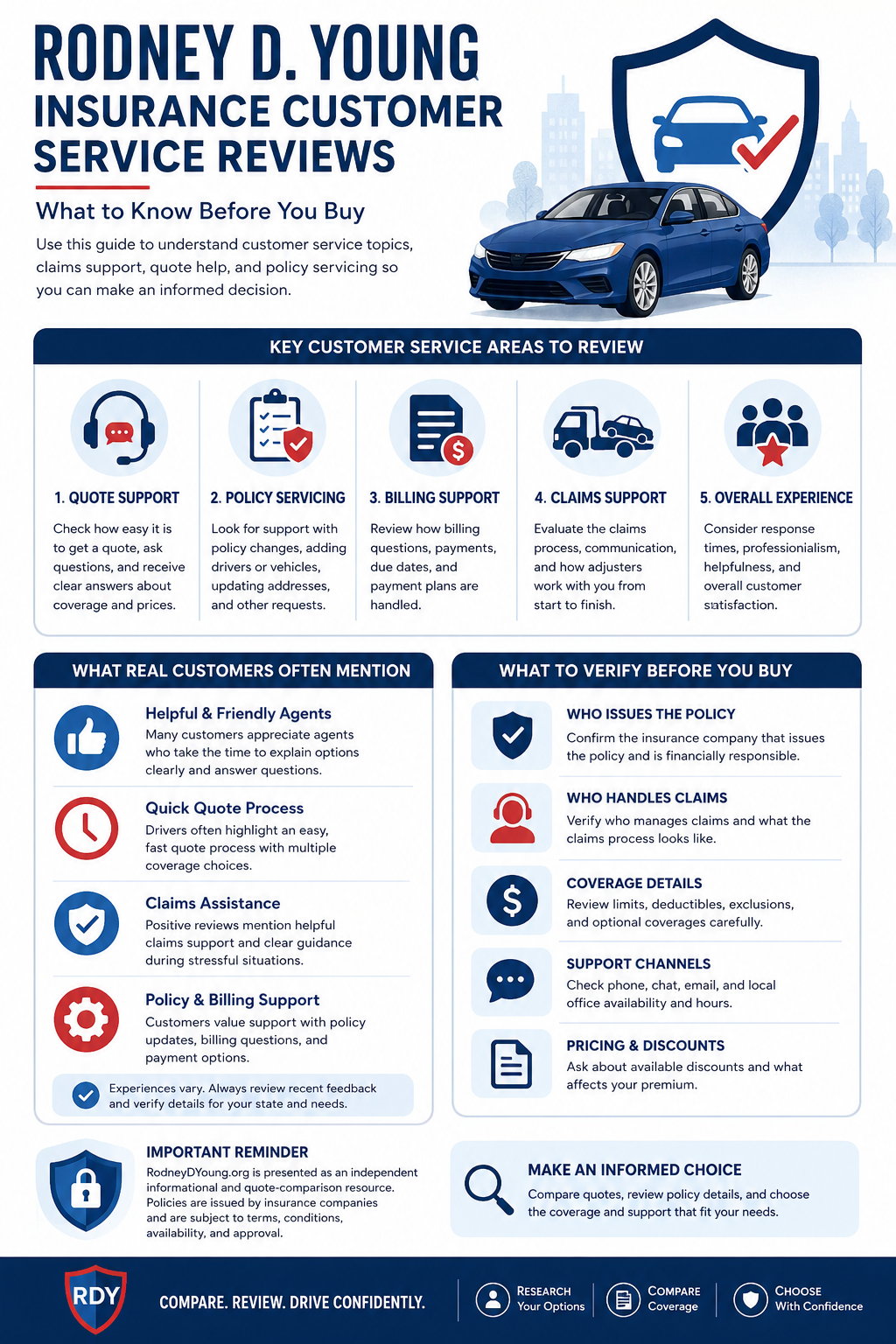
Rodney D. Young insurance customer service reviews can help drivers understand what to check before choosing a policy, filing a claim, requesting quote support, or comparing coverage options. Before relying on any review or quote path, confirm who issues the policy, who handles claims, how billing works, what support channels are available, and what the final price actually includes.
This review-style guide does not assume that every coverage, discount, or service is available to every driver. Instead, it explains what to compare before you buy: coverage types, limits, deductibles, payment terms, discounts, claims support, policy documents, and the actual carrier named on the policy.
Quick takeaway
Do not choose auto insurance based only on a familiar name or a low advertised price. Compare the actual carrier, coverage limits, deductibles, exclusions, payment schedule, cancellation terms, claims process, and proof of insurance before buying.
What is Rodney D. Young insurance?
People may use “Rodney D. Young insurance” to describe different things: a brand search, a local insurance agency search, a quote-comparison path, or informational content about auto insurance. Those are not always the same thing. A website can provide information or route quote requests, while the actual policy may be issued by a separate insurance company.
Because of that, drivers should verify the exact legal name of the company or agency involved, the carrier that would issue the policy, and the coverage terms shown in the documents. The National Association of Insurance Commissioners recommends comparing coverage details carefully when shopping for auto insurance so consumers understand what they are buying [1].
For a broader overview of the topic, you can review Rodney D. Young car insurance resources and then compare those pages against the actual quote or policy documents you receive.
Important verification note
Before buying, confirm whether you are dealing with an insurer, an agency, a broker, a lead-generation quote path, or an informational website. The company listed on the policy documents is the entity responsible for the insurance contract.
Is RodneyDYoung.org an insurer, agency, or quote resource?
RodneyDYoung.org is presented as an independent informational and quote-comparison resource. That means readers should not assume that RodneyDYoung.org itself underwrites policies, adjusts claims, guarantees discounts, or sets final rates. Those functions usually depend on the insurer, agency, or participating provider involved in the quote path.
When comparing any insurance option, ask these basic questions before submitting payment:
Questions to verify before buying
- What is the legal name of the insurer or carrier?
- Is there an agency or broker involved?
- Who handles billing and policy changes?
- Who handles claims?
- What coverage limits and deductibles are included?
- What fees, installment charges, or cancellation terms apply?
- When does coverage begin?
- How do you access proof of insurance?
Coverage types to compare
Auto insurance coverage can include several parts. The exact options available depend on the insurer, state, vehicle, policy type, and underwriting rules. The Insurance Information Institute explains that auto insurance pricing can be affected by coverage choices, deductibles, vehicle use, driving record, location, and other rating factors [2].
If you are comparing policies, avoid looking only at the monthly payment. A lower premium may reflect lower limits, fewer coverages, a higher deductible, or a different payment plan. A helpful next step is to review the key features of auto insurance policies so you can compare policy features more clearly.
| Coverage type | What it may help with | What to verify |
|---|---|---|
| Liability coverage | May help pay for injuries or property damage you cause to others, up to policy limits. | Check your state minimums and whether higher limits are appropriate. |
| Collision coverage | May help repair or replace your car after a covered collision, subject to deductible and terms. | Confirm whether it is included, optional, or required by a lender. |
| Comprehensive coverage | May help with covered non-collision losses such as theft, vandalism, hail, fire, or animal damage. | Review the deductible and covered-loss terms. |
| Uninsured or underinsured motorist coverage | May help when another driver has no insurance or not enough insurance, depending on state and policy terms. | Ask whether it is required, optional, offered, or rejectable in your state. |
| Roadside or rental options | May help with breakdowns or temporary transportation after a covered claim. | Check whether it is included or costs extra. |
Minimum requirements vary by state
Auto insurance requirements are state-specific. A Texas driver may need to review Texas liability rules, while a driver in another state should check their own state insurance department or policy documents. The Texas Department of Insurance explains that Texas requires minimum liability coverage of $30,000 for injuries per person, $60,000 per accident, and $25,000 for property damage [3].
Minimum coverage may satisfy legal requirements, but it may not be enough after a serious accident. Drivers should compare the cost difference between state minimums and higher liability limits before choosing only the lowest required coverage.
Minimum coverage reminder
A state-minimum policy can be cheaper, but it may leave you with higher out-of-pocket risk. Compare limits and coverage types before choosing the lowest price.
Discounts to ask about
Discounts can help reduce premiums, but they are not guaranteed and they vary by insurer. Instead of assuming a specific Rodney D. Young-related quote includes a discount, ask the carrier or provider which discounts were actually applied and what proof is required.
The NAIC recommends asking about discounts when shopping for auto insurance, but also comparing coverage and deductibles carefully before making a decision [4]. Some discounts may change at renewal, require documentation, or depend on the driver’s age, vehicle, household, or state.
Discount categories to ask about
- Safe driver or claims-free discounts.
- Multi-car or multi-policy discounts.
- Good student discounts where available.
- Low-mileage or usage-based programs.
- Anti-theft or safety-feature discounts.
- Paperless billing or automatic payment discounts.
For shoppers comparing pricing factors, payment terms, and coverage decisions, the Rodney D. Young auto insurance guide can be a useful related resource before reviewing the final quote documents.
Quote estimate vs. final policy
A quote is not the same as a final policy. A quote is an estimate based on the information entered. The final price may change if the insurer verifies different driver details, vehicle information, claims history, garaging address, coverage choices, or eligibility factors.
Coverage also is not active just because a quote appears on the screen. The policy should show a confirmed carrier, policy number, effective date, effective time, payment status, and proof of insurance. If speed matters, review instant car insurance quote options and confirm what must happen before coverage becomes active.
Quote warning
Do not drive or cancel another policy based only on a quote. Confirm the policy is active and save proof of insurance before relying on the coverage.
Who may be a good fit?
Rodney D. Young-related resources may be useful for drivers who want to compare auto insurance information, understand coverage basics, or start a quote path. The right fit depends on the actual policy, provider, state, vehicle, driver profile, and budget.
May be worth comparing if you…
- Want to compare budget-focused auto insurance options.
- Need a plain-language explanation of coverage types.
- Are comparing Texas or Dallas auto insurance topics.
- Want to review quote timing, payment terms, and proof of insurance.
- Prefer checking multiple quote paths before choosing.
May require extra review if you…
- Need a specific national carrier and do not want alternatives.
- Want fully online policy servicing from one direct insurer.
- Need specialty coverage, business use, rideshare coverage, or non-standard filings.
- Have a financed or leased vehicle with lender requirements.
- Need to verify licensing, claim handling, or policy servicing before buying.
Potential limitations to consider
A review should include both strengths and limitations. The main limitation with any quote path or insurance resource is that the reader may not know the final carrier, exact coverage, fees, exclusions, or discount eligibility until the quote and policy documents are reviewed.
Possible limitations
- Availability may vary by state or ZIP code.
- Not every discount applies to every driver.
- Quote estimates may change after underwriting review.
- Claims may be handled by the carrier listed on the policy, not by the website where the quote started.
- Payment terms, fees, and cancellation rules can vary.
- Some coverage options may require additional review or documentation.
What to verify before buying
Before buying any policy, verify the details in writing. This is especially important if you are comparing options quickly or switching from another insurer.
| What to verify | Why it matters | Where to check |
|---|---|---|
| Carrier name | The carrier usually issues the policy and handles policy obligations. | Quote summary and policy declarations page. |
| Coverage limits | Limits determine the maximum amount the policy may pay for covered losses. | Declarations page and coverage schedule. |
| Deductibles | Deductibles affect premium and out-of-pocket cost after a claim. | Collision and comprehensive sections. |
| Exclusions | Exclusions describe what is not covered. | Policy contract and endorsements. |
| Payment schedule | A low first payment may not mean the lowest total cost. | Billing page, installment agreement, and payment plan. |
| Cancellation terms | Rules vary by insurer and state. | Policy documents or insurer support. |
| Claims contact | You need to know who to contact after a loss. | ID card, app, policy packet, or carrier website. |
Claims and customer service checklist
Before choosing a policy, confirm how claims are filed and who handles them. A quote website may help you start the shopping process, but the carrier or servicing agency listed on your documents may be the party responsible for claims, billing, and policy changes.
For related claim-documentation basics, review our stress-free auto claims guide and compare that information with the actual instructions from the carrier named on your policy.
Before you buy, ask…
- How do I file a claim?
- Is there a 24/7 claims phone number?
- Can I access digital ID cards?
- Who handles billing questions?
- How do I make policy changes?
- What documents should I keep after buying?
How to compare Rodney D. Young-related options with other quotes
When comparing options, use the same driver details, vehicle, ZIP code, limits, deductibles, and effective date across each quote. The Insurance Information Institute notes that auto insurance costs can vary based on several factors, so comparing consistent details helps make the review more useful [2].
Drivers who want a broader comparison can use a resource such as compare auto insurance policy key features to organize limits, deductibles, coverage options, and policy terms before deciding.
Comparison rule
A lower quote is not automatically better. It may be lower because it has less coverage, higher deductibles, fewer listed drivers, a different vehicle use category, or a different payment structure.
Mistakes to avoid
Most mistakes happen when drivers rely on marketing language instead of reading the quote and policy documents. Take time to verify details before paying or canceling another policy.
Do not make these mistakes
- Do not assume a website name is the same as the company issuing the policy.
- Do not assume every listed discount is available to you.
- Do not compare a state-minimum quote against a higher-limit policy.
- Do not ignore deductibles, fees, exclusions, or cancellation terms.
- Do not rely on a quote as proof of insurance.
- Do not omit household drivers or regular vehicle use.
- Do not choose the lowest price without checking claims and support information.
- Do not use unverifiable testimonials or savings claims as the main reason to buy.
FAQ about Rodney D. Young insurance reviews
Is RodneyDYoung.org an insurance company?
RodneyDYoung.org is presented as an independent insurance information and quote-comparison resource. Before buying any policy, verify the carrier, agency, or provider shown on the quote and policy documents.
What should I compare before choosing coverage?
Compare carrier name, coverage limits, deductibles, exclusions, fees, payment schedule, cancellation terms, claims contact, and policy effective date.
Does Rodney D. Young offer discounts?
Discount availability should be verified on the actual quote. Participating insurers may offer discounts, but eligibility depends on the carrier, state, driver profile, vehicle, and documentation.
Can high-risk drivers compare options?
High-risk drivers may still be able to compare options, but pricing, eligibility, down payment, and available coverage can vary. Drivers with serious violations, lapses, or special filing needs should confirm requirements before buying.
What coverage types should I review?
Review liability, collision, comprehensive, uninsured or underinsured motorist coverage where available, roadside assistance, rental reimbursement, deductibles, and any endorsements.
How do I request a quote?
You can start by entering your ZIP code through an available quote path, but you should review the actual carrier, policy limits, deductible, payment terms, and effective date before buying.
Are online quotes final prices?
No. Online quotes can change after the insurer verifies driver, vehicle, location, coverage, claims, and eligibility information.
What should I check before buying a policy?
Check the carrier name, policy number, effective date and time, payment confirmation, coverage limits, deductibles, exclusions, and proof of insurance.
Final thoughts on reviewing Rodney D. Young insurance options
Rodney D. Young-related insurance resources can be useful for drivers who want to compare auto insurance information and quote options, but a careful review should focus on the actual policy details. The name on a page is less important than the carrier, coverage limits, deductibles, exclusions, payment terms, claims process, and proof of insurance.
Before choosing any auto insurance policy, compare coverage side by side, confirm who issues the policy, ask which discounts actually apply, and review the final documents before relying on coverage.
Start with your ZIP code
Enter your ZIP code to begin comparing available auto insurance quote options from participating providers.
References
- National Association of Insurance Commissioners — A Shopping Tool for Auto Insurance ↩
- Insurance Information Institute — What Determines the Price of an Auto Insurance Policy? ↩
- Texas Department of Insurance — Auto Insurance Guide ↩
- National Association of Insurance Commissioners — Tips for Saving on Your Auto Insurance ↩