
The best car insurance rate for a young driver is not simply the lowest number on a quote screen. It is the best priced option after comparing the same drivers, vehicle, ZIP code, coverage limits, deductibles, payment terms, and discounts.
This guide focuses on young-driver rates and pricing strategy: how to compare quotes today, which rate factors matter, and how to avoid choosing a low price that weakens your coverage. For a broader explanation of coverage choices, parent policy decisions, deductibles, and general young-driver insurance options, review the young driver car insurance guide. This page stays focused on how young drivers can compare rates today without weakening coverage by mistake.
What “Best Rates” Really Means for Young Drivers
A young driver’s best rate is the lowest reliable price for the coverage level that actually fits the driver’s situation. A quote can look cheaper because it has lower liability limits, higher deductibles, fewer optional coverages, a larger down payment, or discounts that may not continue at renewal.
NAIC lists common auto insurance rating factors such as location, age, gender where allowed, marital status, driving experience, driving record, claims history, credit history where allowed, previous insurance coverage, vehicle type, vehicle use, miles driven, selected coverages, and deductibles.[1] For young drivers, that means the rate is not based on age alone. The vehicle, coverage choices, household policy setup, and driving habits can all matter.
Rate comparison rule
Do not compare a minimum-liability quote against a stronger policy and call it a better rate. First match the coverage limits, deductibles, drivers, vehicles, garaging ZIP code, and payment assumptions. Then compare price.
Rate Factors Young Drivers Can and Cannot Control
Young drivers usually pay more because limited experience and higher crash exposure can increase expected risk. Insurance Information Institute explains that insurers generally charge more when teenagers or young adults below age 25 drive a car, although age rating rules vary by state.[2]
Drivers buying coverage for the first time should also review first-time driver insurance options, because a new insurance history can affect quote comparison, payment terms, discount eligibility, and coverage decisions.
| Rate factor | Can a young driver control it? | Pricing strategy |
|---|---|---|
| Age and driving experience | Not immediately | Build a clean record and re-shop after renewals or major birthdays. |
| Driving record | Yes, over time | Avoid speeding, distracted driving, claims, and coverage lapses. |
| Vehicle choice | Often yes | Compare insurance costs before choosing a sporty, luxury, high-repair-cost, or high-theft vehicle. |
| Annual mileage | Sometimes | Ask about low-mileage or usage-based programs if you drive less than average. |
| Coverage limits | Yes, within legal and lender rules | Do not lower limits only to make the monthly payment look cheaper. |
| Deductible | Yes, if allowed | Choose a deductible you could realistically pay after a covered claim. |
| Discount documentation | Often yes | Ask what proof is needed for good student, driver training, low mileage, or telematics discounts. |
Why Young Driver Rate Tables Can Be Misleading
Average rate tables can be useful as broad context, but they should not be treated as a personal quote. A “young driver average” may combine different states, ages, coverage levels, vehicles, deductibles, family-policy setups, and driving records. That makes it risky to publish one monthly number as if it applies to every young driver.
Instead of relying on generic averages, young drivers should compare personalized quotes using the same coverage assumptions. A quote for a 17-year-old on a family policy in one ZIP code is not the same as a quote for a 22-year-old with a separate policy, different vehicle, and different coverage limits.
Better than an average rate
Use averages only as rough background. Your real rate depends on your own driver profile, vehicle, location, coverage choices, deductibles, payment terms, discounts, and insurer rules.
Best Rate Strategy by Young Driver Profile
The best pricing strategy depends on the driver’s situation. A teen driver, college student, first-time policyholder, low-mileage driver, and young driver with an accident history should not all shop the same way.
| Young driver profile | Rate strategy | What to avoid |
|---|---|---|
| Teen driver using a family vehicle | Compare being added to a household policy, multi-car discounts, good student discounts, and driver training options. | Leaving the teen driver off the policy if they regularly drive. |
| College student away from home | Ask whether garaging address, school location, low mileage, good student status, or student-away rules affect the quote. | Assuming the home ZIP code still applies if the car is kept elsewhere. |
| First-time policyholder | Compare several insurers because no prior insurance history may affect pricing differently. | Choosing only the smallest down payment without checking total cost. |
| Low-mileage young driver | Ask about low-mileage discounts, telematics, or pay-as-you-drive options where available. | Enrolling in a driving-monitoring program without understanding what is tracked. |
| Young driver with a ticket or accident | Compare quotes after the insurer rates the incident and ask how long it may affect pricing. | Hiding violations or claims to get a lower quote. |
| Young driver buying a financed car | Compare rates with lender-required collision and comprehensive coverage included. | Comparing liability-only quotes that would not satisfy lender requirements. |
Discounts That Can Affect Young Driver Rates
Discounts can lower the quoted rate, but they are not guaranteed and may require proof. Young drivers should ask each insurer which discounts are included, which require documentation, and whether the discount can change at renewal.
Common young-driver rate opportunities may include good student discounts, driver education or defensive driving discounts, low-mileage discounts, telematics or usage-based programs, multi-car discounts, paperless billing, autopay, and staying on an eligible household policy. For a detailed discount-focused breakdown, review young driver car insurance discounts before choosing a policy based only on the lowest monthly price.
Discount questions to ask before buying
- Does the good student discount require a GPA, transcript, or report card?
- Does a driver training or defensive driving course qualify in my state?
- Does telematics only reduce rates, or can risky driving increase the rate?
- Does low mileage need verification?
- Are paperless billing, autopay, or pay-in-full discounts available?
- Will the discount apply immediately or at renewal?
How Telematics Can Change Young Driver Rates
Telematics, usage-based insurance, or pay-as-you-drive programs may use driving data to help price a policy. Insurance Information Institute explains that telematics can allow insurers to adjust rates based on driving habits, though specific programs and measured behaviors vary by company.[3]
This can help careful young drivers who drive less, avoid hard braking, limit late-night driving, and maintain safer habits. But young drivers should ask what is tracked, whether the rate can increase, how long monitoring lasts, whether all household drivers are included, and how privacy is handled.
Young drivers who do not drive often should also compare low-mileage car insurance discounts, especially if they mainly drive to school, work, or local errands.
Telematics can be useful, but read the rules
A driving app may reward safer behavior, but the details matter. Do not enroll only because it says “discount.” Ask what happens if the driving data is worse than expected.
Driving Behavior and Future Rates
Young driver rates can improve over time when the driver builds a clean history. Safety matters for more than pricing. NHTSA teen-driving guidance highlights risk factors for novice teen drivers, including inexperience, speeding, distracted driving, and passenger-related risk.[4]
For rate purposes, safe driving matters because tickets, at-fault crashes, claims, and lapses can make future quotes more expensive or limit options. For a deeper explanation, review how driving history affects young drivers insurance before choosing coverage based only on the current monthly price.
Rate improvement habits
- Avoid speeding and distracted driving.
- Keep continuous insurance when a vehicle needs coverage.
- Review quotes after a clean renewal period.
- Choose vehicles with reasonable repair and insurance costs.
- Ask about discounts after grades, mileage, or driving habits improve.
How Deductibles and Limits Change the Rate
Deductibles and liability limits can change the quoted price, but they also change financial risk. A higher deductible may lower the premium, but the driver pays more out of pocket after a covered collision or comprehensive claim. Lower liability limits may reduce price, but they can leave the driver more exposed after a serious accident.
As one state example, Texas Department of Insurance says minimum liability coverage in Texas is 30/60/25, meaning $30,000 for injuries per person, $60,000 per accident, and $25,000 for property damage.[5] Drivers in other states should check their own state’s requirements because minimum limits vary.
Do not chase a rate by cutting protection blindly
If a lower rate comes from lower limits or a deductible you cannot afford, the quote may not be the best value. The goal is a fair rate for coverage that still protects the driver’s real situation.
How Vehicle Choice Affects Young Driver Rates
The car itself can change the quote. Young drivers should compare insurance costs before buying or switching vehicles, especially if considering a newer, financed, luxury, performance, modified, or high-theft vehicle. A practical vehicle with reasonable repair costs may be easier to insure affordably.
Vehicle choice also interacts with coverage. A financed or leased vehicle may require collision and comprehensive coverage, which can make the quote higher than liability-only coverage. If the driver owns an older paid-off vehicle, liability-only may reduce the rate, but it also means damage to the driver’s own car may not be covered after an at-fault crash.
| Vehicle factor | Why it can affect rates | Young driver shopping tip |
|---|---|---|
| Repair cost | Expensive repairs can increase physical damage coverage costs. | Compare insurance before buying a vehicle. |
| Theft risk | Vehicles with higher theft exposure may cost more to insure. | Ask whether anti-theft features affect the quote. |
| Financing or leasing | Lenders may require collision and comprehensive coverage. | Compare rates with lender-required coverage included. |
| Performance features | Some vehicles may be rated as higher risk or more expensive to repair. | Avoid comparing a practical car quote to a sporty car quote as if they are equal. |
How to Compare Young Driver Rates Today
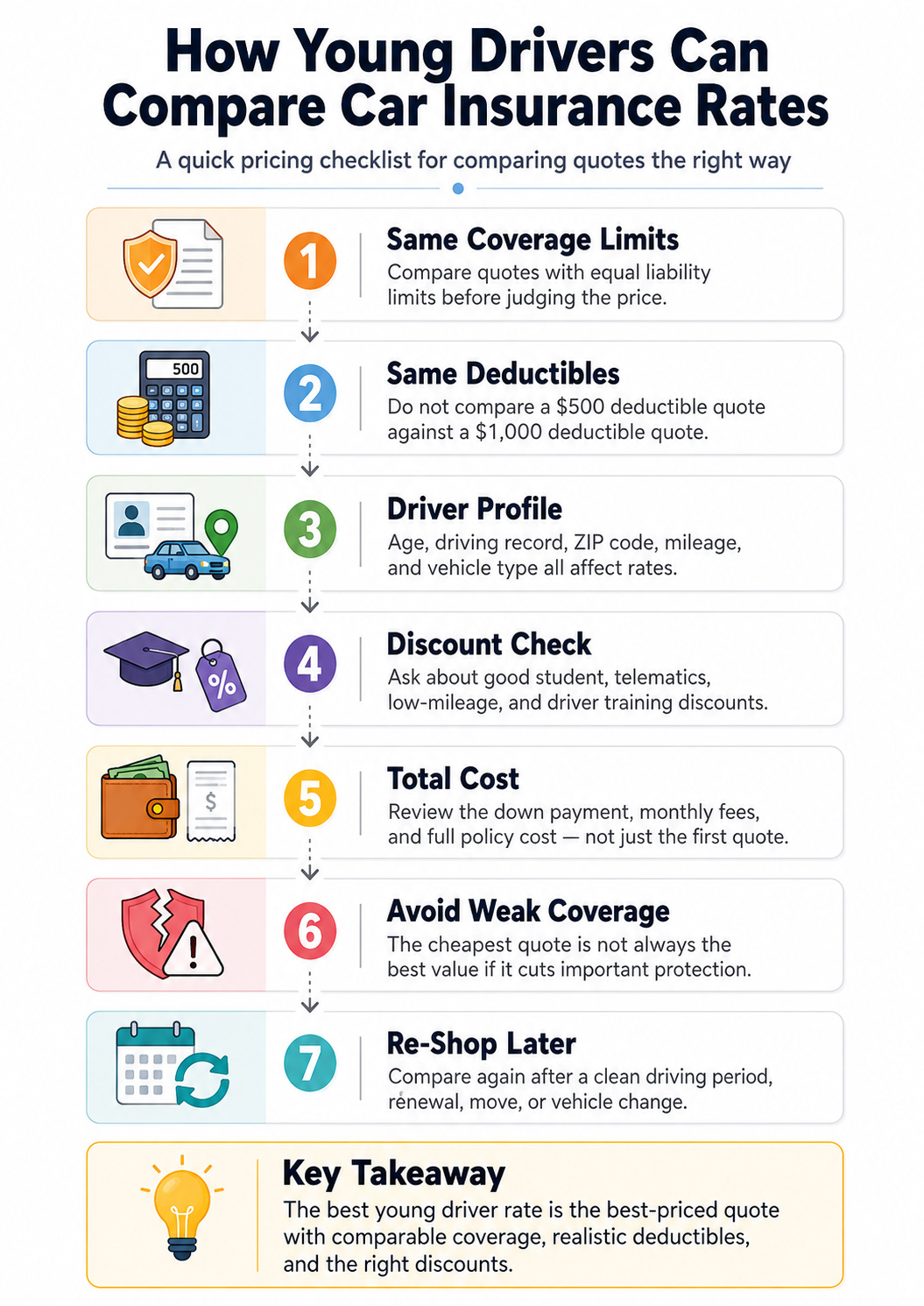
To compare rates correctly, keep the quote inputs the same. If one quote has higher limits, a lower deductible, or a different vehicle use assumption, the price comparison is not fair.
- Choose the comparison baseline. Decide the liability limits, deductibles, and optional coverages before requesting quotes.
- Use the same driver and vehicle details. Keep the ZIP code, garaging address, mileage, and vehicle use consistent.
- Compare the same policy setup. Family policy and separate policy quotes should be compared separately.
- Ask about discounts one by one. Do not assume good student, low-mileage, telematics, or training discounts are included.
- Check total cost, not only monthly payment. Review down payment, installment fees, billing fees, and pay-in-full options.
- Save the quote details. Keep the quote assumptions so you can compare changes later.
For general policy-shopping steps that apply to all drivers, review compare auto insurance policies by key features. This can help young drivers compare limits, deductibles, payment terms, coverage types, and discounts before choosing the lowest quote.
When Young Drivers Should Re-Shop Rates
Young drivers should not treat the first policy as permanent. Rates can change when a driver gets older, builds a clean record, changes vehicles, moves, reduces mileage, completes a course, improves student status, joins or leaves a household policy, or reaches a renewal period without tickets or claims.
Good times to compare again
- At renewal.
- After 6 to 12 months of clean driving.
- After moving or changing garaging address.
- Before buying a different vehicle.
- After completing a qualifying driver course.
- After grades improve, if a good student discount may apply.
- After annual mileage changes.
- After leaving or joining a household policy.
Common Mistakes That Make Young Driver Rates Worse
Some young-driver pricing problems happen because the quote is rushed or the comparison is not equal. Avoiding these mistakes can help prevent expensive surprises.
Rate mistakes to avoid
- Comparing quotes with different liability limits or deductibles.
- Choosing the cheapest quote without checking coverage quality.
- Leaving a regular driver off the policy.
- Using the wrong garaging address.
- Ignoring discounts that require proof.
- Choosing a high deductible that the young driver could not pay after a claim.
- Letting coverage lapse when a vehicle still needs insurance.
- Assuming a generic average rate predicts the driver’s personal quote.
Compare Young Driver Rates by ZIP Code
Young-driver rates can vary by state, ZIP code, vehicle, driver history, coverage limits, deductibles, payment method, household policy setup, and insurer. Use the form below to begin reviewing available quote paths, then compare coverage and total cost before choosing.
Review Young Driver Quote Paths
Enter your ZIP code to start comparing auto insurance quote paths for young drivers. Review limits, deductibles, discounts, payment terms, and total cost before choosing a policy.
FAQ
What is the best car insurance rate for a young driver?
A strong rate is usually the lowest reliable price for comparable coverage. Compare the same drivers, vehicle, ZIP code, liability limits, deductibles, payment terms, and discounts before deciding which quote is truly better.
Why are young driver rates usually higher?
Young drivers often have less driving experience, and insurers may rate that as higher risk. Price can also depend on vehicle type, location, driving record, coverage choices, deductibles, mileage, and discounts.
Can a young driver lower rates quickly?
Some changes can help quickly, such as comparing quotes, documenting discounts, choosing a practical vehicle, adjusting deductibles carefully, and using a household policy when appropriate. Other improvements, such as a clean driving record, take time.
Are average young driver rates reliable?
Average rates are only rough benchmarks. A personal quote depends on the driver’s state, ZIP code, vehicle, coverage limits, deductibles, discounts, payment terms, prior insurance, and driving history.
Does telematics always lower rates?
No. Telematics rules vary by insurer. Some programs may lower rates for safe driving, while others may also use risky driving data in pricing. Ask what is tracked and whether the rate can increase.
Is a parent policy usually cheaper for young drivers?
Often it can be cheaper for a teen or young driver to stay on a household policy, but it depends on the vehicle, address, ownership, insurer rules, and driver history. Compare both setups if both are available.
How often should young drivers compare rates?
Compare at renewal, after a clean driving period, after moving, before changing vehicles, after completing a driver course, after mileage changes, or when new discounts may apply.
Conclusion
The best car insurance rates for young drivers come from comparing equal quotes, not from choosing the smallest monthly number. Young drivers should match coverage limits, deductibles, drivers, vehicles, ZIP code, payment terms, and discounts before deciding which quote is truly better.
The main takeaway is simple: compare rates with the same coverage assumptions, document available discounts, avoid misleading averages, and re-shop when your driving profile improves. A lower rate is only useful if the policy still gives the driver the protection they actually need.
References
- National Association of Insurance Commissioners, “Auto Insurance.” ↩
- Insurance Information Institute, “What determines the price of my auto insurance policy?” ↩
- Insurance Information Institute, “Background on: Pay-As-You-Drive Auto Insurance / Telematics.” ↩
- National Highway Traffic Safety Administration, “Teen Driving.” ↩
- Texas Department of Insurance, “Auto Insurance Guide.” ↩