
Article Information
Updated: June 30, 2026
Editorial details
The RodneyDYoung.org Editorial Team creates informational content focused on auto insurance quotes, policy changes, coverage options, payment timing, cancellation steps, and practical shopping topics for U.S. drivers.
This guide has been updated to remove outdated promotional language, clarify the switching process, improve source quality, and help drivers avoid coverage gaps when comparing a new auto insurance policy.
This content is for general informational purposes only and does not constitute insurance, legal, or financial advice. Coverage availability, pricing, cancellation procedures, refunds, discounts, and policy terms vary by insurer, state, driver profile, vehicle, lender requirements, and underwriting rules. RodneyDYoung.org is an independent insurance information and quote-comparison resource.
Switching car insurance should be done in the right order: review your current policy, compare new quotes with the same coverage details, bind the new policy, confirm the effective date and time, and then cancel the old policy. The most important rule is simple: do not cancel your current policy until the replacement coverage is confirmed.
This guide explains how to switch car insurance using a safer step-by-step process. It is written for drivers comparing options through RodneyDYoung.org or researching Rodney D. Young-related auto insurance resources, but the same basic switching principles apply to most auto insurance changes.
Quick takeaway
Switching safely means confirming the new policy before ending the old one. Compare like-for-like coverage, check the effective date and time, save proof of insurance, request written cancellation confirmation, and keep records of any refund or billing adjustment.
What it means to switch car insurance
Switching car insurance means replacing one active auto policy with another. Drivers commonly switch because they want a lower premium, different coverage, better payment options, new household-driver changes, a new vehicle, or a policy that better fits their current situation.
Auto insurance pricing can vary because insurers may consider factors such as coverage type, limits, deductibles, vehicle type, driving record, vehicle use, location, and other rating factors allowed by state law [1]. That is why a driver may see different quotes even when the vehicle and ZIP code are the same.
If you are comparing Rodney D. Young-related options, start with a general overview of Rodney D. Young insurance resources and then compare the actual policy details offered by the participating provider or carrier.
Coverage gap warning
A quote is not the same as active coverage. Before canceling your old policy, make sure the new policy is bound, paid as required, and shows a confirmed effective date and time.
Step-by-step switching process
The safest switching process is organized and documented. You do not need to rush cancellation before the replacement policy is active.
Review
Check your current limits, deductibles, drivers, vehicles, payment schedule, and cancellation rules.
Compare
Compare new quotes using the same coverage limits, deductibles, vehicle use, and driver details.
Confirm
Bind the new policy, confirm the effective date and time, then cancel the old policy in writing.
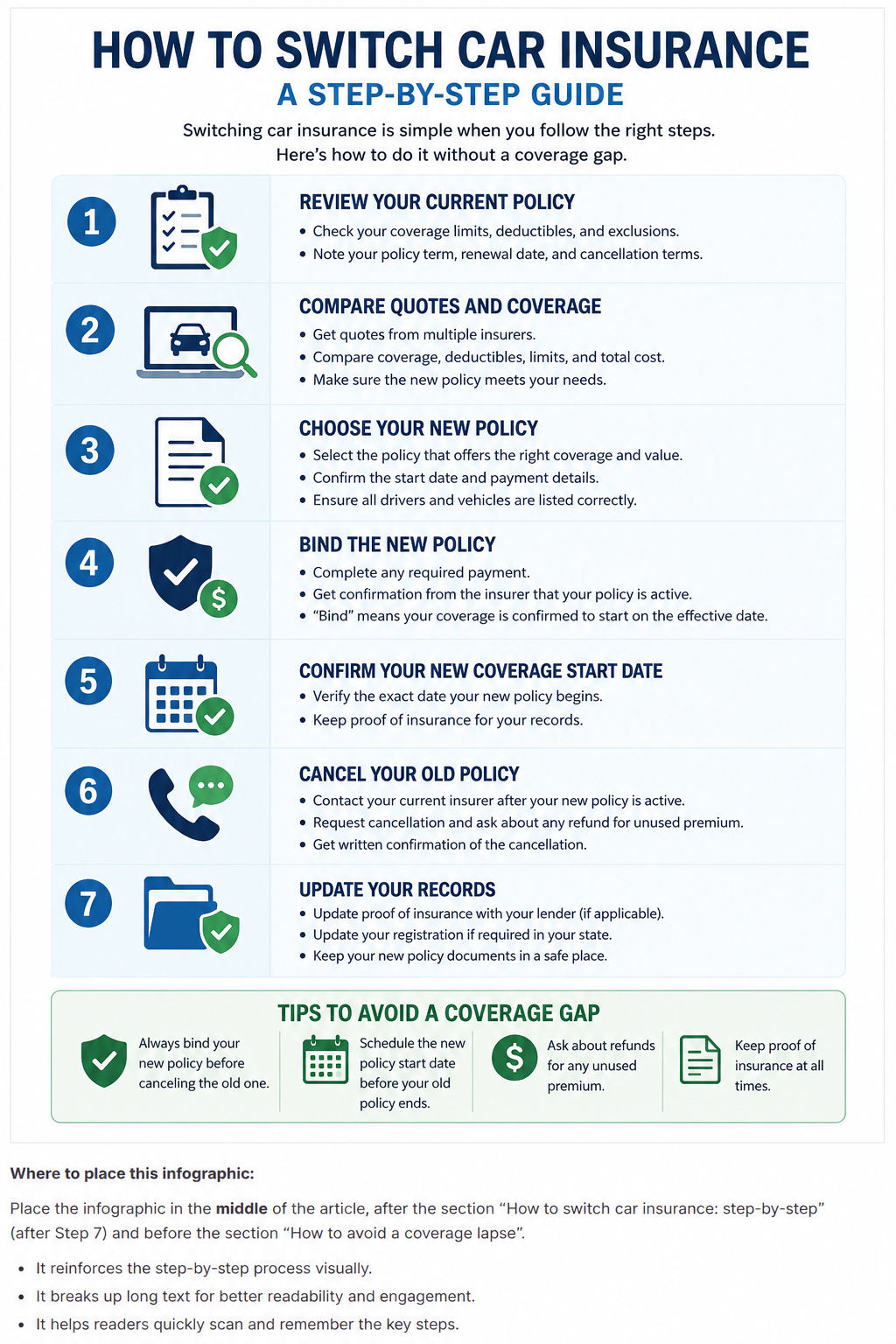
Review your current policy before switching
Before replacing your policy, review your current declarations page. This document usually shows your covered vehicles, listed drivers, liability limits, deductibles, optional coverages, lienholder information, policy dates, and premium details. It gives you a baseline for comparing new quotes.
The National Association of Insurance Commissioners provides an auto insurance shopping tool that encourages consumers to compare the same coverage limits and deductibles across quotes so the comparison is fair [2]. If you compare a low-limit quote against your current higher-limit policy, the lower price may not mean better value.
Current policy details to check
- Policy number and current insurer.
- Policy start date, renewal date, and billing cycle.
- Covered vehicles and listed household drivers.
- Liability limits and optional coverage selections.
- Collision and comprehensive deductibles.
- Roadside assistance, rental reimbursement, or other add-ons.
- Autopay status and any remaining installment payments.
- Cancellation requirements and refund process.
Compare new quotes apples-to-apples
When comparing a new quote, match the same limits and deductibles wherever possible. A cheaper quote may simply have lower liability limits, no collision coverage, no comprehensive coverage, fewer drivers listed, or a higher deductible.
RodneyDYoung.org has broader information about Rodney D. Young auto insurance topics, but the final decision should always come down to the actual quote, carrier, coverage terms, payment schedule, and policy documents.
| Item to compare | Why it matters | What to verify |
|---|---|---|
| Liability limits | Lower limits may reduce the premium but increase financial exposure after a serious accident. | Compare the same bodily injury and property damage limits. |
| Collision coverage | This may help repair or replace your vehicle after a covered collision, subject to deductible and policy terms. | Check whether it is included or excluded. |
| Comprehensive coverage | This may help with covered non-collision losses such as theft, vandalism, hail, fire, or certain weather events. | Compare deductible and included terms. |
| Deductibles | A higher deductible can lower the premium but increases what you pay after a covered claim. | Choose an amount you could realistically pay. |
| Listed drivers | Leaving out regular drivers can create underwriting or claim problems. | List household and regular-use drivers accurately. |
| Vehicle use | Commuting, business use, rideshare, or delivery use can affect eligibility and coverage. | Disclose vehicle use honestly. |
| Payment terms | A low first payment may not mean the lowest total policy cost. | Review down payment, installment fees, and total premium. |
Documents and information needed to switch
Having accurate information ready can make the switch smoother. Missing or incorrect details may delay the new policy or change the final price.
Switching checklist
- Current declarations page.
- Driver’s license information for each listed driver.
- Vehicle identification number, year, make, and model.
- Garaging address and ZIP code.
- Estimated annual mileage and vehicle use.
- Current lienholder or leaseholder information, if applicable.
- Desired effective date and payment method.
- Proof of new insurance after the replacement policy is active.
How to avoid a coverage lapse
A coverage lapse can happen if your old policy ends before your new policy begins. A lapse may create legal, lender, registration, or future-pricing issues depending on your state, vehicle, and insurer.
In this context, “bind” means the insurer has accepted the policy for the selected start date, any required payment step has been completed, and you have confirmation that coverage is scheduled to begin.
The cleanest approach is to bind the new policy first, confirm the effective date and time, download proof of insurance, and then contact the old insurer to cancel. If possible, keep the old policy active until the new one is confirmed in writing.
Do this in order
- Choose the new policy.
- Complete any required payment.
- Confirm the policy number.
- Confirm the effective date and time.
- Save proof of insurance.
- Cancel the old policy only after the new one is active.
Cancellation process for the old policy
Do not simply stop paying the old policy. Contact the current insurer and ask how to cancel correctly. Some companies may require a signed cancellation form, a written request, or confirmation through an online account.
Ask for the exact cancellation date and written confirmation. If the old policy has autopay, confirm whether future payments have been stopped. Keep all emails, screenshots, cancellation confirmations, and refund details in case there is a billing dispute later.
Questions to ask before canceling
- What date and time will the cancellation take effect?
- Do you require a signed cancellation request?
- Will there be any remaining balance or billing adjustment?
- Will I receive any unearned premium refund?
- How and when will the refund be issued?
- Can you send written cancellation confirmation?
- Will autopay stop automatically after cancellation?
Refunds and old policy billing
If you cancel a policy before the end of the term, you may be owed a refund for the unused portion of premium, depending on policy terms and state rules. Texas guidance says insurers must refund unearned premium after cancellation, and Texas rules for personal auto policies refer to refund timing after the effective date of cancellation or termination [3] [4]. Ask your current insurer for written confirmation of any refund amount, timing, and final billing adjustment.
Billing reminder
Keep proof of the old policy cancellation and the new policy effective date. If a payment is drafted after cancellation, those records make it easier to resolve the issue.
Financed or leased vehicle note
If your car is financed or leased, do not reduce coverage without checking lender requirements. The Texas Department of Insurance explains that if you owe money on your car, your lender will require collision and comprehensive coverage to pay for damage to your car [5]. Lenders may also require their name and address to appear correctly on the policy.
Before switching, ask the new insurer to list the lienholder or leaseholder correctly and send proof of insurance if required. If the lender does not receive acceptable proof, it may add force-placed coverage, which can be expensive and may protect the lender’s interest rather than your full financial situation.
Lender coverage warning
A state-minimum liability policy may not satisfy a finance or lease agreement. Confirm lender requirements before removing collision or comprehensive coverage.
Switching timeline
A simple timeline can help you avoid mistakes. The exact timing depends on your renewal date, cancellation rules, and how quickly the new policy can be confirmed.
| Stage | What to do | What to save |
|---|---|---|
| Before comparing | Review your declarations page and current billing schedule. | Current policy number, coverage limits, deductibles, and renewal date. |
| While comparing | Use the same limits, deductibles, drivers, and vehicle details across quotes. | Quote summaries and carrier names. |
| Before canceling | Bind the new policy and confirm payment, effective date, and proof of insurance. | New policy number, ID cards, and payment confirmation. |
| Cancellation step | Contact the old insurer and request cancellation on the correct date. | Written cancellation confirmation. |
| After switching | Confirm autopay is stopped and monitor any refund or final bill. | Refund confirmation, final statement, or billing adjustment. |
Where discounts may fit into the switch
Switching is a good time to ask about discounts, but discounts should not replace coverage review. A lower premium can come from a real discount, a lower coverage limit, a higher deductible, a different vehicle use rating, or a different payment plan.
When comparing savings during a switch, make sure the lower price is not coming from weaker protection. Review the key features of auto insurance policies so discounts, deductibles, coverage limits, and payment terms are compared fairly.
Discounts to ask about
- Multi-car or multi-policy discounts.
- Safe driver or claims-free discounts.
- Good student discounts where available.
- Telematics or usage-based programs.
- Anti-theft or safety-feature discounts.
- Paperless billing or automatic payment options.
Claims and service considerations
Price is important, but it should not be the only factor. Before switching, consider how claims are handled, how you can contact support, whether digital ID cards are available, and how policy changes are processed.
If you want a better sense of claim-documentation basics, review our stress-free auto claims guide and compare that information with the actual claim process explained by the insurer named on your policy.
Mistakes to avoid when switching car insurance
Most switching problems come from timing issues, incomplete information, or comparing policies that are not equivalent.
Do not make these mistakes
- Do not cancel the old policy before the new one is active.
- Do not compare quotes with different liability limits and deductibles.
- Do not leave regular drivers off the new policy.
- Do not forget lender or leaseholder requirements.
- Do not rely only on the lowest first payment.
- Do not forget to cancel autopay with the old insurer.
- Do not ignore cancellation confirmation or refund details.
- Do not remove collision or comprehensive coverage without understanding the risk.
What to do after switching
After the new policy is active and the old policy is canceled, take a few minutes to organize your records. This helps avoid billing confusion and makes it easier to show proof of insurance if needed.
After-switch checklist
- Download or print new insurance ID cards.
- Save the new policy number and carrier contact information.
- Update lender, dealer, or leasing company records if needed.
- Confirm the old policy cancellation date in writing.
- Confirm old autopay or recurring billing has stopped.
- Watch for any refund, final bill, or billing adjustment.
- Keep both old and new policy documents for your records.
FAQ about switching car insurance
Can I switch car insurance anytime?
In many situations, drivers can switch before renewal, but cancellation procedures, refund handling, and fees can vary by insurer, state, and payment plan. Ask your current insurer for written instructions before canceling.
Should I cancel my old policy before buying the new one?
No. Confirm the new policy first. The safer order is to bind the replacement policy, confirm the effective date and time, save proof of insurance, and then cancel the old policy.
Will switching create a coverage lapse?
It should not if the dates are coordinated correctly. A lapse can happen if the old policy ends before the new policy begins. Confirm both dates in writing.
What documents do I need to switch?
You may need your current declarations page, driver’s license information, VIN, garaging address, mileage estimate, vehicle use, lender information, and payment method.
Can I get a refund if I cancel mid-term?
You may receive a refund for unearned premium depending on policy terms and state rules. Texas has specific rules for unearned premium refunds, but drivers in other states should check with their insurer or state insurance department.
Should I compare the same limits and deductibles?
Yes. Comparing the same limits and deductibles helps you understand whether a new quote is truly better or simply less protective.
What if my car is financed or leased?
Check your loan or lease requirements before switching. The lender may require collision and comprehensive coverage and may need to be listed correctly on the new policy.
Do I need new proof of insurance before driving?
Yes. You should have proof of the new active policy before relying on it. A quote alone is not proof of coverage.
Final thoughts on switching car insurance
Switching car insurance can be simple when you follow a careful order. Review your current policy, compare new quotes with the same coverage details, confirm the new policy, and cancel the old policy only after the replacement coverage is active.
The goal is not just a lower payment. The better goal is a policy that fits your vehicle, household, lender requirements, driving needs, and budget without creating a coverage gap. If you are comparing Rodney D. Young-related resources, you can also review Rodney D. Young insurance in Dallas, TX for local context before choosing a policy.
Start with your ZIP code
Enter your ZIP code to begin comparing available auto insurance quote options from participating providers.
References
- Insurance Information Institute — What Determines the Price of an Auto Insurance Policy? ↩
- National Association of Insurance Commissioners — A Shopping Tool for Auto Insurance ↩
- Texas Department of Insurance — Was Your Auto Insurance Not Renewed or Canceled? ↩
- Texas Department of Insurance — 28 TAC §5.7015, Refund of Unearned Premium ↩
- Texas Department of Insurance — Auto Insurance FAQ ↩