The RodneyDYoung.org Editorial Team creates informational content focused on auto insurance costs, low first-payment options, coverage types, quote comparison, and practical shopping topics for U.S. drivers.
Articles are written to help readers better understand how upfront payments, monthly billing, deductibles, coverage limits, state requirements, and insurer underwriting rules may affect the cost of starting or maintaining an auto insurance policy.
This content is for general informational purposes only and does not constitute insurance, legal, or financial advice. Coverage availability, pricing, deposits, discounts, and policy terms vary by insurer, state, driver profile, vehicle, and underwriting approval. RodneyDYoung.org is an independent informational and quote-comparison resource and is not an insurance company.
Very Cheap Car Insurance No Deposit: What It Really Means
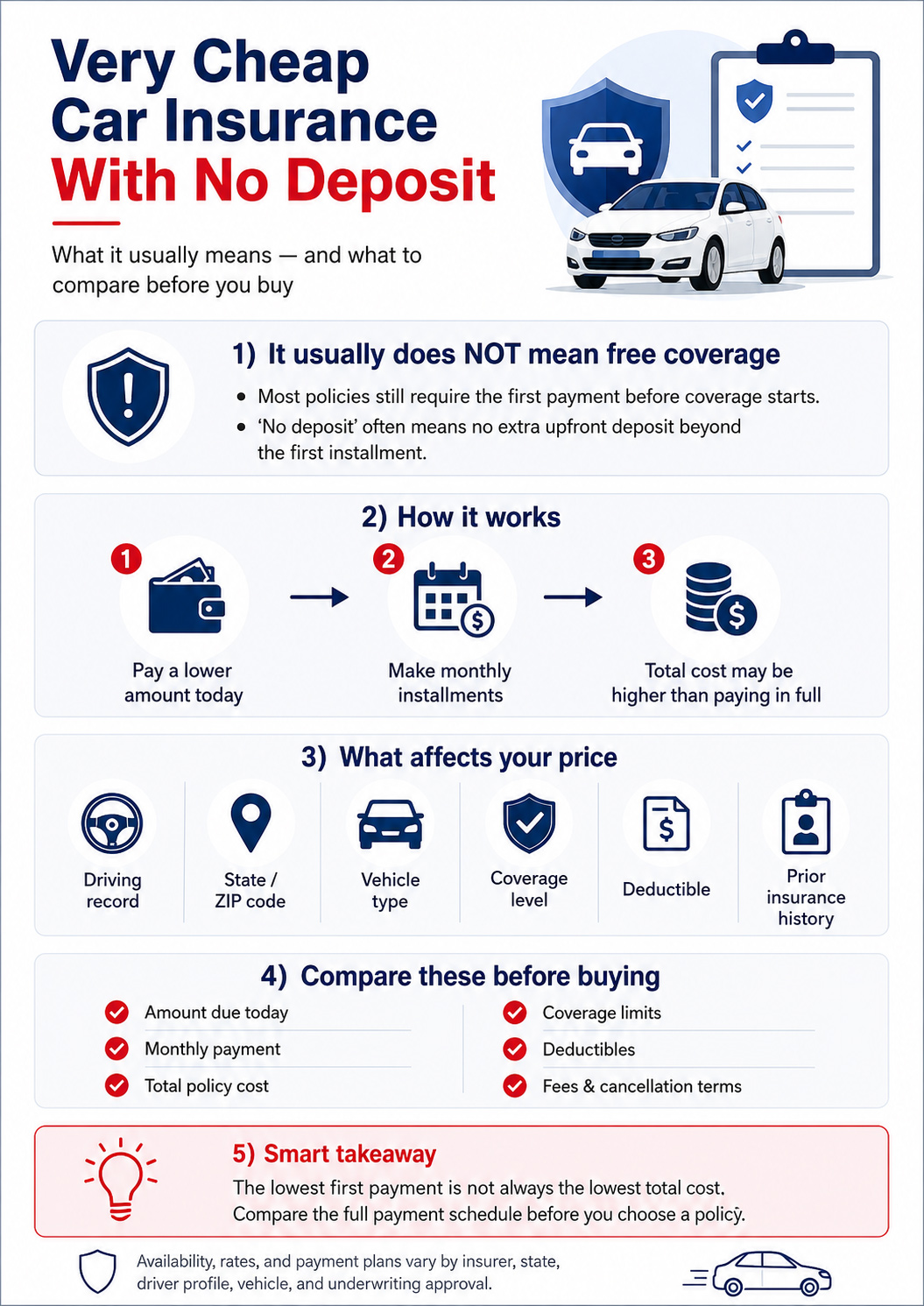
Many drivers search for very cheap car insurance no deposit because they need coverage but cannot afford a large upfront payment. The important thing to understand is that “no deposit” usually does not mean free car insurance or zero dollars due before coverage starts. In most cases, it means the insurer does not require an extra deposit beyond the first installment. You normally still need to make the first payment before the policy becomes active.
A low first-payment policy can help if you recently bought a car, are between paychecks, need to reinstate coverage, or simply want to spread your premium across monthly installments. However, the cheapest way to start a policy is not always the cheapest way to pay over the full policy term. Monthly plans may include installment fees, and a lower first payment can sometimes mean higher remaining payments.
Quick Summary
- “No deposit” usually means no extra deposit beyond the first required payment.
- Coverage is not free. Most insurers require payment before the policy starts.
- Availability varies by state, insurer, driver profile, vehicle, coverage level, and underwriting rules.
- Monthly payments may cost more overall than paying the policy in full.
- Always compare the total policy cost, not just the first payment.
No Deposit Car Insurance Is Not Free Coverage
One of the biggest mistakes drivers make is assuming that no-deposit auto insurance means the first month is free. It does not. Auto insurance is a contract, and the insurer generally requires an initial payment before coverage begins. If a company advertises “no deposit,” read the payment page carefully. The offer may simply mean that your first monthly installment starts the policy.
For example, a driver might see a policy with a lower first payment instead of a larger down payment. That can be helpful for cash flow, but the driver should still check the remaining monthly payments, installment fees, cancellation rules, and total premium. The National Association of Insurance Commissioners recommends comparing policy terms, coverage limits, deductibles, and company information before choosing auto insurance.[1]
Important coverage note: A quote is not the same thing as active insurance. Coverage generally starts only after the application is accepted and the required payment is made. Before driving, confirm the policy effective date, covered vehicles, listed drivers, limits, deductibles, and proof-of-insurance documents.
How Low First-Payment Auto Insurance Works
Auto insurance premiums are commonly priced for a policy term, such as six months or twelve months. Depending on the insurer, you may be able to pay the full amount upfront or divide the cost into installments. When you choose installments, the insurer may require a first payment and then bill the remaining balance monthly.
The exact amount depends on your state, the insurer, the coverage you choose, your vehicle, your driving record, your location, your claims history, and other underwriting factors. The Insurance Information Institute explains that auto insurance pricing can be affected by items such as driving record, vehicle use, where the vehicle is kept, coverage choices, deductibles, and other risk factors.[2]
Lower first payment
This can reduce the amount you need to start the policy. It may help when cash is tight, but it does not automatically mean the policy is cheaper overall.
Pay-in-full option
Paying the full premium upfront may reduce installment fees or qualify for a discount with some insurers. It requires more cash at the beginning.
Example: Low First Payment vs. Pay in Full
The table below is only a simplified example. It is not a quote and does not represent a guaranteed rate. The point is to show why drivers should compare the total cost, not only the amount due today.
| Payment Detail |
Pay in Full |
Monthly Installment Plan |
| Amount due to start |
$1,596 |
$140 |
| Remaining payments |
$0 |
Example monthly installments |
| Estimated total paid |
$1,596 |
$1,680 |
| Main tradeoff |
Higher upfront cost, lower total in this example |
Lower starting cost, higher total in this example |
Before buying a policy, ask the insurer or agency to show the amount due today, the number of remaining payments, the due dates, any installment fees, and the total cost if you pay monthly. That is the safest way to compare offers fairly.
Who May Benefit from Low Down Payment Car Insurance?
A low down payment or low first-payment plan may be useful for drivers who need to get legally insured quickly but cannot pay a large upfront amount. This can include someone who recently bought a used vehicle, a driver restarting coverage after a lapse, a student on a tight budget, or a household trying to balance several bills at once.
However, choosing the lowest first payment should not be the only goal. Drivers should also think about whether the coverage is enough. A state-minimum liability policy may be cheaper, but it may not fully protect your finances after a serious accident. If your vehicle is financed or leased, the lender may require collision and comprehensive coverage. The Consumer Financial Protection Bureau also advises consumers to shop and compare insurance options when financing a vehicle.[3]
What Affects Your First Payment and Monthly Premium?
There is no single price that applies to every driver. One person may qualify for a low first payment, while another may be asked for more upfront because the insurer sees a higher risk. Factors that can affect the premium and payment plan include:
- Your driving record and claims history.
- Your age, location, and how the vehicle is used.
- The make, model, year, and repair cost of the vehicle.
- The coverage level, liability limits, and deductibles you choose.
- Whether the car is financed, leased, or owned outright.
- Your prior insurance history and whether there was a lapse.
- Credit-based insurance information where state law allows it.
Credit-based insurance scores are not the same as regular credit scores. The NAIC explains that state laws limit how these scores may be used, and some states restrict or prohibit certain uses. Where allowed, insurers may use credit-based insurance information as one factor, but rules vary by state.[4]
Can High-Risk Drivers Get Very Cheap Car Insurance No Deposit?
High-risk drivers may have a harder time qualifying for a low first-payment policy. Recent accidents, violations, DUI-related history, lapses in coverage, poor payment history, or a vehicle that is expensive to repair can all make insurance more expensive. Some drivers may still find monthly payment options, but the first payment may be higher than expected.
If you are considered high-risk, focus on comparing multiple quotes, avoiding another lapse, choosing coverage you can keep active, and asking whether there are payment-plan options. A cheaper first payment does not help if the remaining monthly payments are too high to maintain.
Should You Choose Liability Only to Lower the First Payment?
Liability-only coverage is often cheaper than a policy that includes collision and comprehensive coverage. It may be the lowest-cost option for some drivers, especially if the vehicle is older and owned outright. But liability coverage mainly helps pay for injuries or damage you cause to others, up to your policy limits. It does not pay to repair your own car after many types of losses.
If your car is financed or leased, you may not be able to choose liability-only coverage because the lender usually wants protection for the vehicle. Even when liability-only is allowed, compare the savings with the risk of having to repair or replace your own car out of pocket.
How to Lower Your Auto Insurance Starting Cost
The goal is not just to find a low first payment. The better goal is to find coverage that is affordable, active, and realistic for your budget. These steps can help:
Compare Multiple Quotes
Different insurers price the same driver differently. Compare national, regional, and local options where available. You can begin with the Rodney D. Young auto insurance guide to review common coverage topics and quote paths, but always confirm the exact terms with the provider before buying.
Ask for the Total Cost, Not Only the First Payment
A low amount due today may look attractive, but it can hide higher monthly payments. Ask for the full payment schedule, fees, renewal terms, and cancellation terms. This is especially important if you are comparing a low-deposit option against a pay-in-full option.
Adjust Deductibles Carefully
Raising deductibles on collision or comprehensive coverage may lower the premium, but only choose a deductible you could actually afford after a loss. NAIC consumer guidance notes that raising deductibles may reduce costs, but drivers should make sure they can absorb the larger out-of-pocket amount if there is a claim.[5]
Remove Coverage You Do Not Need
Review optional add-ons such as rental reimbursement, roadside assistance, or other extras. These can be useful, but they may not be necessary for every driver. If you already have similar benefits elsewhere, removing overlap may help lower the premium.
Look for Discounts
Discounts vary by insurer, but common examples may include safe driver, multi-policy, multi-vehicle, paperless billing, automatic payment, defensive driving course, student, military, vehicle safety features, or pay-in-full discounts. Ask the provider to list every discount applied to your quote.
Avoid a Coverage Lapse
A lapse can make future insurance more expensive and may create legal or registration problems depending on your state. If you cannot afford your current policy, compare options before canceling and confirm the new policy’s effective date before ending any existing coverage.
Pros and Cons of Low First-Payment Car Insurance
Possible advantages
- Lower amount needed to start coverage.
- May help drivers avoid a lapse.
- Can make budgeting easier with scheduled payments.
- Allows comparison between several coverage levels.
Possible downsides
- Monthly plans may cost more overall.
- Not every driver or state will qualify.
- Lower first payment can mean higher later payments.
- Cheap liability-only coverage may leave gaps.
Low First-Payment Options for Seniors, Students, and Budget-Conscious Drivers
Some seniors, students, and budget-conscious drivers may be looking for the lowest amount due today. The right approach is the same for each group: compare quotes, check coverage limits, ask about discounts, and make sure the monthly payments are sustainable. A student may qualify for a good-student discount with some insurers. A retired driver who drives fewer miles may be able to ask about low-mileage options. A household with more than one policy may be able to compare bundling options.
For more general information about coverage types and quote options, you can also review the Rodney D. Young car insurance guide. Use any quote result as a starting point, then confirm the actual policy details before paying.
Questions to Ask Before Buying a Low-Deposit Policy
- How much is due today?
- When does coverage actually begin?
- How many payments remain after the first payment?
- Are there installment fees, processing fees, or late fees?
- What is the total policy cost if paid monthly?
- What is the total policy cost if paid in full?
- What are the liability limits and deductibles?
- Are collision and comprehensive included or excluded?
- What happens if a payment is late?
- How do cancellation and refund rules work?
These questions protect you from choosing a policy that looks cheap today but becomes difficult to keep active later. They also help you compare a policy from one company against another in a fair way.
Quote Comparison and Privacy
Online quote forms often ask for personal and vehicle information so insurers or agencies can estimate a rate. Before submitting information, review the site’s privacy policy and understand that you may receive calls, texts, or emails from insurance providers or partners depending on the consent language. Do not submit payment information until you are ready to buy and have reviewed the terms.
RodneyDYoung.org provides information and quote-comparison paths, but the final premium, deposit, payment plan, fees, discounts, and approval decision come from the insurer, agency, or quote provider. To understand how the site presents insurance information, visit the Rodney D. Young insurance overview.
When Cheap Car Insurance May Not Be Enough
The cheapest policy is not always the best policy. If you choose very low liability limits, you could be personally responsible for costs above your limits after an at-fault accident. If you remove collision and comprehensive coverage, damage to your own vehicle may not be covered in many situations. If you choose a very high deductible, you need to be ready to pay that amount before the insurer pays for a covered loss.
A better strategy is to compare several levels of coverage: state minimum, higher liability limits, and full coverage if needed. Then compare the first payment, monthly payments, and total premium for each. For drivers who want help understanding agency-style insurance resources, the Rodney D. Young insurance agency guide may also be useful.
Compare Low First-Payment Car Insurance Options
Before choosing a policy, compare the amount due today, the monthly payments, the total policy cost, the coverage limits, and the deductible. A lower first payment can help, but the full payment schedule matters.
Start Comparing Quote Options
Frequently Asked Questions
Is no deposit car insurance really zero dollars down?
Usually, no. In most cases, “no deposit” means there is no extra deposit beyond the first installment. You normally still need to make the first payment before coverage starts.
Can I get car insurance without paying the first month?
Most insurers require payment before coverage becomes active. Be careful with any offer that sounds like free insurance. Confirm the effective date and payment requirement before driving.
Why do insurers ask for a down payment?
A down payment reduces the insurer’s risk that the policy will be issued and then quickly canceled for nonpayment. It also starts the payment schedule for the policy term.
Is liability-only coverage the cheapest option?
Liability-only coverage is often cheaper than full coverage, but it does not protect your own vehicle in many situations. It may not be allowed if your car is financed or leased.
Can high-risk drivers get low down payment car insurance?
Some high-risk drivers may find monthly payment options, but they may be asked for a higher first payment. Comparing several providers is important because underwriting rules vary.
Should I choose the policy with the lowest first payment?
Not automatically. Compare the total premium, installment fees, monthly payments, limits, deductibles, and cancellation rules. The lowest first payment may cost more over the full policy term.
Final Thoughts on Very Cheap Car Insurance No Deposit
Very cheap car insurance with no deposit can be useful when you need to start coverage with a lower upfront payment. But the phrase should be understood carefully. It usually means a lower first payment or no extra deposit, not free coverage. The safest approach is to compare multiple quotes, review the full payment schedule, check the coverage limits, and confirm the policy effective date before driving.
If you want the lowest realistic starting cost, focus on more than the headline price. Choose a policy you can keep active, ask about discounts, avoid coverage lapses, and compare the total amount you will pay over the full policy term.