
Rodney D. Young car insurance is a broad search topic for drivers who want to understand coverage options, quote factors, payment choices, and the practical questions to ask before starting or switching a policy. This page is designed as a general car insurance guide, not a Dallas-specific or Texas-specific page, so it focuses on coverage comparison rather than local requirements.
Because car insurance rules and minimum coverage requirements vary by state, the best policy choice depends on where you live, what you drive, your driving history, your lender or lease requirements, and the level of financial protection you want.
Rodney D. Young Car Insurance: How to Use This Page
Drivers comparing Rodney D. Young Insurance information should avoid choosing a policy based only on a low monthly payment. A useful comparison should look at liability limits, collision and comprehensive coverage, deductibles, uninsured or underinsured motorist options, payment terms, exclusions, and the total policy cost.
General Car Insurance Focus
This page explains how to compare car insurance coverage in a broad way, without focusing on one city or state. That helps separate it from local pages that discuss state-specific requirements.
Coverage and Quote Clarity
The goal is to help drivers understand what each coverage type does, what questions to ask, and how to compare quotes more fairly before starting a policy.
What Car Insurance Usually Covers
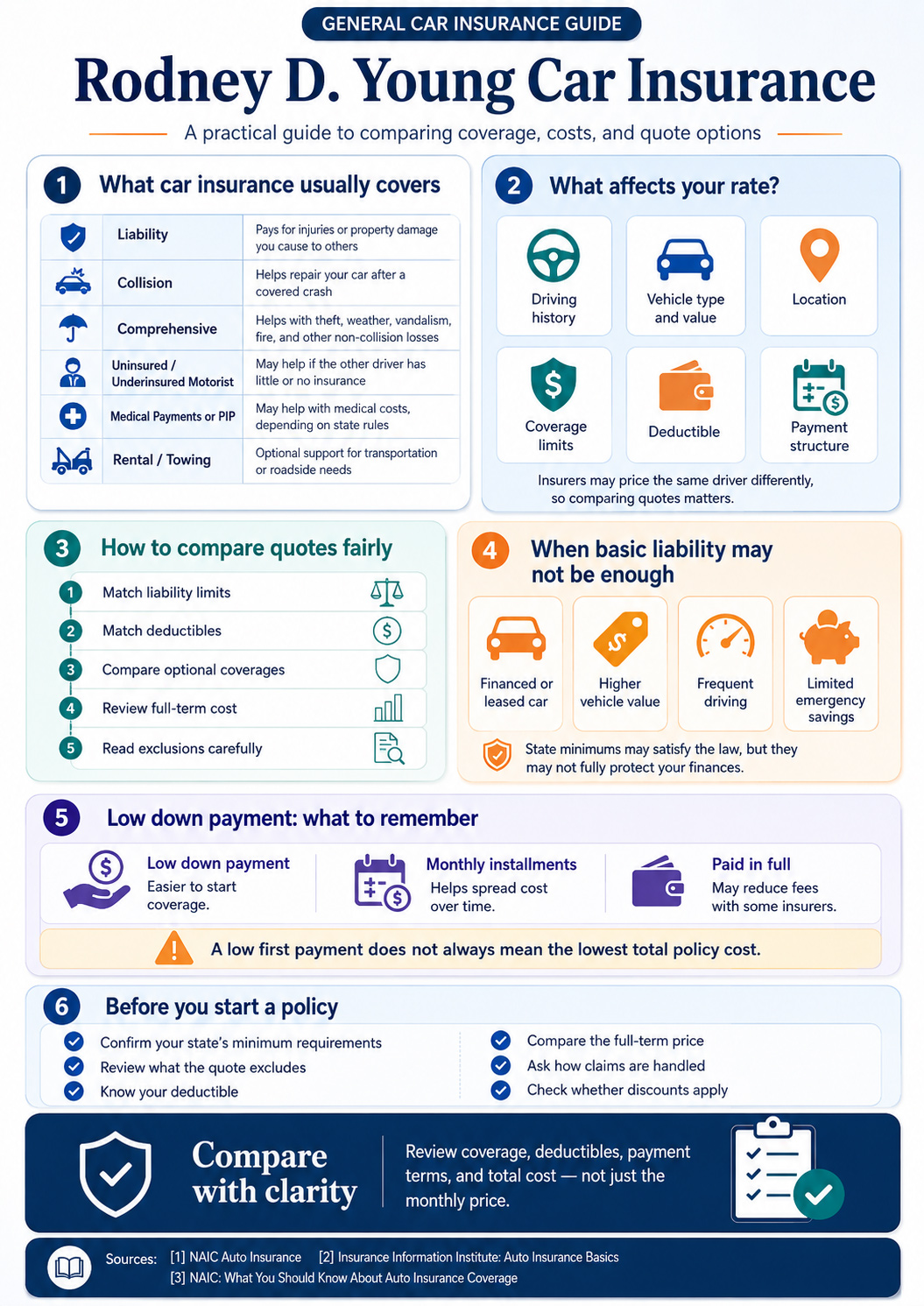
The National Association of Insurance Commissioners explains that auto insurance can generally be divided into two broad coverage areas: liability and property damage.[1] The Insurance Information Institute also explains that a typical auto policy may include liability coverage, medical coverage, and property coverage, while optional collision and comprehensive coverages help protect your own vehicle.[2]
| Coverage Type | What It Generally Helps With | Important Question Before Buying |
|---|---|---|
| Liability Coverage | Helps pay for injuries or property damage you cause to others in a covered accident. | Are my limits high enough to protect my finances beyond the state minimum? |
| Collision Coverage | Helps pay to repair or replace your own car after a covered collision, subject to your deductible. | Does the value of my vehicle justify the extra premium and deductible? |
| Comprehensive Coverage | Helps with certain non-collision losses such as theft, fire, vandalism, falling objects, weather, or animal-related damage. | Could I afford to repair or replace my car without this coverage? |
| Uninsured/Underinsured Motorist Coverage | May help if another driver has no insurance or not enough insurance to pay for covered losses. | How common is this coverage in my state, and what limits are available? |
| Medical Payments or PIP | May help with medical expenses after an accident, depending on state rules and policy terms. | Is this required, optional, or automatically included where I live? |
| Rental Reimbursement or Towing | May help with temporary transportation, towing, or roadside support after covered events. | Would I need a rental car or towing support if my vehicle were unavailable? |
How Car Insurance Rates Are Usually Evaluated
Car insurance pricing can vary because insurers evaluate risk differently. Common rating factors may include your location, vehicle, driving record, coverage limits, deductible, prior insurance history, claims history, and how the vehicle is used. The NAIC notes that two major factors determine what you pay for auto insurance: underwriting and rating.[1]
- Driving historyAccidents, claims, tickets, and prior coverage lapses can affect quote options.
- Vehicle detailsRepair cost, vehicle age, theft risk, safety features, and financed or leased status can change coverage needs.
- Coverage limitsHigher limits usually cost more but may provide stronger financial protection.
- Deductible choiceA higher deductible may lower premium but increases what you pay after a covered claim.
- Payment structureDown payment, monthly installment fees, and full-term cost should all be reviewed.
- State rulesMinimum coverage requirements and optional coverage rules vary by state.
Compare Car Insurance Quote Options
Enter your ZIP code to continue comparing car insurance options and review quote paths that may fit your coverage needs, payment preferences, and budget.
Car Insurance vs. Auto Insurance: Is There a Difference?
In everyday shopping, “car insurance” and “auto insurance” are often used to mean the same thing. For this site, this page focuses on a broad car insurance buying checklist, while the Rodney D. Young auto insurance page can support broader auto-policy language and related quote-intent searches.
Canibalization note for structure: This page should stay focused on general car insurance comparison, coverage types, quote factors, and buying steps. Local pages should handle city or state-specific requirements, and payment-focused pages should handle low-deposit or no-deposit topics.
How to Compare Rodney D. Young Car Insurance Quotes Fairly
A lower price does not always mean a better policy. To compare quotes fairly, use the same drivers, vehicles, coverage limits, deductibles, and optional coverages when reviewing each option. You can also review broader auto policy options if you need a deeper breakdown of coverage features.
| Comparison Step | What to Check | Why It Matters |
|---|---|---|
| 1. Match liability limits | Use the same bodily injury and property damage limits across quotes. | Otherwise, the cheaper quote may simply provide less protection. |
| 2. Match deductibles | Compare the same collision and comprehensive deductibles. | Higher deductibles can reduce premium but increase claim-time costs. |
| 3. Compare optional coverage | Check rental reimbursement, towing, gap coverage, roadside assistance, and medical coverage. | Small optional coverages can change both protection and price. |
| 4. Review payment terms | Compare down payment, monthly payments, fees, and total policy cost. | A low initial payment may not be the lowest total cost. |
| 5. Read exclusions | Look for excluded drivers, business use restrictions, delivery use restrictions, and cancellation terms. | Exclusions can affect whether a claim is covered. |
When Basic Liability May Not Be Enough
Most states require some form of liability insurance or financial responsibility before a driver can legally drive, but state minimum limits may not be enough for every person. Liability coverage generally protects others when you are at fault; it usually does not repair or replace your own car. Drivers who need broader protection may want to compare collision, comprehensive, uninsured or underinsured motorist coverage, and medical-related coverage where available.
Financed or Leased Car
Your lender or lease agreement may require collision and comprehensive coverage, even if your state does not require them by law.
Higher Vehicle Value
If repairing or replacing your car would be financially difficult, physical damage coverage may be worth comparing.
Frequent Driving
More time on the road can increase exposure to accidents, weather, theft, and uninsured drivers.
Limited Emergency Savings
If a large repair bill would be hard to absorb, a broader policy may provide more practical protection.
Low Down Payment Car Insurance Considerations
Some drivers search for car insurance with a low starting payment because they need coverage quickly. That can be helpful, but the first payment is only one part of the cost. Before choosing a policy, compare the total policy price, monthly installment fees, cancellation rules, and coverage limits. For a more payment-focused guide, see our page on very cheap car insurance with no deposit.
| Payment Feature | Potential Benefit | Potential Risk |
|---|---|---|
| Low Down Payment | Can make it easier to start coverage quickly. | Monthly payments or fees may raise the full-term cost. |
| Monthly Installments | Can help spread the cost over time. | Missing a payment can risk cancellation or a lapse. |
| Paid-in-Full | May reduce fees or qualify for savings with some insurers. | Requires more money upfront. |
Discounts Drivers May Want to Ask About
Discounts vary by insurer, state, driver profile, vehicle, and policy type. Do not assume a discount applies unless it appears in the quote or policy documents. Ask about common discount categories and compare the final premium after all discounts are applied.
Driver Discounts
Ask about safe driving, defensive driving, accident-free history, or good student discounts where available.
Vehicle Discounts
Ask whether anti-theft devices, safety equipment, mileage, or vehicle use can affect pricing.
Policy Discounts
Ask about multi-car, bundling, paperless billing, automatic payment, or paid-in-full discounts.
Coverage Adjustments
Ask how different deductibles and optional coverages change both your premium and your risk.
Questions to Ask Before Starting a Policy
Before starting a policy, gather enough information to make an informed comparison. If you need a faster quote path, our instant car insurance quote guide explains what drivers usually need before comparing same-day options.
- What coverage is required in my state?State minimums and optional coverage rules vary.
- What does the quote exclude?Ask about excluded drivers, business use, delivery work, and special vehicle use.
- What is my deductible?Know what you would pay after a covered claim.
- What is the full-term cost?Compare down payment, installments, fees, and renewal terms.
- How are claims handled?Ask whether claims can be filed online, by phone, through an app, or through an agent.
- Can I change coverage later?Ask how policy changes, driver changes, or vehicle changes are handled.
Independent information notice: RodneyDYoung.org is an independent information website and is not an insurance carrier. Policy availability, underwriting approval, rates, discounts, fees, payment plans, and claim handling depend on the insurer and the driver’s eligibility.
Frequently Asked Questions
Is Rodney D. Young car insurance the same as auto insurance?
In everyday use, car insurance and auto insurance usually refer to the same type of coverage. This page focuses on general car insurance comparison, while other pages may focus on local requirements, payment plans, or specific quote situations.
What coverage should I compare first?
Start with your state’s required liability coverage, then compare whether collision, comprehensive, uninsured or underinsured motorist coverage, medical-related coverage, towing, or rental reimbursement make sense for your situation.
Is the cheapest car insurance always the best option?
No. The cheapest quote may have lower limits, fewer optional coverages, a higher deductible, or a payment structure that costs more over the policy term. Compare coverage and total cost together.
What information do I need for a car insurance quote?
You may need your ZIP code, driver details, vehicle information, driving history, current insurance status, desired coverage limits, and preferred deductible.
Can I get car insurance with a low down payment?
Some quote paths may offer lower initial payment options, but availability depends on the insurer, state, driver profile, and underwriting eligibility. Always compare total policy cost, not just the first payment.
Conclusion
Rodney D. Young car insurance searches should lead drivers to compare coverage quality, not only price. A useful quote comparison looks at liability limits, optional coverages, deductibles, payment terms, discounts, exclusions, and claims support. Since state rules vary, drivers should also confirm the minimum coverage requirements where they live before choosing a policy.
The best car insurance choice is usually the one that balances affordability, legal compliance, and practical protection. Before starting coverage, compare quotes with the same limits and deductibles, ask about discounts, review the full-term cost, and make sure the policy fits your vehicle, driving habits, and financial situation.
Explore Car Insurance Quote Options
Enter your ZIP code to continue comparing car insurance options and review quote paths that may fit your coverage needs and budget.