
Article Information
Same-Day Car Insurance With DUI or Tickets
By RodneyDYoung.org Editorial Team — independent educational content for U.S. auto insurance shoppers.
Created: May 7, 2026, 5:32 PM UTC+0
Updated: June 29, 2026
RodneyDYoung.org Editorial Team creates informational content focused on auto insurance education, quote comparison topics, coverage research, safe-driver discounts, and practical shopping questions for U.S. drivers.
Articles are written to help readers better understand how driving history, location, coverage choices, deductibles, claims history, and insurer requirements may affect car insurance costs.
This article is for general informational purposes only and does not provide legal, financial, or insurance advice. RodneyDYoung.org is an independent informational website and is not the official website of Rodney D. Young Insurance or any insurer.
Same-Day Car Insurance With DUI or Tickets: How Your Driving Record Can Affect Costs
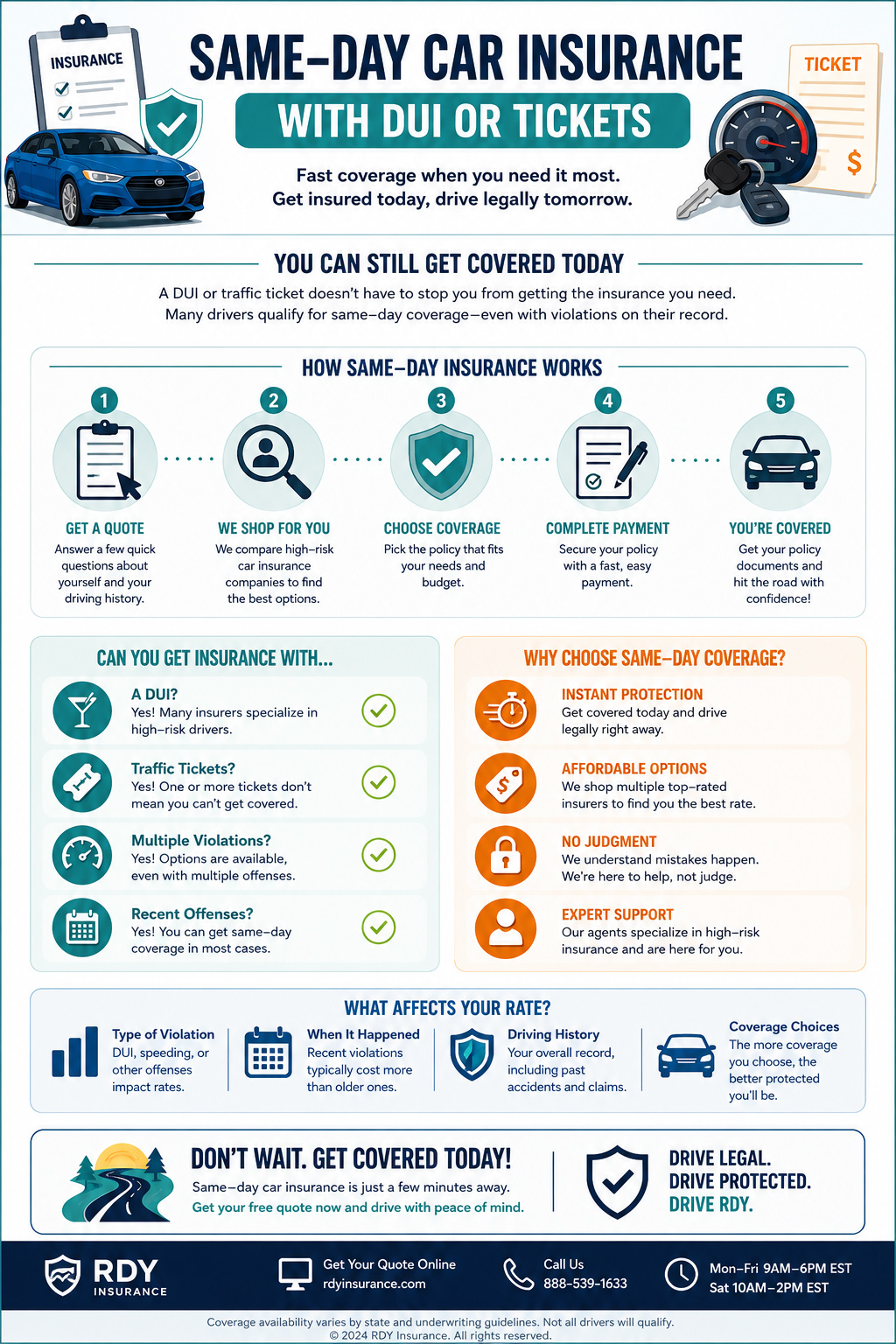
Finding same-day car insurance with a DUI, speeding ticket, accident, or other recent violation can be more challenging, but it may still be possible depending on your state, insurer, driving record, vehicle, and coverage needs.
Your driving record can play an important role in how auto insurance companies evaluate risk and price a policy. A clean record may help you qualify for better pricing or safe-driver discounts, while recent accidents, serious violations, or repeated tickets may lead to higher premiums or fewer coverage options.
This can matter even more when you need coverage quickly. If you are comparing immediate coverage, it may help to review same-day car insurance options and understand how your driving history may affect the quotes available to you.
Why Your Driving Record Matters
Insurance companies generally use several rating factors when pricing auto coverage. These may include your location, driving experience, claims history, vehicle type, mileage, coverage choices, deductibles, and driving record. A driver with recent violations or at-fault accidents may be viewed as more likely to file a future claim, which can increase the cost of coverage.
A clean driving history does not guarantee the lowest rate, but it may make it easier to qualify for more favorable pricing, safe-driver programs, or standard market options. If you are trying to reduce costs over time, reviewing ways to maintain a safe driver discount can be a helpful starting point.
Clean Driving Records
Drivers with fewer violations, fewer claims, and consistent safe driving habits may have access to better pricing opportunities, depending on the insurer and state rules.
Recent Violations
Speeding tickets, at-fault accidents, reckless driving, DUI-related violations, or multiple moving violations can lead to higher rates or stricter underwriting review.
How DUIs, Speeding Tickets, and Accidents Can Affect Premiums
Major violations such as DUI-related offenses, reckless driving, or serious at-fault accidents can have a substantial effect on insurance costs. Speeding tickets and other moving violations may also affect premiums, especially when there are multiple violations or a pattern of risky driving.
The exact impact varies by insurer, state, violation type, prior driving history, and how recently the incident occurred. Instead of relying on a fixed percentage, it is usually better to compare quotes and ask each provider how long a violation may be considered in its rating process.
Young drivers and first-time drivers may already face higher rates because they have less driving and insurance history. If that applies to you, it may help to review how driving history affects young drivers’ insurance before comparing quotes.
Why Prices Vary From One Insurance Provider to Another
Two insurance companies may look at the same driving record and still offer different prices. Each insurer uses its own underwriting rules, rating models, discounts, eligibility standards, and state-approved pricing structure. That is why shopping around can matter, especially after a ticket, claim, or change in your driving history.
When reviewing options, do not compare only the monthly price. Look at coverage limits, deductibles, fees, exclusions, payment schedule, cancellation rules, and whether the quote reflects the same coverage choices. You can use resources that explain how to compare car insurance policies to review these details more carefully.
Managing Your Driving Habits for Better Long-Term Rates
Safe driving habits may help you avoid tickets, reduce claim risk, and maintain a stronger record over time. Defensive driving, obeying traffic laws, avoiding distracted driving, and keeping a safe following distance can all support a better driving history.
Some insurers may also offer usage-based insurance or telematics programs that consider driving behavior, such as mileage, braking, acceleration, or time of day. These programs are not right for everyone, and drivers should review what data is collected, how it is used, and whether participation could raise or lower premiums.
Before joining a usage-based or telematics program, review the insurer’s privacy terms and ask whether the program can increase your rate, reduce discounts, or affect future renewals.
Same-Day Car Insurance and Driving History
Same-day car insurance can be helpful when you need coverage quickly, but your driving history still matters. Insurers may review recent tickets, claims, accidents, lapses in coverage, or other risk indicators before offering a policy or quote.
If your record is not perfect, you may still have options, but premiums, down payment requirements, available coverage limits, or payment plans may differ. Comparing coverage details carefully can help you avoid focusing only on the first price you see.
Other Factors Beyond Your Driving Record
Your driving record is important, but it is only one part of the pricing picture. Insurers may also consider your ZIP code, vehicle, annual mileage, coverage selections, deductible choices, insurance history, prior claims, and in some states, insurance-based credit information. You can also review how location affects auto insurance rates to understand why prices may change from one area to another.
Because these factors work together, a driver with a clean record may still see different prices across companies. A driver with a recent ticket may also find that one provider prices the risk more favorably than another. Comparing options can help you see how different insurers evaluate your situation.
Vehicle and Coverage Choices
A newer vehicle, higher repair costs, full coverage, lower deductibles, or added optional coverages can increase the cost of a policy.
Location and Use
Where you live, how far you drive, and whether the vehicle is used for commuting, business, or personal use can also influence pricing.
How to Check Your Driving Record
It is a good idea to periodically review your driving record, especially before shopping for insurance after a ticket, accident, or license issue. In many states, you can request your motor vehicle record through the state DMV or equivalent agency.
If you notice an error, follow your state’s process to correct it. Incorrect information can affect how insurers evaluate your risk. Keeping your record accurate can also make it easier to compare quotes with the right information.
Using Discounts to Improve Premium Costs
Discounts can help offset costs, especially if you maintain a clean record or improve your driving habits over time. Depending on the insurer and state, discounts may be available for safe driving, defensive driving courses, bundling, good students, low mileage, vehicle safety features, or continuous insurance coverage.
Discounts are not automatic in every case, so it is worth asking each insurer what is available and what documentation is required. You can also review how to unlock savings with safe driver discounts before comparing quotes.
FAQ
How does a DUI affect car insurance rates?
A DUI-related violation can substantially increase car insurance costs and may affect eligibility with some insurers. The exact impact depends on the state, insurer, prior record, timing, and underwriting rules.
Will my insurance company notify me if my rate changes?
Insurers generally provide renewal documents or policy notices showing rate changes, but the timing and format can vary. Review your renewal carefully and ask the insurer or agent to explain any increase you do not understand.
How can I get a better rate after a speeding ticket?
You may be able to improve your options by keeping a clean record going forward, comparing quotes, asking about defensive driving courses, and reviewing available discounts. Results vary by insurer and state.
Do all insurance companies treat driving violations the same?
No. Insurance companies evaluate violations differently. One insurer may rate a ticket more heavily than another, which is why comparing quotes can be useful after a violation.
Bottom Line
Your driving record can have a major influence on car insurance costs, especially if you need same-day coverage or have recent violations. Maintaining safer driving habits, checking your record for accuracy, comparing quotes, and asking about discounts may help you find more suitable coverage options over time.
Because pricing varies by insurer, state, driver profile, and policy details, review the full quote carefully before making a decision. Make sure the coverage limits, deductibles, fees, and payment terms fit your needs, not just the advertised price.
Compare Your Car Insurance Options
Use your ZIP code to start reviewing auto insurance options and compare coverage questions with more clarity.
Check Your Car Insurance Options