
A car accident can leave you trying to make several decisions quickly: checking safety, exchanging information, documenting the scene, contacting your insurer, arranging repairs, and understanding what your policy may or may not cover. A clear claims process helps reduce confusion and keeps important details from being missed.
This guide explains practical steps to take after an accident, how to organize your information, what to ask your insurer, how deductibles and coverages may apply, and what to do if the estimate or settlement does not seem right. Rules and claim procedures vary, so always follow your policy, your insurer’s instructions, and any state or local accident reporting requirements.
Quick Summary
- Start with safety. Move out of traffic if it is safe, check on passengers, and call emergency services when needed.
- Exchange driver, vehicle, contact, and insurance information with the other driver.
- Take photos and videos of vehicle damage, license plates, road conditions, traffic signs, and the accident location.
- Call your insurer or insurance professional as soon as reasonably possible. NAIC and III both recommend contacting the insurer promptly and asking what documents are needed for the claim.[1][2]
- Get a claim number, the adjuster’s contact information, and a list of next steps.
- Keep receipts, repair estimates, photos, police report details, medical-related records, towing invoices, rental bills, and all claim communications in one folder.
- Do not admit fault, sign broad releases, or accept a final settlement until you understand what is being resolved.
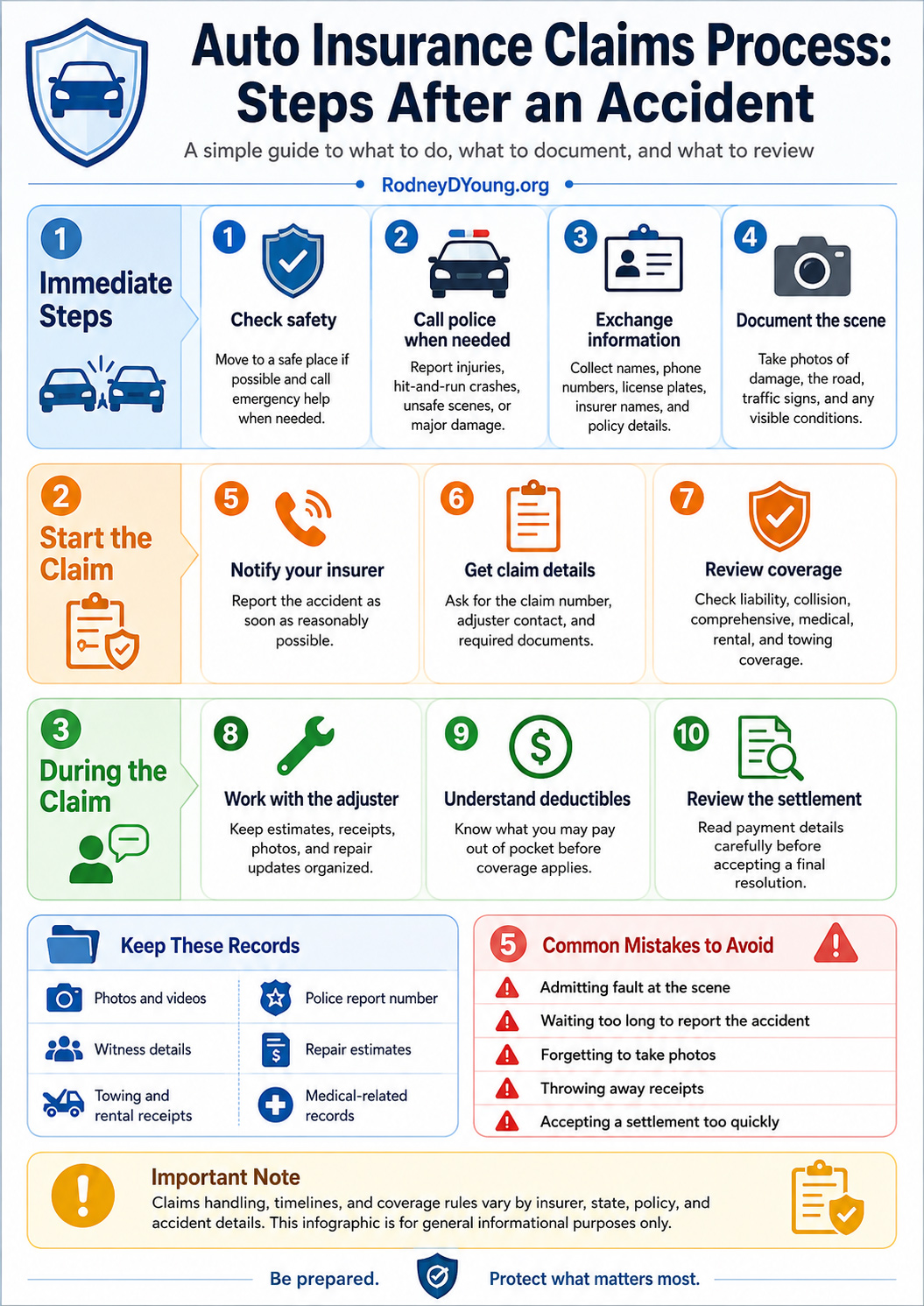
Step-by-Step Auto Insurance Claims Process After an Accident
The order of steps can change depending on the accident, injuries, state law, police response, and your insurer’s claim process. Still, most auto claims follow a similar path.
| Step | What to do | Why it matters |
|---|---|---|
| 1. Check safety | Move to a safe place if possible, turn on hazard lights, and call emergency services if anyone may be hurt or the situation is unsafe. | Safety comes before the insurance process. |
| 2. Call police when needed | Follow local rules and call police for injuries, hit-and-run, stolen vehicles, unsafe scenes, blocked traffic, or significant damage. | A police report can help document facts and may be required in some situations. |
| 3. Exchange information | Collect names, phone numbers, driver’s license details, insurance company, policy number, license plate, vehicle details, and contact information. | Your insurer may need this to open or evaluate the claim. |
| 4. Document the scene | Take photos, videos, witness details, location notes, weather conditions, road signs, and visible vehicle damage. | Good documentation can reduce delays and support a clearer claim review. |
| 5. Contact your insurer | Report the accident as soon as reasonably possible, even if you are not sure whether you will file a full claim. | Your insurer can explain deadlines, coverage, deductibles, repairs, and required forms. |
| 6. Get the claim details | Ask for the claim number, adjuster contact, document list, repair process, rental coverage rules, and expected timeline. | This keeps the claim organized from the beginning. |
| 7. Review coverage | Check liability, collision, comprehensive, PIP or MedPay, UM/UIM, rental reimbursement, towing, and deductibles. | Different coverages apply to different losses. |
| 8. Work through estimates and repairs | Coordinate inspections, repair estimates, supplements, approved shops, and payment instructions. | The first estimate may change if hidden damage is found. |
| 9. Review settlement carefully | Read payment details, deductible treatment, total loss valuation, release language, and any remaining responsibilities. | A claim payment can affect what rights or amounts remain open. |
1. Start With Safety and Emergency Help
Before thinking about the claim, focus on safety. If the vehicle can be moved and it is safe to do so, get out of traffic. Turn on hazard lights. If anyone may be hurt, if the scene is dangerous, if a vehicle cannot be driven safely, or if local law requires a report, contact emergency services or police.
Do not stand in traffic to take photos. Wait until it is safe. If police respond, ask how to get the accident report or report number. Texas Department of Insurance advises drivers to write down accident details, witness information, and the police report number if available.[3]
Important safety reminder
If there are injuries, road hazards, a hit-and-run, suspected impairment, blocked traffic, or a vehicle that cannot be moved safely, treat the situation as more than a simple insurance exchange. Safety and official reporting come first.
2. Exchange Information Without Admitting Fault
After safety is handled, exchange information with the other driver. Stay calm and stick to facts. Avoid arguing, guessing, apologizing as an admission of responsibility, or making statements about who caused the accident. Fault is normally reviewed later using evidence, statements, police reports, damage patterns, state law, and insurer investigation.
Information to collect
- Driver’s name, phone number, and address if available.
- Insurance company name and policy number.
- Driver’s license information.
- License plate number.
- Vehicle make, model, year, and color.
- Names and contact information for passengers or witnesses.
- Police officer name, badge number, agency, and report number if police respond.
- Location, date, time, weather, traffic conditions, and road layout.
If the other driver does not have an insurance card, TDI recommends asking for the driver’s name, phone number, insurance company name, and policy number. It also recommends letting your own insurance company know after filing with the other driver’s insurer.[4]
3. Document the Accident Scene Carefully
Photos and notes are often easier to collect at the scene than later. They do not guarantee a claim outcome, but they can help your insurer understand what happened and what damage is being claimed. TDI advises taking photos and videos of damage when working toward a claim payment.[5]
| Document | Examples | Why it helps |
|---|---|---|
| Vehicle damage | Wide shots and close-ups of each vehicle from multiple angles. | Helps support the initial damage review and repair estimate. |
| Scene layout | Intersection, lane markings, traffic signals, stop signs, parking position, and roadway direction. | Helps explain how the accident occurred. |
| Road and weather conditions | Rain, ice, debris, visibility, construction zones, or road hazards. | Provides context for the insurer’s review. |
| Other driver information | Insurance card, license plate, driver’s license, and vehicle details. | Helps identify the correct policy and driver. |
| Witness details | Name, phone, email, and brief factual notes. | May help if liability is disputed. |
| Expenses | Towing, storage, rental, rideshare, repair, and medical-related receipts. | Helps track possible reimbursable costs depending on coverage and liability. |
For a deeper checklist on photos, receipts, witness details, and claim documents, use this guide to gather evidence for an auto insurance claim.
4. Report the Accident to Your Insurer
Contact your insurer or insurance professional as soon as reasonably possible. NAIC says drivers can generally file by calling the phone number on the proof-of-insurance card, and many insurers also allow claims through mobile apps.[1] III also recommends calling your insurance professional as soon as possible and asking what documents are needed to support the claim.[2]
Do not assume a minor accident does not need to be reported. Some damage appears later, and some policy duties require timely notice. If you are unsure whether opening a claim is worth it, ask your insurer how the process works, what deductible applies, and whether the claim can be closed if you decide not to continue.
Questions to ask when reporting the accident
- What is my claim number?
- Who is the adjuster, and how do I contact them?
- What documents, photos, forms, or police reports are needed?
- What deadline applies under my policy?
- Which coverage may apply: liability, collision, comprehensive, PIP, MedPay, UM/UIM, rental, towing, or roadside?
- What deductible applies?
- Can I choose my own repair shop?
- How are supplements handled if the shop finds more damage?
- Is rental reimbursement available, and what daily or total limit applies?
- How can I track claim status?
5. Understand Which Coverage May Apply
Claims can become confusing because different parts of the policy apply to different losses. NAIC describes common auto insurance parts such as bodily injury liability, property damage liability, and uninsured or underinsured motorist coverage.[6] Your declarations page and policy language control what is actually available.
| Coverage | What it may help with | Important limitation |
|---|---|---|
| Liability coverage | Damage or injuries you are legally responsible for causing to others. | It does not repair your own vehicle. |
| Collision coverage | Damage to your vehicle from a crash, subject to policy terms and deductible. | If you do not carry collision, your own insurer may not pay for your vehicle damage from a crash. |
| Comprehensive coverage | Many non-collision losses such as theft, vandalism, hail, fire, or certain falling-object damage. | It usually does not replace collision coverage. |
| Uninsured or underinsured motorist coverage | Losses involving a driver with no insurance or insufficient insurance, depending on state and policy terms. | Availability, limits, deductibles, and rules vary by state and policy. |
| PIP or MedPay | Certain medical-related expenses after an accident, depending on state and policy. | Rules vary widely by state, coverage type, and policy limits. |
| Rental reimbursement | Temporary transportation costs while a covered claim is being repaired. | Usually optional and subject to daily and total limits. |
| Towing or roadside assistance | Towing or roadside help after a covered event, depending on the policy. | May be optional and may have limits or vendor rules. |
If you are unsure how each claim step connects with coverage review, adjuster communication, repair estimates, and documentation, review how to navigate the auto insurance claims process before making changes at renewal.
6. Work With the Adjuster and Repair Shop
After the claim is opened, an adjuster may review photos, police report details, statements, repair estimates, and coverage. The insurer may inspect the vehicle directly, ask you to upload photos, or work with a repair network. The first estimate may not include every repair item if hidden damage is discovered after the shop begins work.
How to keep the repair process organized
- Ask whether the insurer requires an inspection before repairs begin.
- Keep copies of every estimate and invoice.
- Ask how supplemental repairs are approved.
- Confirm whether the insurer pays you, the repair shop, a lender, or another party.
- Ask whether using a preferred shop is optional or required under your policy.
- Document delays, storage fees, towing fees, and rental expenses.
Do not authorize repairs you cannot pay for until you understand the claim estimate, deductible, payment process, and any required approvals. If the vehicle is unsafe to drive, ask the insurer what towing, inspection, or storage steps are appropriate.
7. Understand Deductibles, First-Party Claims, and Third-Party Claims
A deductible is the amount you may have to pay before certain coverages apply. Collision and comprehensive claims commonly involve deductibles. Liability claims against another driver’s insurance may work differently. If another driver is responsible, your insurer may later try to recover money from the other insurer through subrogation, depending on the claim and coverage.
Deductible example
If your covered collision damage is estimated at $3,000 and your collision deductible is $500, the claim payment may reflect that deductible. The exact payment depends on policy terms, repair process, depreciation, supplements, taxes, fees, lender involvement, and state rules.
Before choosing coverage after a claim, compare the monthly savings with what you could realistically pay after an accident. You can also review Rodney D. Young insurance customer service reviews to understand why claim support, billing clarity, document access, and communication can matter after an accident.
8. If the Accident Was Not Your Fault
If another driver appears responsible, you may be able to file a claim with that driver’s insurer. TDI advises taking a picture of the other driver’s insurance card and driver’s license, filing a claim with the other driver’s insurance, letting your own company know, and sending the police report to the other insurer if police responded.[4]
Even when the other driver appears responsible, avoid assuming the process will be automatic. The other insurer may need to investigate liability, contact its insured, review damage, and confirm coverage. Keep your own insurer informed, especially if your vehicle is not drivable or you need help understanding collision, rental, or uninsured motorist options.
9. If It Is a Hit-and-Run or Uninsured Driver Accident
If a driver leaves the scene or does not have insurance, call police promptly and notify your insurer. NAIC specifically advises calling police promptly if your car is damaged by a hit-and-run driver or is stolen.[1] Your policy may include uninsured motorist, collision, medical-related, or other coverage that could become relevant, depending on the facts and your state.
Give your insurer the police report number if available, any witness information, photos, video, license plate details, and the exact location. If you have dashcam footage or nearby business camera information, preserve it quickly because footage may be overwritten.
10. If There Are Injuries or Medical Bills
When injuries or medical bills are involved, the claim can become more complex. Keep medical-related records, bills, claim letters, and insurer communications organized. Ask your insurer which coverage may apply and whether your state uses PIP, MedPay, fault-based injury claims, no-fault rules, or other requirements.
Before signing anything
Do not sign a broad release or final settlement document unless you understand what claims are being closed. If there are injuries, disputed fault, large bills, or legal questions, consider speaking with an appropriate professional before signing.
11. If the Vehicle Is a Total Loss
A vehicle may be treated as a total loss when repair costs, salvage value, state rules, and insurer guidelines make repair uneconomical. If that happens, ask the insurer how the value was calculated, what comparable vehicles were used, how taxes or fees are handled, whether your deductible applies, and how any loan or lease balance will be addressed.
Total loss questions to ask
- What is the actual cash value calculation based on?
- Which comparable vehicles were used?
- Were mileage, condition, trim, options, and prior damage considered?
- Will taxes, title fees, or registration fees be included where required?
- How will payment be handled if there is a lender or lease company?
- What happens if the loan balance is higher than the claim payment?
- Is gap coverage available under my policy, loan, or lease?
12. What to Do if You Disagree With the Estimate or Settlement
If the estimate, total loss value, liability decision, or settlement seems incorrect, stay organized and respond with facts. Ask the adjuster to explain the decision in writing. Provide missing documents, repair shop supplements, comparable vehicle listings, photos, receipts, or witness details. Keep communication professional and written whenever possible.
Escalation options to consider
- Ask the adjuster for the specific reason behind the decision.
- Request a supervisor review if the explanation does not resolve the issue.
- Send additional evidence in one organized message.
- Review your policy’s appraisal, dispute, or claim review provisions.
- Contact your state insurance department if you believe the claim is being mishandled.
- Seek professional advice when the dispute involves injuries, liability, large losses, or legal rights.
For broader organization tips during a stressful claim, review this guide to make auto claims less stressful.
13. Claim Mistakes to Avoid After an Accident
Common mistakes that can slow down a claim
- Leaving an unsafe scene without calling for help when help is needed.
- Failing to collect the other driver’s insurance information.
- Admitting fault instead of sticking to factual information.
- Waiting too long to notify your insurer.
- Taking only one photo or no photos at all.
- Not getting witness contact information when available.
- Throwing away receipts for towing, storage, rental, rideshare, repairs, or medical-related expenses.
- Authorizing repairs before understanding the inspection and payment process.
- Ignoring deductible, rental, towing, or storage limits.
- Accepting a final settlement before reviewing what it covers.
- Canceling or switching insurance during an open claim without understanding the impact.
- Comparing replacement coverage after the accident without matching limits, deductibles, and coverage types.
14. Review Your Coverage Before the Next Renewal
An accident often reveals whether your policy fits your real needs. After the immediate claim is under control, review your liability limits, collision deductible, comprehensive deductible, rental reimbursement, towing, uninsured motorist coverage, and medical-related coverage. A cheaper policy is not always better if it removes protection you needed during the claim.
If you decide to review your coverage after the claim, avoid rushing into changes before you understand the claim status, deductible, repair estimate, rental limits, and renewal impact. Review stress-free auto claims so your documents, claim number, adjuster communication, and repair records stay organized.
Compare Auto Insurance Options After Reviewing Your Claim
Use your ZIP code to begin comparing quote paths. Match coverage limits, deductibles, drivers, vehicles, and policy terms before deciding whether a lower premium is truly better.
FAQ
What should I do first after a car accident?
Start with safety. Move out of traffic if it is safe, check whether anyone needs help, call emergency services when needed, and follow police or local reporting requirements.
How soon should I report an accident to my insurer?
Report it as soon as reasonably possible. Your policy may have specific notice duties or deadlines, and your insurer can explain what documents are needed.
Should I admit fault at the accident scene?
No. Exchange information and stick to factual details. Fault is usually reviewed later based on evidence, statements, policy terms, state law, and insurer investigation.
What information should I collect after an accident?
Collect driver names, contact details, insurance information, license plates, vehicle details, witness contacts, police report information, photos, videos, and receipts for related expenses.
Do I need a police report for an insurance claim?
It depends on the accident and local rules. A police report can be especially important for injuries, hit-and-run, uninsured drivers, disputed fault, significant damage, or unsafe scenes.
What does an insurance adjuster do?
An adjuster reviews coverage, damage, estimates, statements, police report details, photos, liability issues, and payment information to help evaluate the claim.
Will I have to pay a deductible?
Possibly. Collision and comprehensive claims often involve deductibles. Liability claims against another driver’s insurer may work differently. The answer depends on your policy, coverage, fault, and claim type.
What if the repair shop finds more damage?
Ask your insurer how supplements work. The shop may need to send additional photos, estimates, or repair details before the insurer approves extra payment.
What if I disagree with the settlement?
Ask for the decision in writing, provide additional evidence, request a supervisor review if needed, review your policy’s dispute process, and consider contacting your state insurance department or an appropriate professional for serious disputes.
Should I compare insurance after an accident?
You can compare after reviewing your claim and renewal options, but do not cancel coverage too early. Compare the same limits, deductibles, vehicles, drivers, and coverage types before switching.
Conclusion
The auto insurance claims process is easier to manage when you know what to do before pressure builds. Start with safety, exchange information, document the scene, report the accident promptly, ask your insurer what documents are needed, and keep every claim detail organized.
After the claim is underway, review the coverage involved, deductible, repair estimate, rental or towing limits, total loss valuation, and settlement terms carefully. If something does not make sense, ask for an explanation in writing and provide additional evidence. A careful, organized approach can help you avoid delays and make stronger decisions after an accident.
References
- National Association of Insurance Commissioners, “What You Should Know About Filing an Auto Claim.” ↩ ↩ ↩
- Insurance Information Institute, “How to File an Auto Insurance Claim.” ↩ ↩
- Texas Department of Insurance, “Were you in a wreck? Tips for auto insurance claims.” ↩
- Texas Department of Insurance, “Accident not your fault? Here’s how to deal with the other driver’s insurance.” ↩ ↩
- Texas Department of Insurance, “Steps to getting your home or car insurance claim paid.” ↩
- National Association of Insurance Commissioners, “Auto Insurance.” ↩