
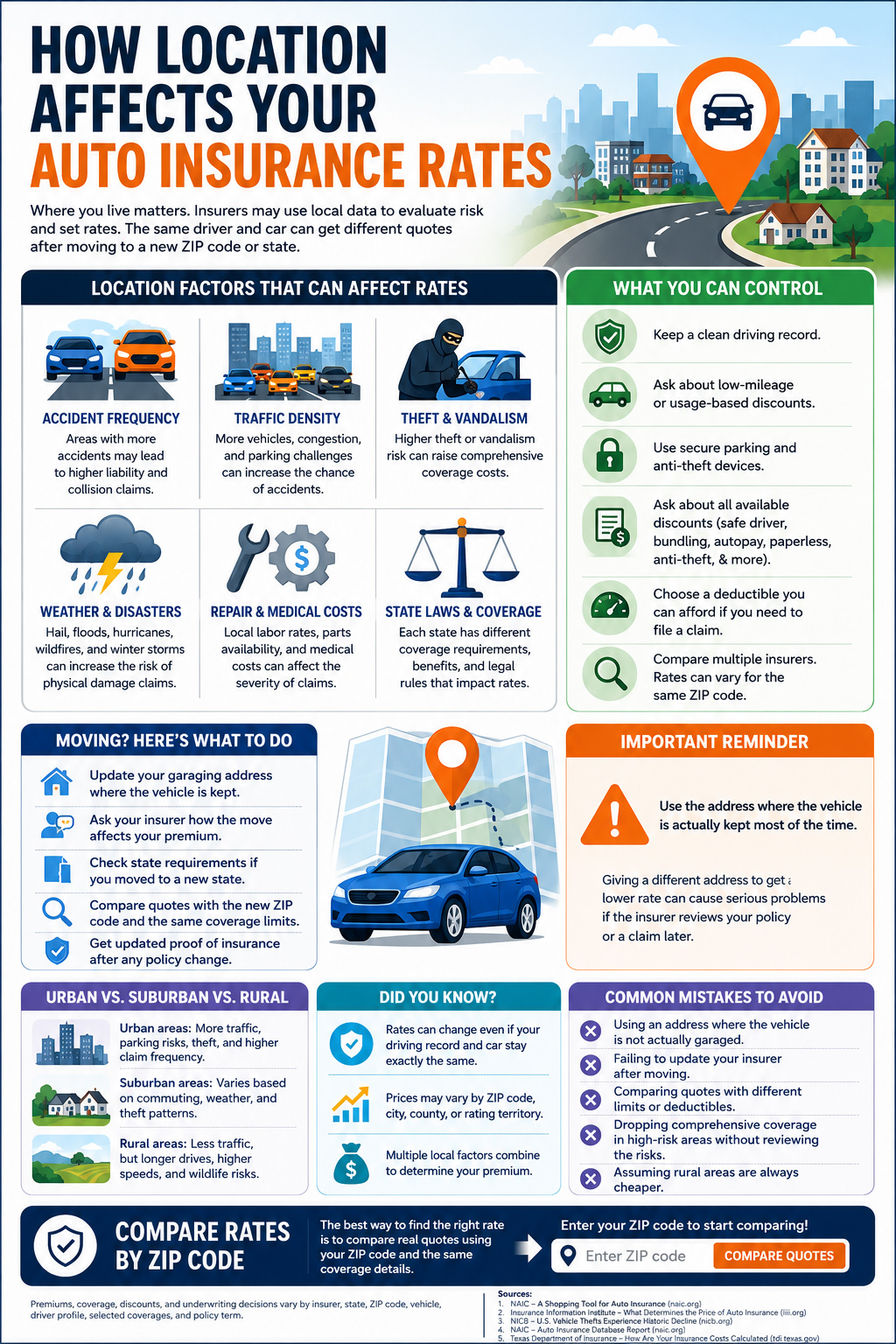
Your location can affect your auto insurance rate because insurers may evaluate local claim patterns, accident frequency, traffic density, theft risk, weather exposure, repair costs, state laws, and the ZIP code, garaging area, or rating territory where the vehicle is usually kept. The same driver and vehicle can receive different quotes after moving because the local risk environment has changed.
Location is only one part of the price. Your driving record, vehicle, mileage, coverage limits, deductibles, credit-based insurance score where allowed, and selected coverages can also affect the final premium. This guide explains which location-based factors matter, what drivers can control, and how to compare quotes honestly after a move or renewal change.
Quick Summary
- Auto insurance rates can vary by ZIP code, city, county, state, and rating territory.
- NAIC explains that premiums may be higher or lower based on an insurer’s claims experience in the ZIP code or territory where you live.[1]
- Location-related factors may include accident rates, traffic density, auto theft, repair costs, weather exposure, medical costs, litigation trends, and state coverage rules.
- Your garaging address should be accurate. Using a false address to get a lower rate can create coverage, billing, or claim problems.
- If you move, compare quotes using your new address and the same coverage limits, deductibles, vehicles, and drivers.
- You may not be able to change your ZIP code risk, but you may be able to compare carriers, ask about discounts, choose deductibles carefully, and adjust optional coverage responsibly.
Why ZIP Code and Garaging Address Matter
Insurers often consider where a vehicle is primarily kept, sometimes called the garaging address. This matters because insurance pricing is based partly on expected claim costs. NAIC’s auto insurance shopping tool states that premiums may be higher or lower depending on the insurer’s claims experience in the ZIP code or territory where the driver lives.[1]
The Insurance Information Institute also lists location as a pricing factor and explains that more accidents and higher theft risk in a neighborhood can lead insurers to charge more than they would in a less risky area.[2] That does not mean every driver in a higher-cost area will pay the same price. Insurers combine location with many other factors, including driving record, vehicle use, selected coverage, deductibles, and the vehicle being insured.
Important address note
Use the address where the vehicle is actually kept most of the time. Giving an address where the car is not normally garaged to obtain a lower price can create serious problems if the insurer reviews the policy or a claim later.
Location Factors That Can Affect Auto Insurance Rates
Location-based pricing is not about one single number. Insurers may review multiple local risk signals, and each company may weigh them differently.
| Location factor | Why it matters | Coverage most affected | What drivers can do |
|---|---|---|---|
| Accident frequency | More crashes in an area can increase expected liability and vehicle damage claims. | Liability, collision | Maintain a clean record, compare quotes, and use safe-driving or telematics programs if appropriate. |
| Traffic density | More vehicles, congestion, and parking conflicts can increase claim frequency. | Liability, collision | Ask about low-mileage discounts if you drive less or work from home. |
| Vehicle theft and vandalism | Higher theft or vandalism risk can affect physical damage pricing. | Comprehensive | Use secure parking, anti-theft devices, and ask whether anti-theft discounts apply. |
| Weather and catastrophe exposure | Hail, floods, hurricanes, wildfires, and winter storms can increase claim costs. | Comprehensive, collision | Review comprehensive coverage, deductibles, parking protection, and claim risk before removing coverage. |
| Repair and medical costs | Local labor rates, parts availability, body shop costs, and medical costs can affect claim severity. | Collision, comprehensive, liability, medical-related coverage | Compare total policy cost and deductible choices before switching carriers. |
| State laws and required benefits | Coverage requirements, no-fault rules, benefits, legal environment, and filing rules vary by state. | Required coverage, liability, PIP or medical-related coverages | Check state requirements before comparing policies across states. |
Urban, Suburban, and Rural Areas Can Price Differently
Urban areas may have more traffic, more parked cars, more intersections, more theft exposure, and higher claim frequency. Suburban areas may have lower congestion but still have commuting risk, storm exposure, or theft patterns. Rural areas may have less traffic but can involve longer drives, higher speeds, wildlife collisions, distance from repair facilities, or emergency response delays.
The best way to compare is not to assume one area is always cheaper. Use the correct garaging address and compare quotes with the same driver, vehicle, coverage limits, deductibles, and policy term.
Vehicle Theft, Vandalism, and Comprehensive Coverage
Theft and vandalism risk can affect auto insurance because comprehensive coverage generally helps with many non-collision losses such as theft, fire, vandalism, hail, and other covered events depending on the policy. Vehicle theft patterns also change over time. NICB reported that U.S. vehicle thefts declined 23% in 2025 compared with 2024, reaching 659,880 reported stolen vehicles, but theft risk still varies by location, vehicle type, and local crime patterns.[3]
If you live or park in an area with higher theft or vandalism risk, ask whether your vehicle’s anti-theft system qualifies for a discount and whether comprehensive coverage still makes sense for your car’s value. Do not drop comprehensive coverage only because the premium looks high without comparing that cost to theft, hail, flood, fire, and vandalism exposure.
Ways to reduce theft-related risk
- Park in a garage, secured lot, or well-lit area when possible.
- Ask whether factory or installed anti-theft equipment qualifies for a discount.
- Do not leave keys, valuables, or documents visible in the vehicle.
- Review whether comprehensive coverage fits the vehicle’s value and local risk.
- Compare the comprehensive deductible against what you could pay after a covered loss.
For more ways to reduce costs without simply cutting protection, review auto insurance discounts that may lower your premium.
Weather Risk and Environmental Conditions
Weather can influence auto insurance because different areas face different physical damage risks. Hail, wind, hurricanes, wildfire, flooding, winter storms, falling objects, and animal collisions may affect claim frequency and claim severity. These risks often matter most for comprehensive coverage, though severe weather can also increase collision risk when roads become dangerous.
A driver in a hail-prone or storm-prone region should be careful before dropping comprehensive coverage. A lower premium may not be worth it if the car is exposed to frequent weather damage and the driver could not afford repairs or replacement.
| Weather or environmental risk | Possible claim type | Coverage to review | Practical action |
|---|---|---|---|
| Hail or wind damage | Dents, broken glass, body damage | Comprehensive | Review comprehensive deductible and covered glass rules. |
| Flooding | Water damage, total loss risk | Comprehensive | Check flood exposure and avoid assuming liability-only coverage protects the car. |
| Winter roads | Skidding, crashes, roadside incidents | Collision, roadside assistance | Drive cautiously and review deductible affordability. |
| Wildfire or falling objects | Fire, smoke, debris, tree damage | Comprehensive | Review physical damage protection before removing coverage. |
| Animal collisions | Vehicle damage from deer or other animals | Often comprehensive, depending on policy terms | Ask how the policy handles animal-related damage. |
State Laws and Required Coverage
Location affects rates not only through ZIP code but also through state law. NAIC notes that many factors affect state expenditures and premiums, including underwriting costs, driving locations, accident rates, traffic density, auto theft statistics, repair costs, and state laws. It also notes that states differ in coverage requirements, limits, and benefits.[4]
That is why comparing rates across states can be misleading. A lower average premium in one state may reflect different minimum limits, different required coverages, different benefits, or different claim rules. When moving to a new state, compare policies based on the new state’s requirements rather than your old policy alone.
For another state-focused example, review the same-day car insurance California guide, especially if you are comparing fast coverage needs after moving or buying a vehicle in a different state.
Moving across state lines
If you move to another state, do not assume your old policy setup still meets legal requirements. Review the new state’s required coverage, registration rules, lender requirements, and proof-of-insurance process.
Drivers comparing state-specific liability rules can also review cheap liability car insurance in Connecticut as an example of how minimum coverage, local requirements, and quote assumptions can differ by state.
How Moving Can Change Your Auto Insurance Rate
A move can affect your premium even if your car, driving record, and coverage stay the same. The new ZIP code may have different theft risk, accident frequency, traffic density, weather exposure, repair costs, and state requirements. If you move, notify your insurer promptly and compare quotes using the new garaging address.
A move can also be a good time to review how your auto coverage fits with other household insurance. If you own a home, comparing both policies can help you see whether separate coverage or a bundle offers better overall value. This home and auto insurance comparison explains how coverage limits, deductibles, exclusions, lender requirements, and bundling differ between the two policy types.
Moving checklist
- Update the garaging address where the vehicle is actually kept.
- Ask whether the move changes your premium before the next renewal.
- Review state requirements if you moved to a different state.
- Check lender or lease requirements if the vehicle is financed or leased.
- Compare quotes using the new ZIP code and the same coverage limits.
- Download updated proof of insurance after any policy change.
If you are changing companies after moving, use the guide on how to switch car insurance provider to avoid coverage gaps, billing confusion, or cancellation mistakes.
What You Can Control in a High-Cost ZIP Code
You may not be able to change local claim patterns, but you can still make practical choices that may help control your total policy cost. The Insurance Information Institute lists several pricing factors, including driving record, mileage, location, vehicle, coverage type, limits, and deductibles.[2] Some of those factors can be reviewed or adjusted responsibly.
For a broader quote-shopping process, review compare car insurance quotes easily and keep the same ZIP code, vehicle, driver details, limits, deductibles, and policy term across each quote.
For a closer look at how pricing can change when coverage needs to start quickly, review factors affecting same-day car insurance premiums before switching based only on a lower price.
Location-Based Rating and Insurance Regulation
Insurance pricing is regulated at the state level. Texas Department of Insurance explains that TDI does not set insurance rates or premiums, and that companies can change rates and premium formulas by filing them with TDI.[5] Other states have their own insurance departments and rules.
This matters because a rate that is allowed in one state may be reviewed differently in another. It also means drivers should use their state insurance department as a source for consumer guidance, complaint options, and insurance requirement questions.
State regulation reminder
Auto insurance is not priced only by one national formula. Each insurer uses its own approved rating approach, and state rules affect what factors can be used, how rates are filed, and how consumers can challenge issues.
Location Examples That Can Change a Quote
The following examples are planning scenarios, not guaranteed quotes. They show why the same driver might see a price change after a location change.
| Scenario | Why the rate may change | What to review |
|---|---|---|
| Moving from a dense downtown area to a quieter suburb | Traffic density, theft risk, and parking exposure may change. | Update garaging address and compare the same limits with the new ZIP code. |
| Moving to a storm-prone region | Comprehensive claim risk may be higher because of hail, wind, flooding, or wildfire exposure. | Review comprehensive coverage and deductible affordability. |
| Moving across state lines | State minimums, required coverages, benefits, and registration rules may change. | Confirm the new state’s insurance requirements before canceling or changing coverage. |
| Changing from commuting to remote work | Annual mileage and usage may decrease. | Ask about low-mileage or usage-based discounts. |
| Parking on the street instead of a garage | Theft, vandalism, and weather exposure may increase. | Ask about anti-theft discounts and review comprehensive coverage. |
Common Mistakes With Location and Auto Insurance
Avoid these location-related mistakes
- Using an address where the vehicle is not actually garaged.
- Failing to update your insurer after moving.
- Comparing quotes from different ZIP codes as if they are equal.
- Dropping comprehensive coverage in a theft- or weather-prone area without reviewing risk.
- Assuming rural areas are always cheaper than urban areas.
- Ignoring state requirements after moving across state lines.
- Comparing quotes with different liability limits or deductibles.
- Assuming a clean driving record completely cancels out a high-cost location.
- Choosing a high deductible only to lower the premium when you could not pay it after a claim.
- Forgetting to ask about low-mileage or anti-theft discounts after a lifestyle or parking change.
Compare Rates by ZIP Code
Location can affect pricing, but every quote still depends on the full driver and vehicle profile. Use your real ZIP code and compare quote paths with the same coverage limits, deductibles, vehicles, drivers, and payment assumptions.
Review Auto Insurance Options by ZIP Code
Enter your ZIP code to begin comparing auto insurance quote paths. Review location, coverage limits, deductibles, discounts, and total policy cost before choosing.
FAQ
Does ZIP code affect auto insurance rates?
Yes. Insurers may consider claim experience, theft risk, traffic density, repair costs, weather exposure, and other local factors in the ZIP code or rating territory where the vehicle is kept.
Why did my car insurance change after I moved?
Your new address may have different claim patterns, state requirements, traffic density, theft exposure, weather risk, or repair costs. Your rate may also change if your mileage, vehicle use, or coverage changed.
Can I use a different address to get cheaper insurance?
No. You should use the address where the vehicle is actually garaged. Using an inaccurate address can create policy, billing, or claim problems.
Are urban areas always more expensive for auto insurance?
Not always, but urban areas may have higher claim frequency, traffic density, theft exposure, and repair costs. Each insurer weighs local risk differently.
Does crime affect auto insurance?
Vehicle theft and vandalism can affect comprehensive coverage pricing. The impact depends on the vehicle, ZIP code, insurer, selected coverage, and local claim patterns.
Does weather affect car insurance rates?
It can. Areas with more hail, flooding, wind, wildfire, winter storms, or other environmental risks may see higher comprehensive or collision claim exposure.
How can I lower car insurance in a high-cost ZIP code?
Compare multiple insurers, keep a clean driving record, ask about discounts, update mileage honestly, review deductibles carefully, consider anti-theft protections, and compare quotes with the same coverage levels.
Should I compare quotes after moving?
Yes. A move can change your premium and coverage requirements. Compare quotes using the new garaging address and the same coverage limits, deductibles, vehicles, and drivers.
Conclusion
Location affects auto insurance rates because insurers may evaluate local claim patterns, theft risk, traffic density, weather exposure, repair costs, state laws, and the ZIP code or territory where the vehicle is kept. A move across town, across a county, or across state lines can change the price even when the driver and car stay the same.
You cannot control every local risk factor, but you can use the correct garaging address, compare quotes carefully, ask about discounts, review comprehensive and collision needs, choose deductibles responsibly, and update your insurer when your address or mileage changes. The strongest strategy is to compare real quotes using the same coverage details instead of assuming one location or company is always cheaper.
References
- National Association of Insurance Commissioners, “A Shopping Tool for Auto Insurance.” ↩ ↩
- Insurance Information Institute, “What determines the price of an auto insurance policy?” ↩ ↩
- National Insurance Crime Bureau, “U.S. Vehicle Thefts Experience Historic Decline.” ↩
- National Association of Insurance Commissioners, “NAIC Releases 2022/2023 Auto Insurance Database Report.” ↩
- Texas Department of Insurance, “How are your auto and homeowners insurance costs calculated?” ↩